
Given the choice between making money from market making and owning its own exchange — a choice the CFTC may soon require prediction markets to make — FanDuel is happy to choose market making and direct customers to third-party exchanges, Peter Jackson, the outgoing CEO of parent company Flutter, says.
The comments came in the earnings call for Flutter’s second quarter results Wednesday. Alongside the results, Flutter announced that Jackson would be leaving as CEO on Oct. 1, to be replaced by the company’s president, Dan Taylor.
Flutter did not break out prediction market revenue, but it said performance there had been “slower than planned.” FanDuel is planning to move all sports prediction market volume away from CME, its joint venture partner, and to Crypto.com, the company said, while finance-related prediction markets will remain with CME.
On the other hand, market making was a bright spot in the results, and Flutter said it expected to make $50 million from trading on prediction markets — mostly on parlays — this year.
During the earnings call, Jackson was asked if FanDuel had any plans to own its own exchange. Sportsbook rival DraftKings launched its in-house exchange in June, and Fanatics bought an exchange of its own last month. Other major players that also operate as FCMs, such as Underdog and Robinhood, have also recently launched their own exchanges.
Jackson said he was happy with FanDuel’s plan to continue acting as a futures commission merchant, directing users to contracts traded on an exchange rather than operating the exchange itself. He pointed to the CFTC’s notice of proposed rulemaking last week, which would limit the activities of market-making arms for companies that also own exchanges. The rule proposal, which has to go through a comment period before it might come into force, would prevent exchange-affiliated market makers from taking specific positions and instead allow them only to act as “bona fide market makers.’
“This is a very fast-moving space, and there’s been news in the last few days around some of the complexities of market making if you own some of the exchange components,” Jackson said. “We’ve just got to be thoughtful that we position ourselves as well as we can, and I think we’re happy with the strategy that we have.”
Parlay market making advantage
When asked directly about market making, Flutter CFO Rob Coldrake said he believed FanDuel had a clear advantage in pricing same-game parlays, where correlations can make odds difficult to calculate.
“We feel that we’ve got a real advantage in that place in pricing complex and correlated markets,” he said. “As the combo volume increases, we’re better placed to take advantage of that. We see that as a really attractive and high-margin segment for us. Of course, though, it’s still early days.
“The volumes that we’re achieving into the second half of the year are encouraging, and we think this has got the potential to become a meaningful revenue stream for us. Wait and see how we trade through the second half of the year, and then we’ll update the forecast into 2027.”
Flutter results
Jackson said that sportsbook trends at FanDuel have been “encouraging” but “the market remains subdued.” He said he still believed the impact of competition from prediction markets on sportsbooks was limited, however.
In the second quarter, Flutter took a $296 million loss, as adjusted EBITDA in the U.S. fell from $400 million to $119 million. U.S. sportsbook revenue was down 15% to $1.03 billion, but handle grew.
In the company’s 2025 earnings call in February, Jackson said FanDuel was too limited in offering customers promotions at the end of the year, and in the company’s first-quarter results in May he suggested that this may have contributed to the removal of Amy Howe as CEO of FanDuel. On Wednesday’s earnings call, he said the company was planning to spend more on customer promotions.
“The encouraging underlying signs we’re seeing give us the confidence to increase generosity to customers and improve our value proposition,” he said. “While this proactive action will result in a reduction in near-term profitability, investing behind customer momentum is an approach that has consistently served us well.”
That additional spend contributed to Flutter cutting its full-year guidance. The business now expects full-year adjusted earnings before interest, tax, depreciation, and amortization to be $2.655 billion, down from $2.875 billion.
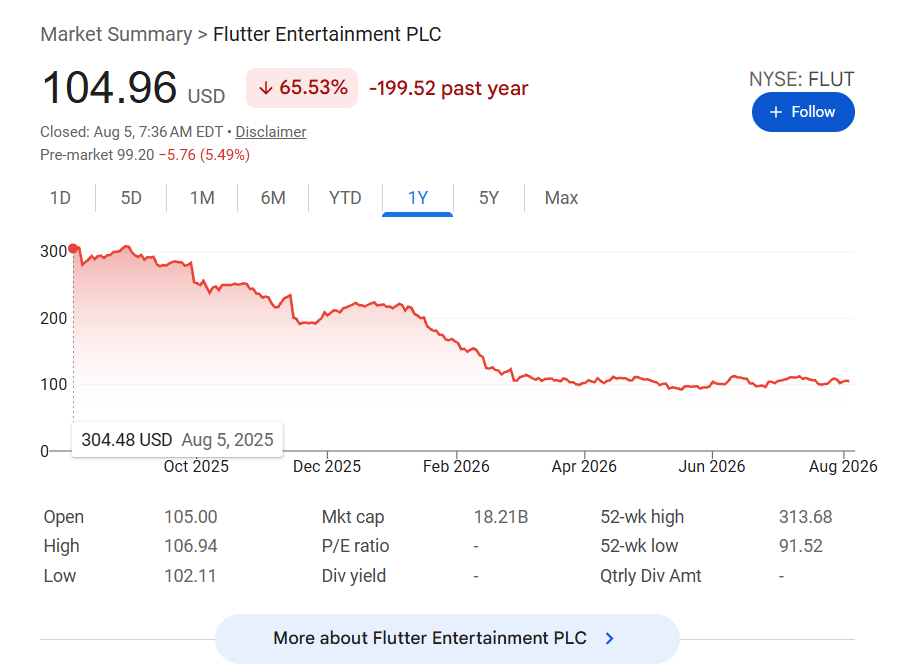
Flutter shares tumbled as the market reacted to the results, the lower guidance, and the change at the top. The shares fell as low as $89.76, a six-year low, and down 14.4% for the day. That would be a 70% decline in a little under a year, and it left the business valued at just $15.5 billion. The shares recovered slightly late in the day to close at $92.91, still an 11.4% one-day decline. DraftKings shares also fell by as much as 8% in reaction to the results.