
Familiar battle lines were drawn and re-drawn on Tuesday during a congressional subcommittee hearing focused on prediction markets that stood out for its overall substance, earnest interest, and lack of performativeness that often characterizes these discussions.
Chaired by Dusty Johnson (R-SD), the House Agriculture Subcommittee on Commodity Markets, Digital Assets, and Rural Development held the discussion “Examining Customer Protections and Market Integrity in Sports Event Prediction Markets.” Five witnesses staked out entrenched positions in the ongoing fight over whether sports event contracts belong under the CFTC’s regulatory umbrella, whether they are simply sports betting dressed in derivatives clothing, and whether federal or state officials (or both) have jurisdiction to regulate prediction markets.
The hearing did not break significant new ground, but it clarified some emerging pressure points: the CFTC’s one-commissioner leadership structure under Michael S. Selig, the agency’s resource constraints, and the Michigan court-order standoff that’s put Kalshi in the crosshairs of competing federal and state authorities.
The panel
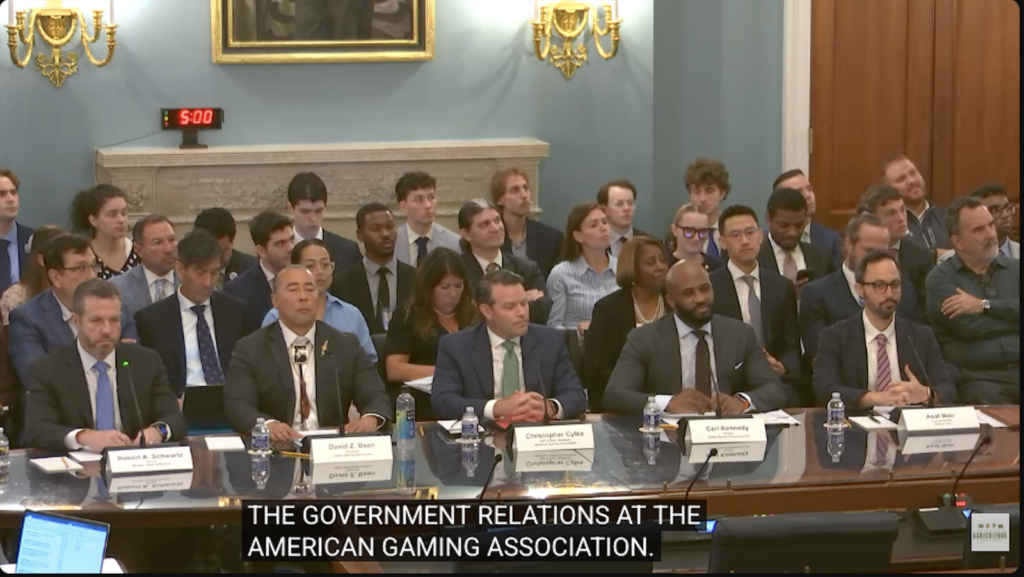
Johnson framed the hearing around three questions: where the law is working, where it may be falling short, and whether Congress has more work to do. Rep. Angie Craig (D-MN) delivered some pointed opening remarks, questioning whether the CFTC has the capability to police prediction markets given proposed budget cuts and the absence of a fully seated commission.
“The CFTC needs a fully appointed commission, increased expert staffing to do their job effectively,” Craig said. “I have serious doubts as to whether the agency has the capability to police these markets.”
Johnson concurred on the staffing gap, if not the tone: “Chairman Selig is wonderful, but we would take four more.”
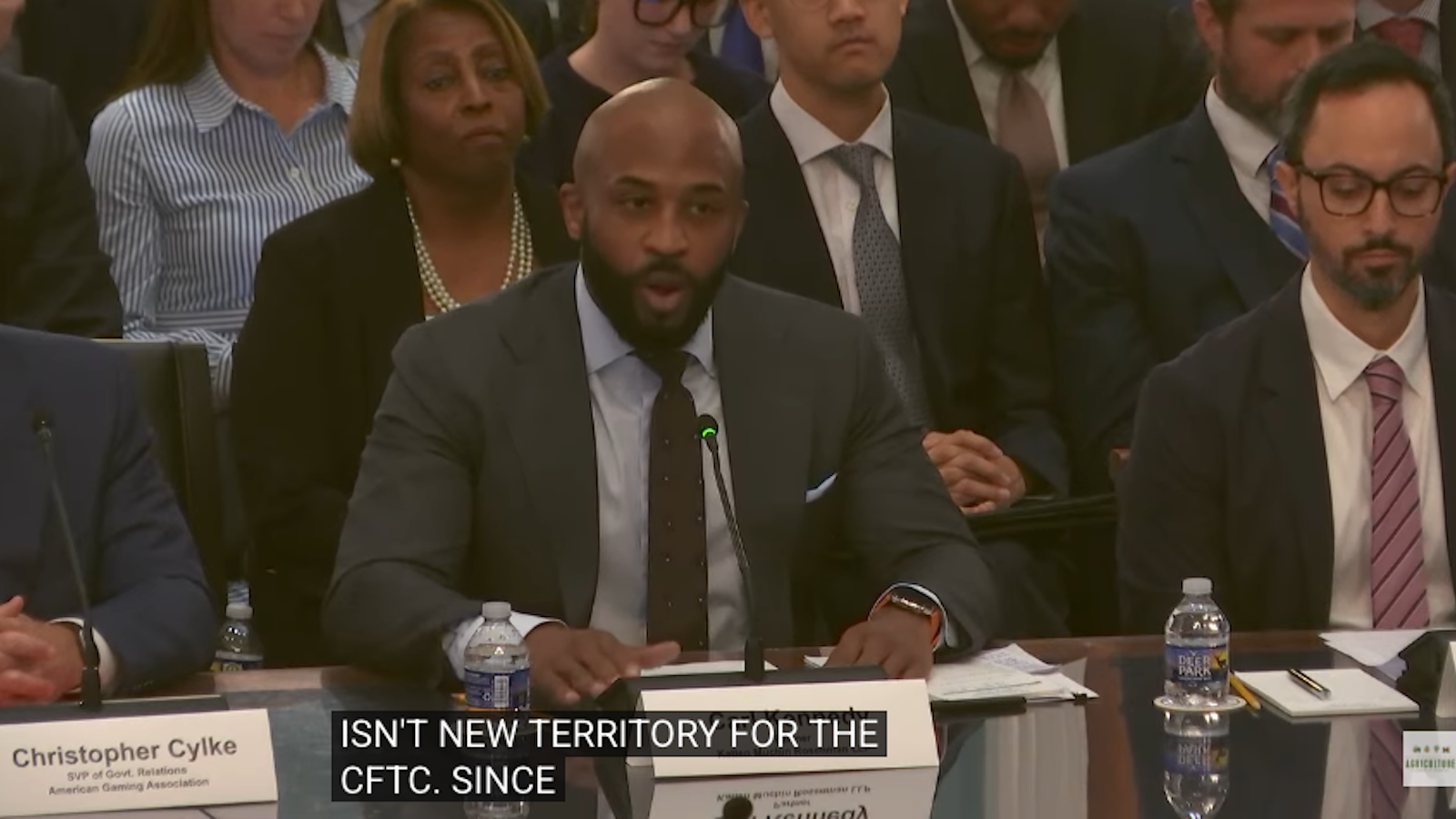
The five witnesses included Robert Schwartz, a partner at Morgan Lewis and former CFTC general counsel, and Carl Kennedy, a derivatives attorney at Katten Muchin Rosenman. Both argued that the Commodity Exchange Act (CEA) already provides the CFTC with comprehensive authority over event contracts and that the agency’s June 2026 notice of proposed rulemaking represents a sound response to a new/emerging product category.
Chris Cylke, senior vice president of government relations at the American Gaming Association (the casino industry’s main public affairs and lobbying apparatus), and David Bean, chairman of the Indian Gaming Association (IGA), argued that sports event contracts are gambling by any functional definition. They said CFTC actions are circumventing historical state police powers as well as tribal authority under the Indian Gaming Regulatory Act of 1988 (IGRA).
Asaf Meir, co-founder and CEO of Solidus Labs, a trading surveillance firm, occupied the pragmatic middle ground, testifying that the integrity challenges posed by prediction markets are real but solvable with purpose-built surveillance technology.
The legal framework debate
Schwartz offered a historically grounded defense of CFTC jurisdiction, opening with a tour through centuries of derivatives-as-gambling controversies, from Amsterdam’s stock exchange in 1688, to Tokugawa-era rice futures in Japan, to the 1867 arrest of seven Chicago Board of Trade members for violating Illinois gambling laws. His core message: Congress has repeatedly expanded the CFTC’s jurisdiction, and the CEA’s definitions of “commodity” and “swap” are deliberately very broad.
He also said that “if Congress today believes that exchanges should not offer contracts based on sports events, or politics, or anything else, it should amend the CEA and require the CFTC to carry out its mission accordingly.”
Kennedy, also in the pro-prediction markets camp, pushed back on the notion that federal and state regulatory regimes are mutually exclusive, arguing they “can, and already do, operate side by side.”
Bean, already an outspoken critic of prediction markets, called the CFTC’s proposed rulemaking “the height of regulatory capture” and accused Selig’s “one-person agency” of forcing nationwide sports gambling “into the homes of every American family.”
“Thanks to a one-person agency, every teenager can now lose their shirt without leaving their dorm room,” Bean said, referencing the minimum age of 18 on many prediction markets. He urged the subcommittee to advance H.R. 7840, the “Event Contract Enforcement Act,” and to “ensure that the CLARITY Act stops sports and casino gambling through prediction markets and provides that IGRA and state and tribal gaming laws have full force and effect.”
Cylke quoted Kalshi’s own 2024 court filings, in which the company argued that “Congress did not want sports betting to be conducted on derivatives markets.” He reinforced the point with some figures: Kalshi’s trading volume reached $111 billion through the first half of 2026, more than 80% of it sports-related. He also noted that 45% of all online sports betting advertising now comes from prediction market operators.
Michigan as a flashpoint
Rep. Kristen McDonald Rivet (D-MI) pressed witnesses on the CFTC’s recent order directing Kalshi to defy a Michigan state court order restricting the platform’s activity within the state.
The exchange, she noted, now faces potential civil penalties regardless of which authority it obeys. “This seems contrary” to the notion that the CFTC is equipped and willing to oversee prediction market activity, “especially when we have a single agency official,” she said. “It’s a stark reality of the complete violation of good faith.”
Schwartz acknowledged the difficulty of Kalshi’s position, saying, “I don’t know what the best advice would be,” and noted that Kalshi had been complying with the state court order before the CFTC intervened.
“It certainly was a flex,” Schwartz said.
Rep. Jill Tokuda (D-HI) called it “regulatory arbitrage” that “flies in the face of states’ rights.”
Surveillance and integrity
Meir’s testimony offered a look at how market integrity actually functions on CFTC-regulated prediction markets. In his written testimony, he disclosed that one designated contract market (DCM) client’s analysts handled over 121,000 surveillance alerts in Q2 2026 across more than 20,000 individual markets, opened more than 400 investigations, and referred more than two dozen matters to law enforcement.
Meir also presented a case study from an offshore platform involving a suspicious $50,000 position taken shortly before the Max Holloway–Conor McGregor UFC fight, a pattern consistent with insider trading (though he was careful not to allege insider trading outright did occur).
His key argument was that surveillance challenges in prediction markets are structurally different from traditional derivatives, involving binary outcomes, combinatorially expanding contracts, bounded pricing, and no standard identifiers, but said that regulated platforms with serious compliance infrastructure are already addressing them.
Other topics that came up repeatedly but did not meaningfully advance anywhere: whether or not the CFTC’s self-certification system for markets can effectively manage the flow of on-exchange trading while preserving market integrity, and consumer protections on CFTC-regulated exchanges in general. This was actually a rare prediction market discussion where insider trading incidents did not dominate.
What comes next
Johnson closed by outlining the subcommittee’s takeaways in four points:
- “The CFTC does have some important work to do. It is used to doing more with less and yet resource adequacy is a legitimate issue we should continue to explore.”
- “Everybody agrees about the importance of market integrity and consumer protection.”
- “I do think this subcommittee needs to continue to explore whether or not there are sufficient tools to ensure market integrity and consumer protection.”
- “Courts are acting in this space. The commission is acting in this space. I do not think that this committee, Congress, should be silent. We have an obligation to drive toward finding out what is the common ground. … It may be that the courts and the commission alone can provide that needed clarity, and yet if we don’t ask if there is a role for Congress, we are not doing our job.”
The hearing reinforced that several tracks are running simultaneously: the CFTC’s proposed rules addressing the crucial Rule 40.11 and its open comment period; active litigation in multiple federal and state courts; potential congressional action through H.R. 7840 and other proposed bills; and possible amendments to the CLARITY Act, the as-yet-unpassed legislation that would establish the first major regulatory framework for cryptocurrency in the U.S.
None of those tracks has yet reached resolution, and Tuesday’s hearing suggested that the subcommittee is not ready to direct traffic. But it seems at least aware that silence may not be a viable choice.