(This article has been updated.)
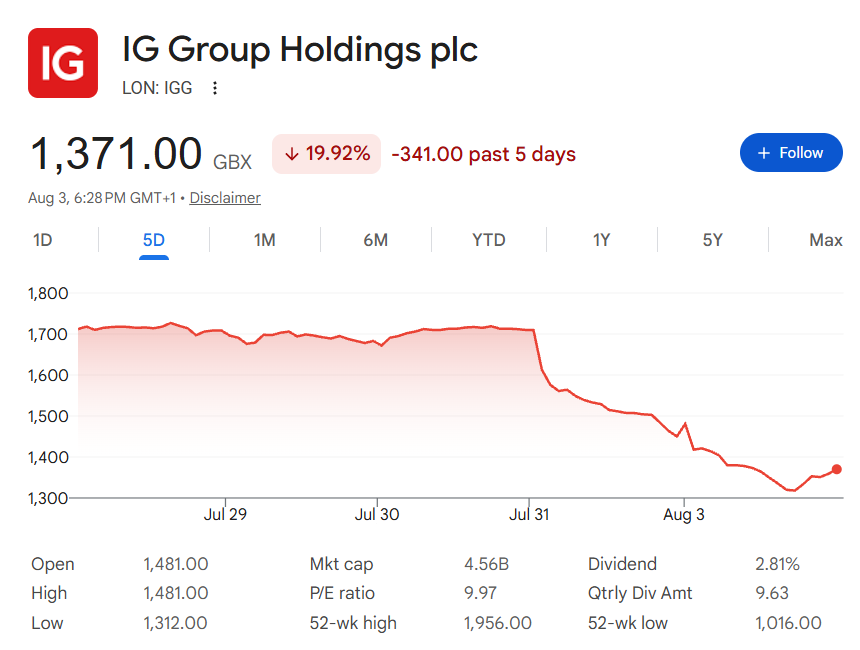
IG Group’s shares have plunged since the company bought daily fantasy and prediction market operator Underdog, losing more than 20% of their value, as the U.K.-based financial trading firm opted to pause buybacks in order to make a deal to get back into sports betting.
The share price fall means the upfront payment in the deal would be worth almost exactly $1 billion instead of the originally advertised $1.1 billion.
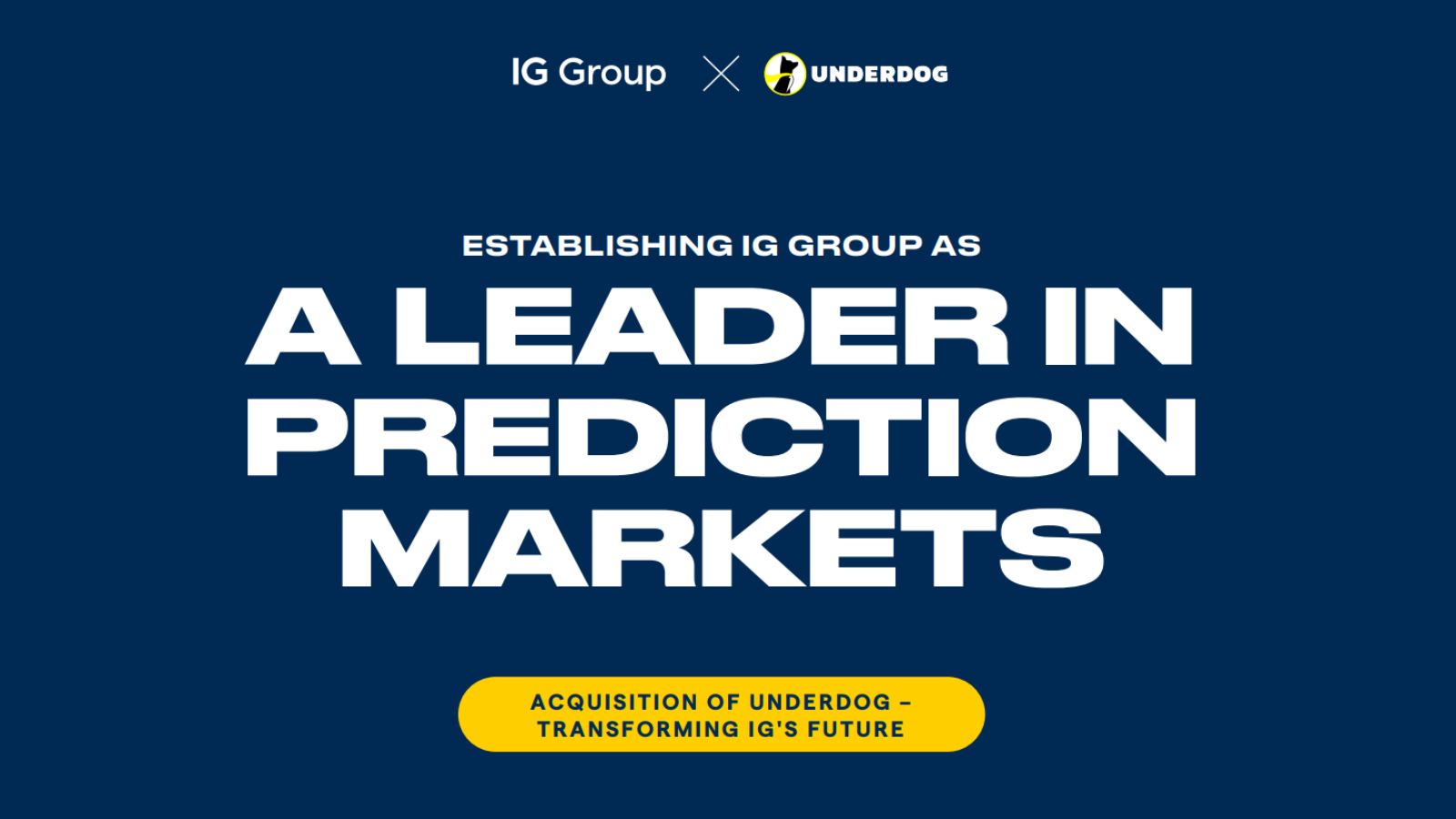
IG Group announced the deal to buy Underdog last Thursday after markets in London closed, for an initial $1.1 billion, and a total consideration of up to approximately $1.3 billion.
However, IG’s shares fell steeply on both Friday and Monday. IG also announced its half-year results Friday, but they did not appear to include anything that would have contributed to the share price fall. The company’s guidance was unchanged in the results, and analysts noted that there was not much of interest in the results themselves.
The shares fell as low as £13.17 ($17.69), down 23% from their closing share price Thursday. They recovered some of their losses on Monday afternoon London time, closing at £13.71 ($18.41). That’s still down 20% the end of Thursday
The decline took some analysts by surprise. When the deal was announced Thursday, the Jefferies team led by Julian Roberts said “the acquisition is interesting, and we suspect it will play well with investors.”
Buyback paused
Part of the reason for the decline may be money going to buying Underdog instead of returning cash to shareholders. In the acquisition announcement, IG Group revealed that it was pausing share buybacks, with an expectation that they will resume in 2027.
“Some shareholders have talked about the importance of the buyback in the investment model,” IG Group CEO Breon Corcoran said on a call with analysts. “We understand that. I think we’ve bought back, since the beginning of calendar 2024, some £550 million ($738 million) worth of stock. We on the board have shown commitment to buying back when the time is right.”
The decline essentially wipes out gains made in mid-May, when IG Group upgraded its medium term revenue growth outlook. In announcing the acquisition, IG said that it would cause revenue growth to rise even more quickly.
On the analyst call, Ian White of Autonomous Research appeared to be skeptical that Underdog would cause an acceleration in revenue growth, noting that “revenues would probably need to double from 2025 levels at Underdog” for that to happen.
Share price fall changes payment price
When the deal was announced, IG Group said that of the $963 million upfront equity value (the other $160 million of the upfront cost is from taking on Underdog’s debt), 60% of it, or $583 million, would be paid by issuing 24.1 million new shares. That would give current Underdog shareholders a combined 6.8% stake in IG. Underdog founders Jeremy Levine and Brandon Stakenborg would receive a combined 2% stake in the business.
The share component is based on a 30-day average of IG Group’s share price for the period leading up to when the merger agreement with Underdog was signed on Thursday.
As a result, a decline in IG Group’s share price changes the cash value of the shares that Underdog shareholders receive. Based on Monday’s closing share price, 24.1 million shares would be worth $466 million.
That would make the upfront equity payment now worth $846 million, or the total upfront payment $1.0 billion.
99% of handle from predictions?
Prediction markets are unsurprisingly the main area of interest for IG.
IG’s presentation on the Underdog acquisition said that by an unnamed “future” date, 99% of Underdog’s handle could come from prediction markets, with only 1% from fantasy sports. Prediction market handle in this context appears to refer to volume, which is not necessarily a one-to-one comparison for sports betting or daily fantasy handle.
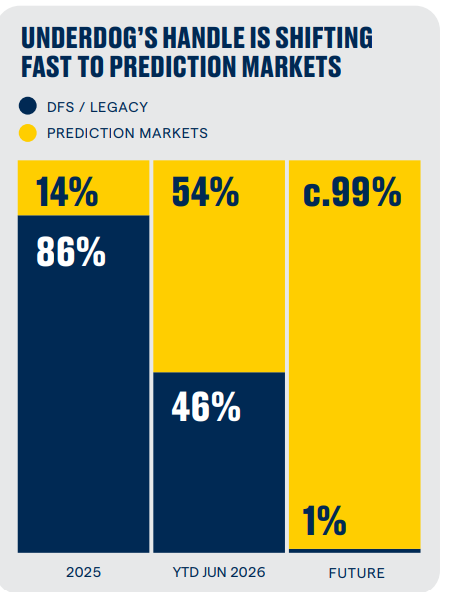
“We also see as the transition of the business model takes place from DFS to prediction models, there’s a liberation from some of the restrictions in terms of the format of propositions that Underdog offers its customers,” IG Group CEO Breon Corcoran said on the call with analysts. “That, we believe, will drive the handle or the dollars wagered significantly up for Underdog, closer to some of the existing players in the market.”
IG Group sits in an interesting position as a financial trading company with particularly notable links to sports betting. In the early 2000s, the business was most associated with spread betting — a type of bet where the size of a payout depends on how much a team wins by — before it became more of a traditional financial trading business amid restrictions on spread betting. Corcoran was previously CEO of betting exchange Betfair and then Paddy Power Betfair, which later became Flutter Entertainment.
IG Group said that both sports and non-sports prediction markets would be an important part of the acquisition. The presentation said that Underdog has “the best sports experience” with “a rapid path to category expansion beyond sports.”
Regulatory risks?
However, IG Group also noted that in the event that court decisions or new laws make prediction markets much less viable, the valuation would still be “underpinned by DFS.” The presentation also highlighted that the deal had a heavy earnout component, with a maximum value of $2.2 billion if a management incentive plan for Underdog management is counted. This, the presentation said, would ensure that IG Group would pay based on results.
“The price of Underdog is essentially buy-one-get-one-free: if DFS 2.0 comes under regulatory and competitive pressure but prediction markets thrive, or (less likely) vice versa, this will be a smart deal,” analyst Paul Leyland of Regulus Partners wrote Thursday. “If neither of them do, then the price tag for failure is both significant and outside of IG’s control, although stepping outside a regulatory comfort zone will no doubt be blamed. Given these risks, the extra smart thing to do may be to get back into traditional sports betting as a hedge while the customers are still there to cross sell to; the regulation might be painful and distant from IG’s core competencies, but at least it’s there …”
Corcoran accepted that the legality of sports event contracts would likely be decided by the Supreme Court.
“I think it’s largely expected that there’s a growing expectation that this will go to the Supreme Court in the U.S.,” he said. “Among commentators, there’s a quite a broad variance in when that might happen. My guess is no better than anyone else’s, and actually less well-informed than many. I think this may ultimately go to the Supreme Court of the U.S. for resolution.
“For those that aren’t as close to the detail, the decision will be whether this should be regulated, whether sports in particular should be regulated by individual states, or whether the CFTC has the right on a federal basis to regulate event contracts, which currently are seen to include sports. I think in the long term, we will get clarity around that. Possibly even in the medium term, we’ll get clarity around that.”
Correction: An earlier version of this article indicated that the 30-day VWAP window was not yet closed, and therefore the number of shares issued from IG to Underdog as-yet undetermined. In fact, the window is closed, and the number of shares issued in connection with the transaction — 24.1 million new shares — is fixed and not variable. We regret the error.