Kalshi has self-certified contracts on draft lotteries such as the NBA’s — including what may be the first contract the prediction market has listed on an event designed to be pure chance — on the heels of Commodity Futures Trading Commission (CFTC) chair Michael Selig remarking that there is “definitely a difference” between contracts on games of chance and skill.
A filing submitted earlier this month self-certifies a contract with the title, “Will <team> win the <league> Draft Lottery in <year>?” This contract would initially depend in part on teams’ records, but would be based on random chance after the end of the regular season.
However, a second filing would allow traders to bet on the pre-draw odds that the winning team would have, which would be unaffected by sports results and solely determined by chance even if it was listed before the regular season ends. That contract is titled “Will the team officially announced as the winner of the #1 overall pick in the <year> <league> draft lottery have official pre-lottery odds of <comparison><value>?”
Self-certification is a process where an exchange tells the CFTC that it plans to list a new type of contract, and provides certain details such as the applicable rules. If the CFTC does not object before the listing date specified, the contract may be listed, though it is not technically considered “approved.” Virtually all prediction market contracts are listed via the self-certification process.
The certifications would have allowed Kalshi to list the draft lottery winner contract by Feb. 6, but it is not currently available on Kalshi’s website. The filing for the second contract says it may be listed by this Friday. Kalshi does not list every contract it self-certifies, and when it does list a contract it does not always do so on the date listed on the filing. For example, it self-certified NFL player prop bets in mid-August, but did not list them until three weeks later. A controversial filing on the NCAA transfer portal, submitted in December, never translated to an actual contract available on the exchange.
A draft lottery is a randomized draw to determine the order of selections in a given league’s player draft. The NBA, NHL, MLB and WNBA all have draft lotteries, with the NBA’s gaining the most attention due to the impact a single high draft pick can have on a franchise’s fortunes.
While some have floated theories of rigged draws, the NBA draft lottery process is audited by financial services giant Ernst & Young to ensure it is a random draw.
A contract on a draft lottery, should it come to fruition, may be Kalshi’s first contract on an underlying event that is specifically designed to resolve based on pure chance. Unlike rival Polymarket’s global site, or Crypto.com’s prediction market, Kalshi did not offer trades on the coin flip to determine first possession and direction of play in the Super Bowl. While the draft lottery contract may be new ground in that respect for Kalshi, the business has not specifically made arguments distinguishing its contract from bets on random chance.
While not based on an underlying event that is specifically designed to be random, other contracts such as 15-minute cryptocurrency price markets are likely to be difficult to distinguish from pure chance as the movement of a cryptocurrency over such a small time horizon is usually close to indistinguishable from a random walk.
Selig: There’s ‘definitely a difference’ between chance and skill
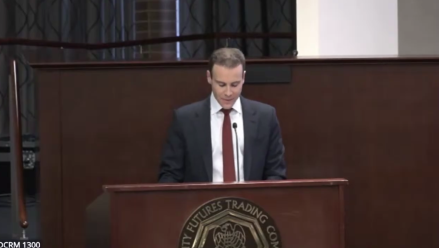
While Kalshi hasn’t focused on a chance/skill distinction, CFTC Chair Michael Selig drew a distinction between event contracts based on chance and those based on skill on Bloomberg’s Odd Lots podcast last week, when asked whether a prediction market could offer a contract on a spin of a roulette wheel.
“Some of these types of gaming where it’s really a game of chance and not a game of skill, there’s definitely a difference,” he said.
He did note that even a contract on a roulette spin may be permitted.
“And I think when we look at what’s a commodity, it’s possible that you could construct some sort of contract, an esoteric derivative, but really the underlying and a game of skill are very different.”
Andrew Kim, a partner at Goodwin Law who has followed the various lawsuits concerning sports event contracts but is not directly involved, wrote on social media site X that he was “confused” by Selig’s decision to draw a line between chance and skill in event contracts.
Kim pointed out that the Commodity Exchange Act definition of a swap — “any agreement, contract, or transaction… that is dependent on the occurrence, nonoccurrence, or the extent of the occurrence of an event or contingency associated with a potential financial, economic, or commercial consequence” — does not suggest that games of chance must be excluded.
The CFTC also has rules concerning “contracts involving gaming.” Opponents of prediction markets have argued that it is required to ban any contracts that involve gaming, while proponents have argued that it merely has the power to do so if it also determines that the contract is against the public interest, but it does not have to ban all contracts that involve gaming.
In 2024, Selig worked as outside counsel on a letter to the CFTC from venture capital fund Paradigm Operations which relied on a particularly narrow interpretation of the term “contracts involving gaming.” The letter argued that a contract only involved gaming if the underlying event that is being bet on is itself a game played for stakes. In this scenario, a contract on the winner of the World Series of Poker is likely to be a contract involving gaming, but a contract on an NFL game would not be.
Economic consequences
On Odd Lots, Selig went on to discuss how the economic consequences of an event contract on the Super Bowl are different to those on a roulette spin.
There is little doubt that the NBA draft lottery has economic, commercial, or financial consequences for the teams and players involved.
The new contracts come as Kalshi has made a greater effort to show that its sports event contracts can be used for hedging in the same manner as a traditional commodity future. Kalshi revealed last week that Game Point Capital — an insurance company that helps college athletics departments, sports teams, and sponsors to hedge the financial risks of having to pay out athletes’ and coaches’ performance bonuses — had started trading on the platform. It plans to hedge about $30 million per year using Kalshi contracts. InGame also reported last week that Kalshi filed for a rule update that would allow it to give fee rebates to sportsbooks that use the prediction market to lay off risk.
Kalshi has also been hiring for “institutional sales” roles for sports, with people in those roles tasked with convincing “small to mid-sized institutional customers whose revenue is exposed to sports outcomes” to hedge their risks on Kalshi.
A draft lottery could be an event where a sports team or an organization whose fortunes are tied to a sports team genuinely would have reason to use event contracts to hedge their risk.
Like most Kalshi self-certifications, the filing includes a list of “trading prohibitions” – people who are automatically not allowed to bet on the market due to the possibility that they might have inside information. Current and former NBA players are banned, as are paid employees of the league and team owners. That would seemingly prevent a team using the draft lottery contract to hedge, though they may still be able to buy an insurance policy from a business that itself uses the contracts to hedge the risk of it paying out.
NBA considers changing lottery
The contracts also come as the NBA considers altering the draft lottery process in an effort to discourage tanking. Commissioner Adam Silver on Saturday said it was time to take a “fresh look” at how the league assigns the order of draft picks.
“It’s so clear that the incentives are misaligned,” Silver said.
The NBA also appears to be moving closer to prediction markets. During the NBA All-Star Tech Summit, Kalshi founders Tarek Mansour and Luana Lopes Lara, and Polymarket founder Shayne Coplan, spoke on a panel on prediction markets. FanDuel CEO Amy Howe, DraftKings co-founder Paul Liberman, MGM Resorts CEO Bill Hornbuckle, and Sportradar CEO Carsten Koerl also spoke on the panel.