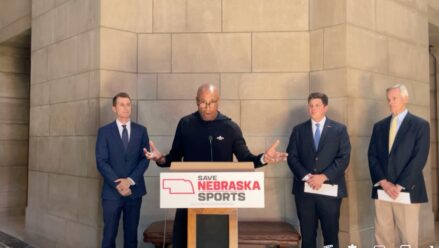
DraftKings and FanDuel have staked “Tax Relief Nebraska,” with $1.1 million each in an effort to get a package of initiatives on the ballot to legalize online sports betting, Nebraska Public Media reported Tuesday. The group is currently gathering signatures for two petitions and must collect qualified signatures from 7% of registered voters for an initiative and 10% for a constitutional amendment. In addition, qualified signatures from 5% of registered voters in 39 of the state’s 93 counties are required. According to the SOS site, 1,254,120 voters were registered in the state as of Jan. 1.
Petitions were approved and began circulating in February. So far, Tax Relief Nebraska has $2.6 million on its books. Besides the DraftKings and FanDuel contributions, BetMGM and Fanatics Betting & Gaming have also put money into the campaign.
Should Nebraska voters approve the proposals, Nebraska would become the second state to legalize since Missouri did in 2024. Wisconsin Gov. Tony Evers signed a law legalized online sports betting with the tribes in charge April 9.
Caesars Entertainment and FanDuel are among the gambling companies that have made campaign contributions to Gov. Jim Pillen and Attorney General Mike Hilgers. Caesars contributed $15,000 to each, and FanDuel contributed $25,000 to Hilgers’ campaign. WarHorse Gaming, which operates in-person casinos and sportsbooks in Nebraska and backs the petitions, contributed $5,000 to Hilgers’ campaign and $20,000 to Pillen’s.
In-person sports betting has been legal in Nebraska since 2020, when voters approved ballot measures. At the time, there was some question as to whether or not those measures extended to online sports betting, but the legislature ultimately decided they did not.
As operators in Nebraska push for legalization, would-be presidential candidate Rahm Emmanuel proposed on tax day … a new tax, according to the Chicago Sun-Times. Emmanuel, the former mayor of Chicago, which earlier this year became the first city to tax sports betting operators, pitched the idea of a 10% federal tax on all sports betting and prediction market operators. Legal wagering operators already pay the federal government an excise tax on handle in addition to state taxes. Emmanuel’s idea would effectively increase taxes on sports betting to more than 60% in the two biggest, highest-taxed betting states — his home state of Illinois and New York.
In other news …
Here’s a look at the status of some other active bills around the U.S.:
Iowa: Lawmakers have begun the process of trying to regulate designated market contracts (DCMs) — the platforms that offer prediction markets. SF 2494, which started as SSB 319, on Wednesday passed out of the Ways and Means Committee. The bill would restrict market making, ban insider trading, require licensing, and set the minimum age at 21. The bill would prohibit government employees or officials, lobbyists, and others from buying or selling contracts.
Iowa’s legislative session closes Tuesday, so it’s unlikely the bill will get through both chambers this session.
Kentucky: State lawmakers Tuesday overrode a veto of HB 904 by Gov. Andy Beshear, meaning the bill that would raise the minimum age to 21, ban some prop bets, regulate daily fantasy sports, and allow fixed-odds betting on horse races is now law. The bill also prohibits partnerships between prediction markets and sports betting licensees and horse racetracks, which begs the question: Will DraftKings, Fanatics Betting & Gaming, and FanDuel have to exit the state? All three companies have prediction partners and offer sports event contracts on their platforms. Kentucky is the first state to pass a law around prediction markets that may have some teeth.
The state didn’t outright ban prediction markets — which are federally regulated by the Commodity Futures Trading Commission — but it has now put the nation’s three biggest sports betting companies in a pickle. If a wagering operator has a license revoked in one jurisdiction, that can affect its suitability elsewhere.
Minnesota: SF 4511, the bill that would ban prediction markets, is primed for a fifth committee vote April 24 in the Senate Finance Committee. The bill passed through the Senate Commerce and Consumer Protection Committee Tuesday as it makes a late run to beat the May 18 legislative adjournment date. Should SF 4511 pass out of the Senate, it must still get through the House.
New York: A bill originally filed in May 2025 that would ban minors from creating sports betting accounts was amended Wednesday and recommitted to the Finance Committee. It passed out of the Racing, Gaming, and Wagering Committee in January.
S 7908A would allow for consumers to create an “identifying information” file that could be registered with a state exclusion list to prevent themselves — or others using their information or device — from wagering. Consumers would be able to remove their information from the list at any time. Among the requirements in the bill, operators would have to “treat a person as a minor if the person’s device communicates or signals that the person is or shall be treated as a minor, including through a privacy setting, device setting, or other mechanism.”
A similar House bill is in that chamber’s Racing, Gaming, and Wagering Committee.