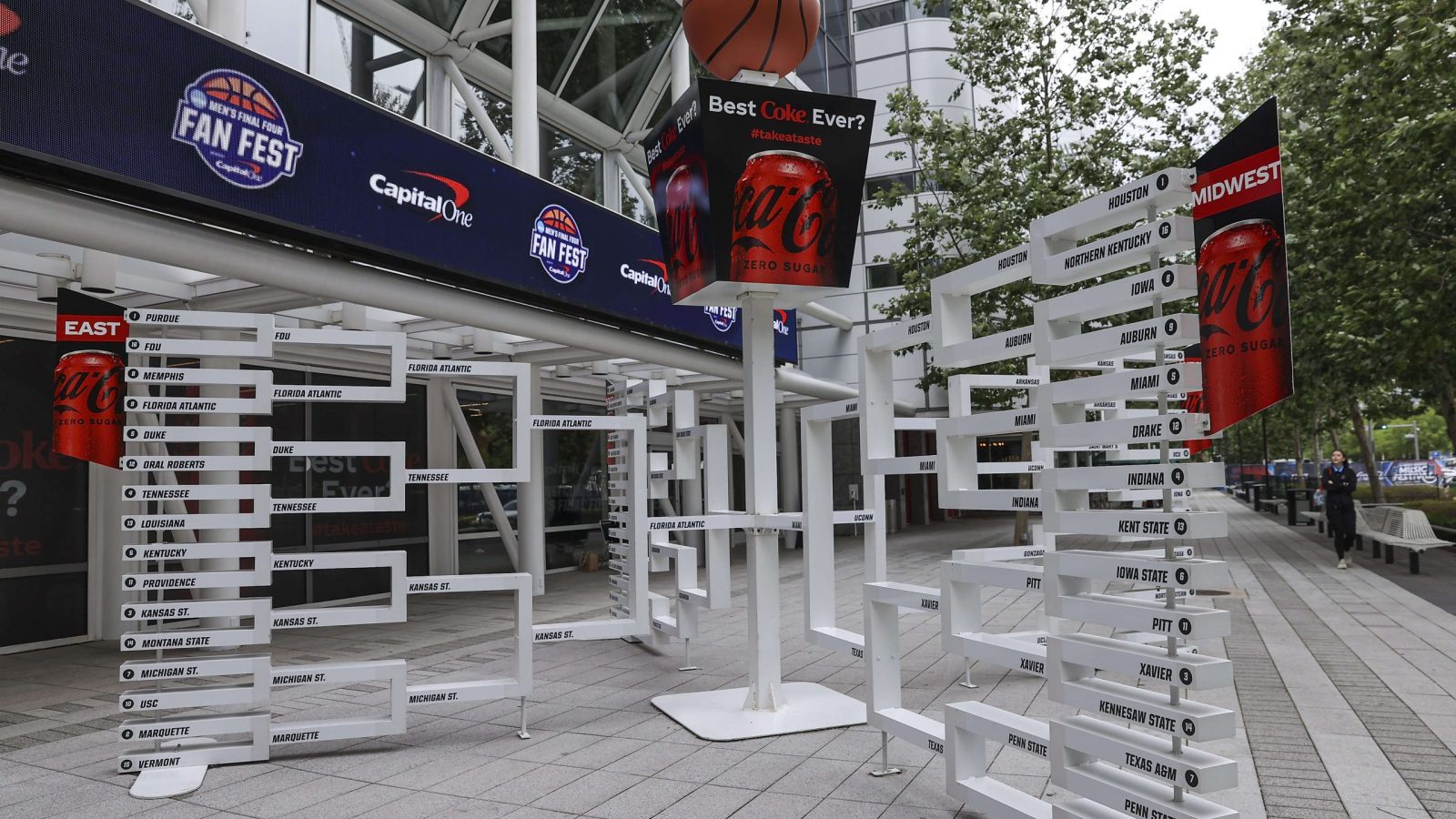
Clipped from newspapers, printed out at work when no one was looking, tacked to corkboards, and smeared with highlighter smudges, the old-school NCAA men’s basketball tournament bracket is a quaint vestige of a simpler time.
Seemingly every American became a gambler, regardless of age, for these few weeks a year. With game-by-game sports betting then confined to Las Vegas or a corner bookie, these ever-haggard sheets of paper provided the taboo-adjacent rush of monetizing fandom. Or supposed smarts.
Then the Supreme Court struck down the Professional and Amateur Sports Protection Act in May 2018, making the legalization of sports betting a state decision.
As the full 2026 NCAA tourney tips on Thursday, cueing the first of two days of gluttonous consumption in sports bars and living rooms, 41 jurisdictions in the United States have legal sports betting markets. Thirty-three of those include mobile/online access.
That tattered and worn paper has all but vanished, but the annual rite of completing a March Madness bracket and plunking down a few bucks to make it interesting endures, albeit online.
In an era when the American sports bettor has numerous options and, according to research, an appetite for action while watching games, the process of tapping out an entire tournament’s worth of results in advance would seem too much for the modern dopamine enthusiast. Instead, it has transformed the bracket into a 63-leg parlay that can cash without perfection.
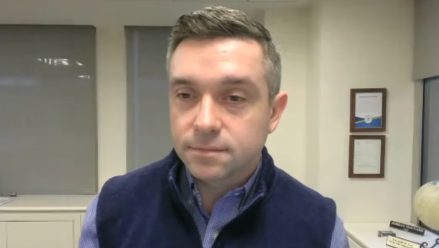
So the annual pool, which was either created at Jody’s Club Forest pub on Staten Island in 1977 (the IRS eventually came for its cut) or by a Louisville postman in 1978, remains an enduring part of the American sporting fabric. Despite technology, or the length of the players’ shorts, or how the interpretation of the traveling rule has evolved, there remains a simple explanation, said Matthew Bakowicz, director of the sports management program at American University’s Kogod School of Business.
“The social component,” he told InGame. “It’s the same reason why we’re actually seeing an increase in sports betting. But it’s why the office pool still goes strong.”
It certainly does at ESPN, whose bracket challenge has steadily grown in user base post-PASPA, with the exception of a COVID-induced dip. ESPN’s name was on an online sportsbook until November, when Penn Entertainment ended the partnership amid poor performance.
Brackets completed at ESPN since 2018:
- 2018 – 17.4 million
- 2019 – 17.3 million
- 2020 – No tournament
- 2021 – 14.7 million
- 2022 – 18.7 million
- 2023 – 20.2 million
- 2024 – 25.7 million
- 2025 – 27.7 million
Elsewhere, the number of unique users participating in the BettorEdge peer-to-peer bracket contest has grown 345% since 2023.
Sportsbooks lean into bracketology
Incorporating communal mirth into gambling has been a focus of the industry in recent years, with some platforms creating dedicated in-app chats to allow players to follow each other’s bets and brag about or bemoan the results. Numerous sportsbooks brandish bracket-themed challenges within their apps, alluding to the form of March Madness gambling familiar to all before legal wagering became so widespread.
Bakowicz cited a 2025 BetMGM sports betting commercial, in which actor Jon Hamm and his buds shake off the nuisance of a windshield broken in a hail storm by livening up a somber bar they happened upon with their merriment over a four-leg parlay.
“It’s just a random game, and it turned it from a boring night to a fun night because of social components,” explained Bakowicz, a former Simplebet trader and DraftKings sportsbook manager. “Sports cuts through everything in the world. It doesn’t matter your race, religion, politics, age, gender, family life, job. It’s the one thing that everybody talks about.”
Hard Rock Bet even commissioned a study asking respondents how they would fill in their brackets this season:
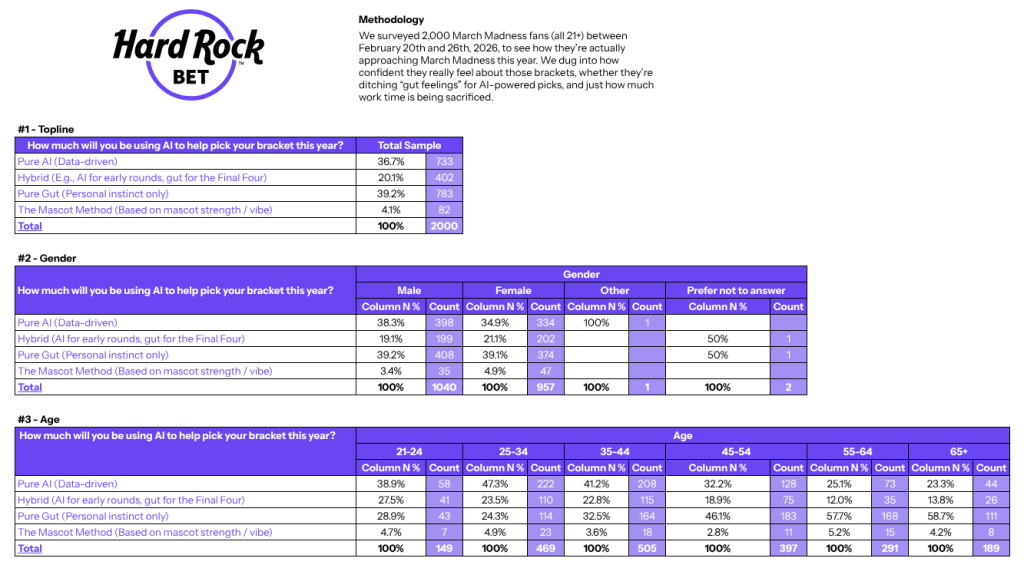
From pens to keyboards, so many brackets
The American Gaming Association (AGA) no longer forecasts the number of NCAA bracket players each spring, but its last estimate pegged the figure at 56.3 million planning to participate in a bracket contest in 2023.
AGA predicted participation data:
- 2019 — 40 million
- 2020 — No data released, NCAA tournament canceled after COVID outbreak
- 2021 — 36.7 million
- 2022 — 36.5 million
- 2023 — 56.3 million
The stagnation in bracket participation and a coinciding lull in Super Bowl squares were attributed partly to American society in a COVID era that still limited in-person fraternization.
Kalshi is even in on the game now, promoting a massive payout for the unicorn perfect bracket.
In states that restrict betting on local college teams, bracket pools may be the only viable way to put some cash down on an event the AGA estimates will generate $3.3 billion of sports betting handle on the men’s and women’s events this year. Determining bracket-pool volume is impossible, given the informal nature of it, where participants set buy-ins that aren’t facilitated by platforms like ESPN or CBS Sports.
An Associated Press-NORC Center for Public Affairs Research found last year that about 25% of Americans filled out a men’s bracket “every year” or “some years.” The poll found that about 60% of participants were men, about a third of them younger than 45. Roughly 70% noted that they participate for “the glory of winning,” “the chance to win money,” or the communal experience.
“You have more female fans that are involved, which means those female fans also want to be part of the social group, so they join the office pool, they join the sports betting world, because it cuts through everything,” Bakowicz said. “It’s a conversation where everybody can talk about the same thing and it doesn’t matter who you are, where you come from, or what you look like. You all are fans of that for that particular day.
“That, I don’t think, will ever get replaced.”