Kalshi made over $25 million in fees during the first four days of the NCAA men’s basketball tournament, as it processed more than $2 billion worth of trades.
March 19, the first day of the tournament, was the second biggest day in Kalshi’s history, trailing only the Super Bowl. Total volume came to $645.7 million.
Volume, the total amount staked by all users, is often used as an equivalent to handle, though the comparison is not like-for-like. For example, a one-dollar bet on an underdog at 1% odds is recorded at $100 of volume, because the other side of the bet is counted too, despite the fact that that side was likely put up by an institutional market maker. In addition, if a user places a bet on a team to win the championship and then cashes out after the first round, this would be recorded as two separate bets for volume purposes.
From that total, Kalshi made $5.5 million in “taker” fees, plus another $1.0 million in “maker” fees before any rebates, giving it $6.6 million in total fee revenue for the day, which was also its second-best day ever. On Super Bowl Sunday, Kalshi made $8.7 million in fees from $870 million in contracts traded.
Volume over four days was $2.3 billion
Volume and fees were high across the whole weekend. Volume on every day of the tournament was higher than every non-tournament day in Kalshi’s history except for the Super Bowl.
Over the two rounds, Kalshi’s total volume came to $2.34 billion. The business made $25.5 million in fees, more than it made during the first five months of 2025.
Unsurprisingly, sports — and college basketball in particular — dominated. Sports made up 90% of volume on all four days of the tournament. College basketball bets, excluding parlays which are not always broken down by sport, made up more than half of volume during the first round, and around 40% in the second round. Parlays made up another 13% of volume.
College basketball alone during the four-day period contributed $13.2 million in fees for Kalshi, with parlays making up another $2.0 million.
The four consecutive heavy-volume days ensured that the week up to March 23 was Kalshi’s biggest-ever seven-day period for volume, exceeding $3.4 billion, and for fees, at $33.1 million. Of that volume figure, $2.8 billion was from sports.
‘Takers’ bet $900 million in four days
A closer approximation to betting handle may be taker-side volume. The vast majority of casual Kalshi users “take” trade offers that have been made by market makers. This still would count cashing out, which may be especially prevalent in bets on the national champion, as a new bet, and would not account for non-professional market makers putting up trade offers.
During the first four days of the tournament, takers on Kalshi staked $900 million across all markets. That included $430 million on college basketball markets, excluding parlays, plus $45 million on parlays.
During the first two days of the tournament, when first-round matchups were being played, takers staked $457.0 million in total, and won back $451.5 million before fees. That means they made a loss of $54.5 million before fees, or 1.19% of their stakes. After fees, takers lost 3.6% of their stakes.
Taker losses on college basketball specifically across the first round were larger at 5.25%.
Takers performed better than normal on parlays over the two days, only losing 2.4% of stakes and making a profit before fees. Parlay performance can be very volatile day-to-day, with takers making profits on some days and steep losses on others. After a taker loss of 17.3% of stakes on March 19, extremely chalky bracket results on March 20 helped parlay takers make an 11.8% profit.
Duke-Siena game attracts $42M in volume
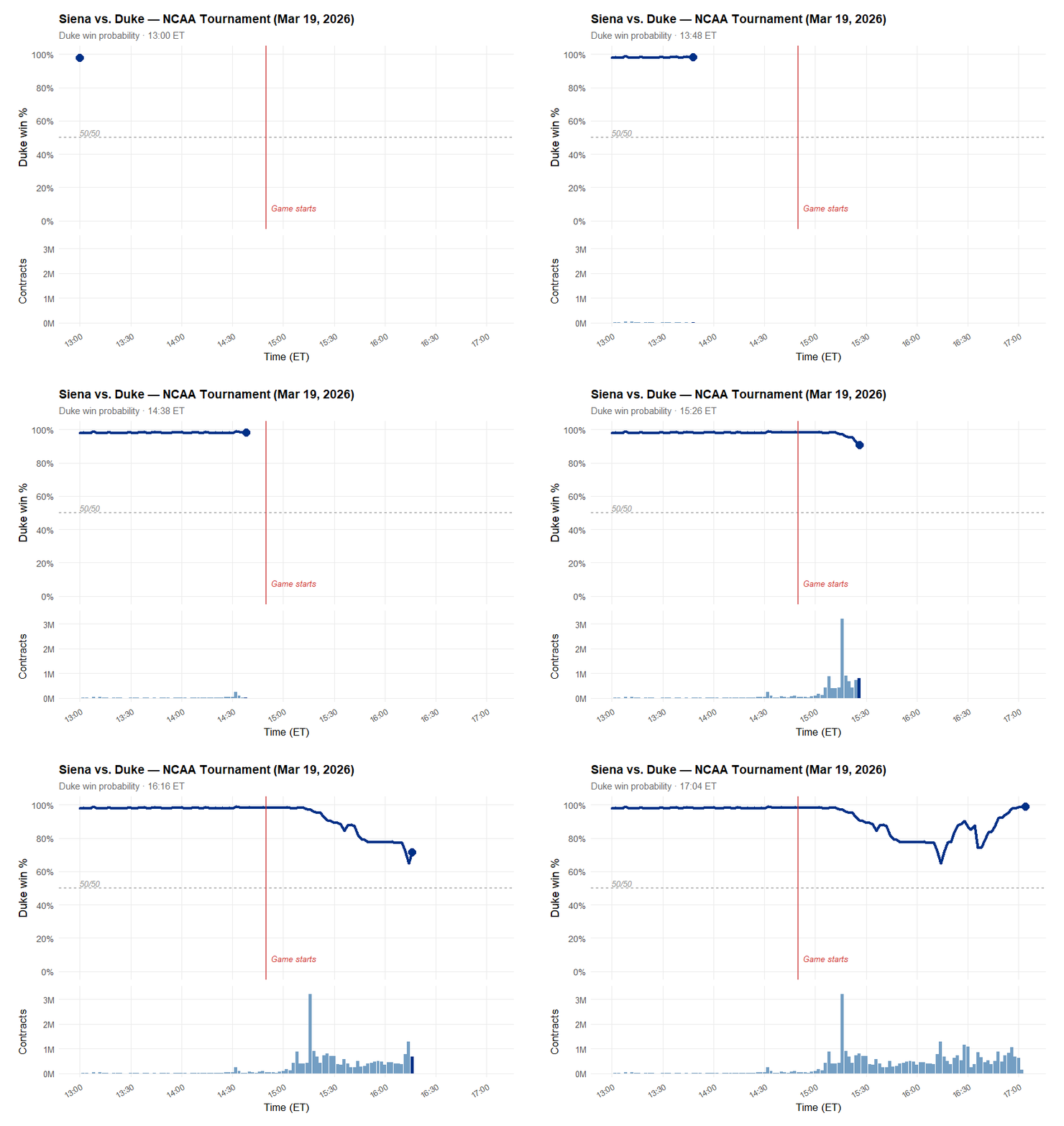
The largest single trade recorded was a $990,000 bet on No. 1 seed Duke to beat 16-seed Siena at 99% odds, which would have paid out just $1,000 in winnings. The bet was placed on March 16, before the tournament began. Siena led by as many as 13 points early in the second half, putting the bet in danger of losing, before Duke came back to win.
The market for the tournament winner was the single biggest market on Kalshi in March, attracting $113.1 million of volume. The Duke-Siena game winner market attracted the most volume of any individual game, at $42.4 million.
That figure was likely boosted not just by Siena’s unexpectedly strong showing but also the Metro Atlantic champ’s location in New York. New York does not permit its sportsbooks to offer bets on in-state college teams, meaning that the state’s 20 million residents would not have had other legal options if they wanted to bet on the game.
Siena’s status as a large underdog also meant that, for example, a $5 bet on the Saints at 5% odds would be recorded as $100 worth of volume.
In total, $24.4 million was staked during the portion of the game where Duke’s odds were below 95%.
Iowa’s upset win over Florida was next in volume, with $24.7 million.
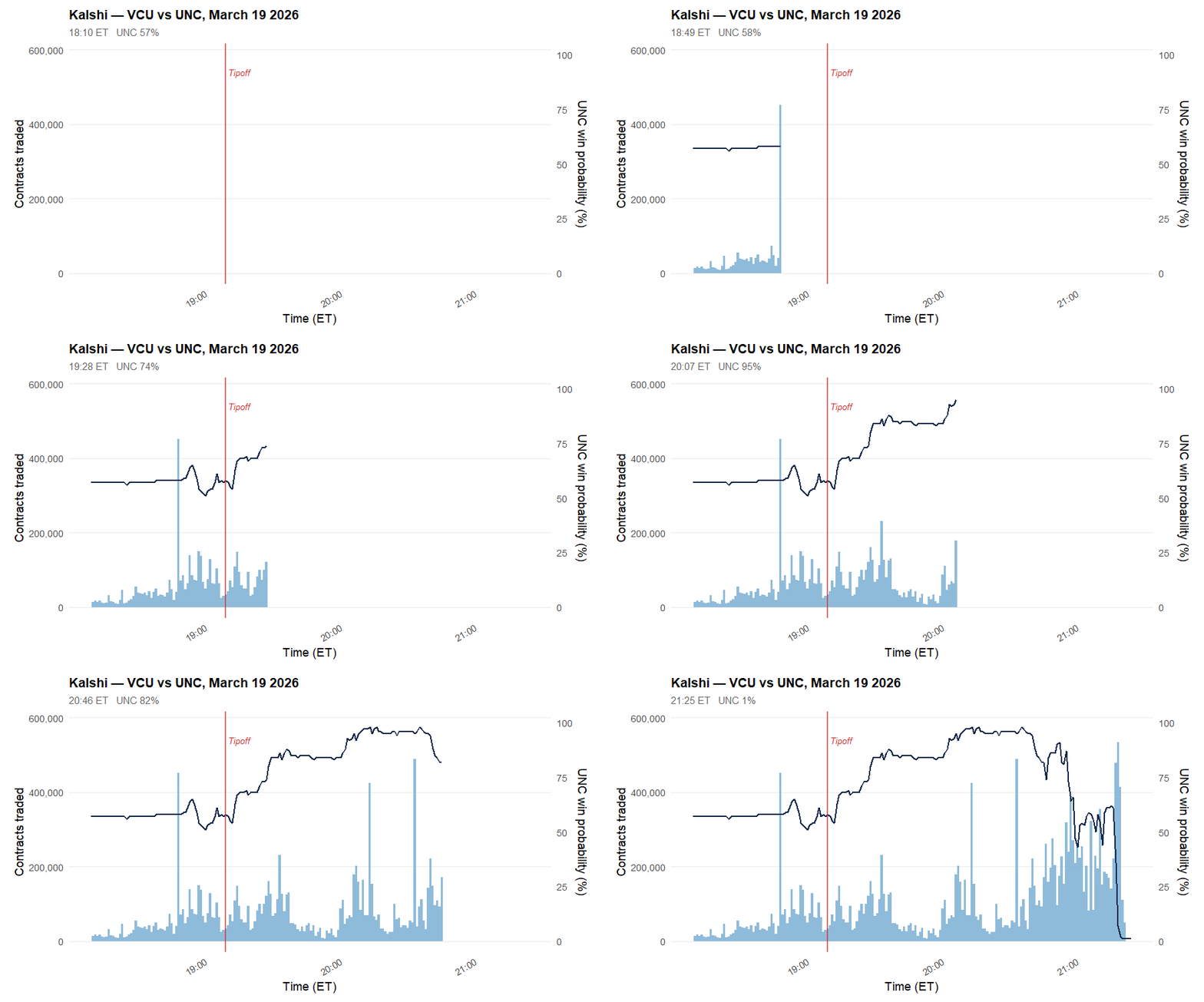
In the 6-11 matchup between North Carolina and Virginia Commonwealth, $3,376 was traded across 20 trades while the Tar Heels were at 99% odds and the Rams were at 1%. Virginia Commonwealth came from behind to win the game, meaning the 99% trades lost and the 1% trades won.
Kalshi on course for huge 2026
Volume during the tournament was around 12 times higher than during the first two rounds in 2025. Those four days at the start of the 2025 tournament were themselves a major milestone in Kalshi’s growth.
The combination of the start of the tournament and Robinhood relaunching Kalshi contracts via a “predictions hub” led to a surge in sports betting on the platform. Before the 2025 tournament, sports contracts had been only a small share of volume.
March is set to be another record month for Kalshi, with the prediction market near-certain to break February’s highs of $10.4 billion in volume and $119 million in fees. The business is on course to easily exceed $1 billion in fee revenue this year, having already crossed the $340 million mark.
That would likely put it ahead of BetMGM and Fanatics for third place in the U.S. sports betting market.
Big jump in volume at Polymarket US
Polymarket US — still just invitation only — also saw a surge in volume around the tournament.
It shattered its previous daily highs for trading volume, with a high of $60.1 million on the last day of the second round.
The business — which currently charges much lower fees than Kalshi — made around $224,000 in fees during the four-day period.
Polymarket’s increase in volume on its U.S. exchange during the 2026 NCAA men’s basketball tournament resembles Kalshi’s surge in 2025.
According to Paradigm’s prediction market dashboard, volume on Polymarket’s global exchange for the four-day period came to $1.45 billion, including $800 million on sports. Polymarket does not yet charge fees on most markets — though it will, starting Monday — meaning it did not make any fee revenue from March Madness trades.