We can argue about it until the cows come home (the “cows” in this case being the U.S. Supreme Court, and “home” would be it deciding to take on a prediction market case) but in the meantime, there is at least one item we can all reasonably agree on when it comes to prediction markets: There is risk involved.
Which made Nate Silver the perfect person to give what amounted to one of the first keynote speeches at one of the first-ever prediction market conferences.
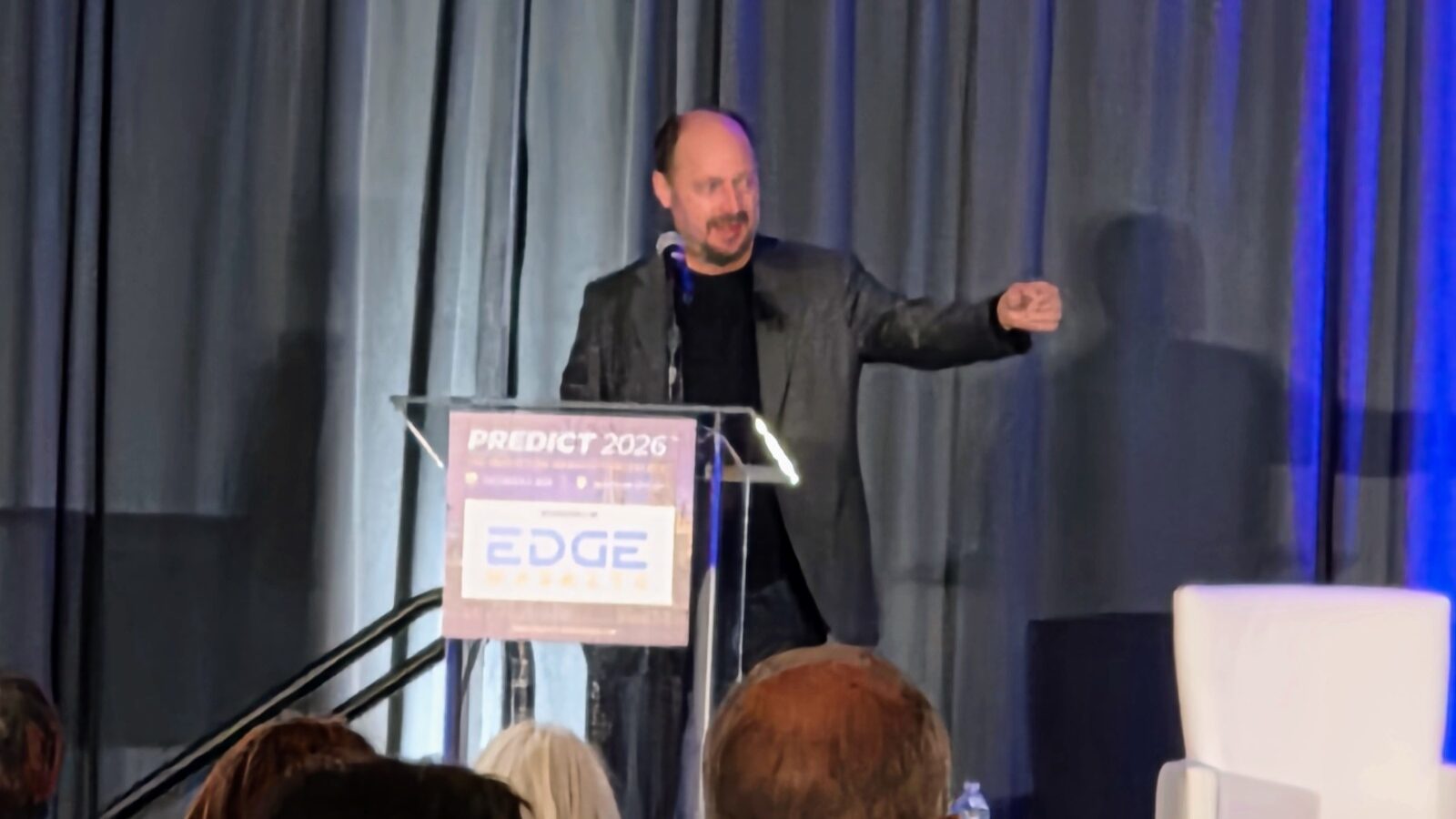
Speaking at PREDICT: The Prediction Markets Conference, which began Tuesday at the Marriott Marquis in New York, Silver delivered a talk titled “7 Habits of Highly Effective Risk-Takers.”
He didn’t tell people how to successfully trade on Polymarket or how to know when to exit a market on Kalshi, but he did flesh out what, exactly, separates the successful risk-takers from the not-so-successful ones.
And sometimes, apparently, the successful ones also need to find a hidey-hole to put down a stiff drink or three after losing a poker hand.
Silver recalled reaching the sixth day of the 2023 World Series of Poker Main Event, with only 93 players remaining and a $12 million first prize dangling in front of his face. He had just won a big pot, and final table dreams were dancing through his head.
Then came pocket sixes, a flop with another six, and an opponent holding pocket sevens. Unfortunately for Silver, the flop also held a seven. Things predictably spiraled from there.
Whoops.
But Silver’s point was that he would play the hand the same way every time. The result didn’t make the decision wrong.
“In uncertain environments, a good decision can produce a bad outcome and vice versa,” he said.
That point ran through his 30-minute talk, which drew on interviews with more than 200 people for his book, On the Edge. Poker players, AI researchers, an astronaut, a military general — different jobs, but all facing similar problems when a decision has to be made without knowing how it will turn out.
For Silver, the work included reviewing those decisions using the information available when they were made.
“It’s easy to kind of fight the last war and say, ‘Oh, if I had known things now, what would I have done?’” Silver said. “Well, that’s not how the game is actually played, right?”
More than process
And a good process still needs work. Silver described tweaking his forecasting models, testing different versions, and comparing his results with markets. A big disagreement is a reason to investigate, with some humility about which side has it wrong.
“The markets are pretty smart for the most part, but thinking incrementally, I think, is very important here,” Silver said.
He also cautioned against making bad luck an explanation for repeated poor performance. At some point, the question becomes whether the results reflect a problem with what you’re doing.
One example came from sports betting. Bet a team at -4 and watch the line move to -3, and, as Silver noted, it might be tempting to put down more money. Same team, better price. What’s not to like?
Well, the possibility, bordering on probability, is that you were wrong in the first place.
“It usually means that you were lacking some insight that many other market participants had in the game,” he said.
Try to understand others
Understanding those other participants was another of Silver’s points. He urged the audience to consider what competitors know, what they want, and why they’re making the decisions they’re making.
“I think generally assuming that your competitors are intelligent and have good incentives is a good practice to have,” he said.
Crucially, their incentives might be different from yours. Silver pointed to the difference between an NBA team trying to win a championship and one more interested in improving its draft position. Understanding that difference can help explain a trade that otherwise looks odd on paper.
Still, respecting the competition leaves a would-be trader with a fairly basic problem: You need some reason to believe you have an advantage.
Having better information can help. So can adapting when circumstances change, rather than digging in because you’ve already taken a position. Silver said effective risk-takers need to understand what they can and can’t influence.
And despite Silver’s propensity for risk, there are places where he’s comfortable accepting the average result. Asked how to know whether you’re good enough to compete, Silver — one of the nation’s foremost gamblers, predictors, prognosticators, call it what you will — offered a useful disclosure about where he puts his own money.
“Ninety-five percent of my investments are in index funds of different kinds,” he said.