
Kalshi’s contract on when traffic will return to normal in the Strait of Hormuz has attracted $4.5 million in volume. Contracts on weekly traffic through the strait have done hundreds of thousands more for each week since it first closed in early March.
These contracts sit at an awkward intersection of conflict and global trade. The market is undeniably economically valuable, but it is also deeply tied to war.
When presented with a self-certification for a contract like this, the Commodity Futures Trading Commission (CFTC) might have to consider exactly what war-related contracts count as an event contract “involving” war. War, alongside gaming, is one of the enumerated categories in the CFTC’s Rule 40.11, which refers to a “prohibition” on certain classes of contract. Kalshi’s lawyers have argued that the rule isn’t actually an outright ban, but CEO Tarek Mansour has suggested such a ban exists, and a Kalshi spokesperson in March told InGame that a war contract “would raise serious questions and trigger such a CFTC review for whether they are against the public interest.”
But Kalshi did not directly file with the CFTC a self-certification for a Strait of Hormuz market or a shipping traffic market in general.
In fact, anyone reading the self-certification that covered the market was probably not immediately thinking of markets like the Strait of Hormuz one.
Instead it used a wide-ranging self-certification from January, with the name “Will <political stat> <time period> be <above/below/exactly/at least/between> <value>?”
The description of the “underlying” — or what the contract is on — said “The Underlying for this Contract is the <value> of <political stat> <time period>.”
Examples in the self-certification listed more traditional political stats: election results, approval ratings, legislative progress, but nothing about global trade or geopolitical events.
Self-certification
Self-certification is a process where an exchange tells the CFTC that it plans to list a new type of contract and provides certain details such as the applicable rules. If the CFTC does not object before the listing date specified, the contract may be listed, though it is not technically considered “approved.” It is the method by which almost all CFTC-regulated contracts — in prediction markets and traditional commodities — are listed.
When a DCM self-certifies contracts, it often sends an application with a template contract that can be applied to a number of circumstances. This removes the need for the DCM to file hundreds of self-certifications for markets that are identical in structure.
For example weather markets — one of the main traditional forms of event contracts before prediction markets took off — might be self-certified under a template like “Will the temperature in <city> reach <temperature>?” rather than an exchange submitting new documents for every city and temperature threshold it wishes to cover.
But as event contracts expand into more areas, and launch more complex products, some of those templates have become very broad.
Economically valuable
There is little doubt that the Strait of Hormuz Kalshi market has genuine economic utility. The extent to which the strait is open or closed, and how long it will remain that way, has been a key driver in the prices of oil and stocks over the past two months. Goods worth more than $1 trillion — or roughly 1% of global GDP — traverse the strait annually. A difference of a single ship per day has a huge impact on global energy and significant knock-on impacts elsewhere.
And with stock markets and oil prices moving in a way that does not always directly reflect how much traffic is actually flowing through the strait, a contract that allows direct trades on the number of ships passing through could be a useful way to hedge risk without other noise coming into play.
There is no reason to think that Kalshi deliberately wrote the “political stat” contract with the intent of using it to introduce markets related to a global conflict.
There’s also evidence that the CFTC would have been fine with a direct Strait of Hormuz self-certification from Kalshi — it allowed one from ForecastEx this month, five weeks after Kalshi launched its contracts.
Still, the contract gets closer than almost all CFTC-regulated offerings to bets on a global conflict, and the prediction market was able to list its version without putting it directly to the CFTC.
CFTC rule written for commodities
The contract raises a question: Could a wide-ranging self-certification be used to allow a contract the CFTC would be more reluctant to permit?
The CFTC probably would not approve a self-certification simply named “<event> <happens>.” But the exact point at which it draws the line is not clear.
There is a rule that exists to prevent overly wide-reaching self-certifications.
In 2024, the CFTC changed its rules to say that self-certifications must be “complete with respect to the product’s terms and conditions, the underlying commodity.”
When it introduced the rule, the CFTC said, “staff has observed a trend of new product certifications that do not include sufficient information on the underlying commodity, particularly for contracts on new commodities (e.g., rare earth metals).”
But like many areas of contention in the world of prediction markets, the rules don’t appear well-designed for every type of product that is now listed. The rule is clearly written more for traditional commodities than event contracts.
In traditional commodity futures, the underlying is usually very clear. Even in crypto, it is usually clear what coin or token is the underlying of a given derivative. But in event contracts, what counts as the underlying commodity is not always so well-defined. The CFTC didn’t publish guidance on exactly what is and is not a sufficient definition if there’s not some form of good — physical or digital — acting as the commodity.
Can a “political stat” — a category broad enough to include both presidential approval ratings and the number of ships that passes through the Strait of Hormuz — be an underlying?
Not all CFTC commissioners wanted to require this level of specifics for self-certifications. Commissioner Summer K. Mersinger dissented, writing that she was “concerned that the Commission will use this sufficiently vague and amorphous standard to subject new products to unreasonable stays and requests for additional information.
“A core tenet of the CFTC’s mission in the CEA is to ‘promote responsible innovation,’ not stifle it with the wet blanket of requests for additional information.”
History of broad self-certifications
Prediction markets have self-certified broad contracts in the past.
The very first sports event contracts — from Crypto.com — were approved via a self-certification for an “industry event,” though the underlying field in the contract clarified specifically that this would include sports.
ForecastEx’s initial filings to list sports contracts came under the name “Success Forecast” and described the underlying as the “officially recognized result of an event, such as the final score of an individual event or the champion of a tournament.” The wording was opaque enough that Polymarket’s contract on whether ForecastEx would self-certify sports contracts did not recognize that the business had done so for months.
The CFTC can revoke a self-certification whenever it wants. This means that if a self-certification is initially allowed but then the regulator sees that it is being used to permit a contract it wouldn’t have approved of, it can always revoke certification.
But new self-certifications are submitted directly to the CFTC. For new products listed under existing self-certifications, the short-staffed CFTC would have to find them itself.
Self-certifications played role in Ninth Circuit arguments
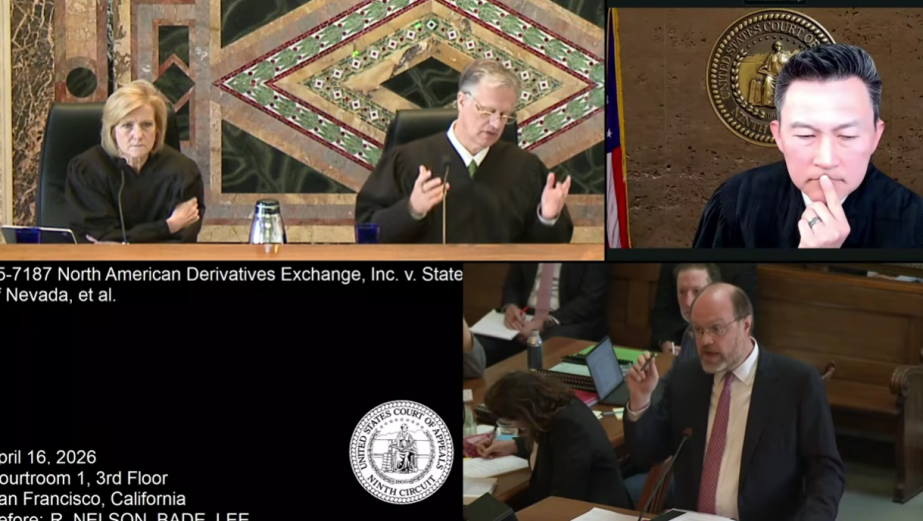
The fact that virtually all contracts are self-certified was a major sticking point for judge Ryan D. Nelson during oral arguments in the U.S. Court of Appeals for the Ninth Circuit.
The legal argument about prediction markets has dealt mostly with whether the federal Commodity Exchange Act preempts state gambling laws and therefore allows event contracts on sports outcomes to be listed. Prediction markets argue it does, while states argue it does not.
One topic that came up was the fact that CFTC rules include a “prohibition” on gaming. The prediction markets did not concede that this was an out-and-out prohibition, or that it applied to sports contracts, but they also said that even if it was, it wouldn’t change the terms of the preemption debate because it is simply a matter for the CFTC.
This is where Nelson invoked self-certification. In his view, the prediction markets couldn’t argue that failing to be in compliance with a CFTC rule was a minor detail to be settled between the CFTC and the exchange, because in theory, they could self-certify anything.
“That can’t be a serious argument,” he said to Robinhood’s lawyer. “It’s self-certification. You can put up anything you want.”
What the Strait of Hormuz market suggests is a version of the same problem: The rules were written to catch what exchanges file but not what they never directly certify.