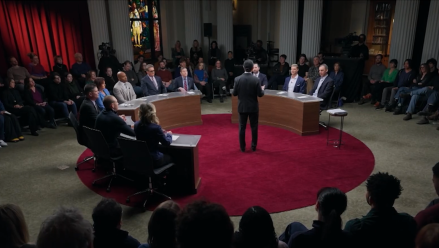

About halfway through the fast-moving first episode of Peacock’s original The Fall and Rise of Reggie Dinkins, the titular lead character, played by Tracy Morgan, crystallizes what often confounds the public at large about the constant drip of sports betting scandals.
Arguing with Arthur Tobin (Daniel Radcliffe), a documentarian he’s hired to rehabilitate his image after being banished from the NFL over sports betting, Dinkins attempts to rationalize his life-altering transgression.
“I only bet on myself and I only bet to win,” he asserted. “That was more motivation to play good. It’s sort of how a waitress works for tips.”
The line, aside from being amusing in what has been an entertaining and well-received first two episodes, likely prompted scores of viewers to thrust their hands toward their televisions, symbolically gesturing, if not actually exclaiming, “See!”
Morgan’s explanation, if not a plea for exoneration, works well for those who pardon Pete Rose for flouting one of the rules MLB really cares about and affixes a warning on a wall in every clubhouse about: betting on baseball.
While Pete Rose is now eligible for election into the National Baseball Hall of Fame after his lifetime ban ended with his death in September 2024, it remains to be seen how Dinkins’ redemption tale unfolds in the remaining episodes of season one.
Scandal mainstream enough for TV plot
Equally fascinating is how not only legal sports betting, but gambling corruption scandals, have arrived as an everyday part of the American sports and entertainment experience since the muting of the Professional and Amateur Sports Protection Act [PASPA] in 2018. The Bookie on Max fizzled, but Dinkins shows promise.
Brian Petrotta, an assistant professor of sports media and communications at the University of Nebraska-Lincoln who teaches a sports betting-related course, was surprised that a gambling scandal could serve as the conceit for a mainstream comedy.
“During the Super Bowl, maybe, I saw the first commercials and I was thinking, ‘You’ve got to be kidding me. We actually have an entire sitcom around this,’” Petrotta told InGame. “The Simpsons had an episode a couple of years ago where Homer develops a gambling addiction, and there was the Last Week Tonight episode, and some one-offs.
“But to see an entire narrative of a show centered around a disgraced athlete, specifically because of sports betting, I think shows us so much about how prevalent sports betting is in the way we consume sports now.”
Dinkins is portrayed as sympathetic, albeit flawed, and written and improvised similarly to Morgan’s character on 30 Rock — with good reason. But his penchant for awful mistakes might inadvertently highlight the level of horrible decision-making some pro athletes have made since PASPA fell. Not so much being in a life situation that pressed them to participate in sports corruption — that certainly wasn’t the case here — but being woefully uninformed and immature.
“The redemption story is an interesting angle. Typically, we don’t view disgraced athletes that way,” Petrotta said. “Pete Rose certainly didn’t make it easy on himself to be seen as a sympathetic character at any point, nor really [former NBA referee] Tim Donaghy, if you ask most people. Tracy Morgan always kind of plays a lovable goofball, and that’s not typically what we think of with a sports bettor that conspired to fix games or get caught. So it’s an interesting premise.”
And without applying too much pressure on a comedy series, it might even elicit a debate similar to the one Tobin envisioned for the Dinkins mockery on “our national gambling addiction.”
“I do think it speaks to kind of a bigger attitude, particularly amongst certain fans. Clearly, some who don’t bet are really upset with the way that this is going with sports betting,” Petrotta said. “But I think for those that are into it, maybe part of it, too, is that the most recent scandals haven’t been the ‘capital S’ scandal.”
As in throwing games. Dinkins wisely doesn’t force the audience to extend its sympathy that far, Petrotta said.
“We’re used to seeing sports betting, we’re seeing these athletes get caught, but it’s generally around prop bets, their own performance, Calvin Ridley betting a parlay, where it doesn’t feel like the outcome of the game necessarily has been challenged,” he said. “So I think it’s made it a little more palatable than it would have if we had had one of those Black Sox-type scandals. I don’t think we would have had this program have this character portrayed in this way.”
Betting scandals as entertainment?
Americans in 41 United States jurisdictions can bet legally now, where it was just one, Nevada, a mere eight years ago. And the matrix of regulators and sportsbooks attempting to harvest each dollar has become increasingly successful in rooting out corruption scandals in the NBA, NFL, NHL, MLB, and college sports.
The NFL, which allows players to bet on sports except for league games, has been fortunate not to suffer a major scandal. While multiple players in 2023 were punished for gambling on team property or using insider information as part of sports bets, none have been accused of manipulating the outcomes of games. Then again, neither did Dinkins, at least not in a bad way, he contends.
While most of the gambling-corruption rings uncovered in recent years have been foiled by integrity monitors or sportsbooks, the fictional Dinkins outed himself, admitting, “I bet on every game,” after mistakenly switching the phone numbers for his bookie and a live-television interview. A two-time MVP with the Packers, he’d just returned to lead his hometown New York Jets to the Super Bowl in 2005 before ruining it all.
Dropped by his soup sponsorship and banished for life, he became a pariah after his Jets went on to lose, 61-2, to Seattle in the Super Bowl.
Even two decades later, Tobin is refused the right to use Dinkins’ highlights in his documentary, because the NFL considers him “a stain on the shield,” a reference to the league logo.
Dinkins’ ex-wife and manager, played by Erika Alexander, begins the reclamation process by professing, “I always bet on Reggie Dinkins.”
“Just like I did. Illegally,” he responds, coyly, still oblivious to much of his undoing.
Alexander neatly wraps Episode 1 with another proclamation, saying, “Reggie messed up, but he deserves a second chance.”
Petrotta’s students seem inclined to offer it. The vast majority of them admit to betting on sports, either via daily fantasy, sweeps sites, or prediction markets, as sports betting is available only at casinos in Nebraska and most of them are not old enough to bet at those. Scandal is just a thing that happens, in their view.
“I’m teaching this class for the third time, and the insider-trading aspect of sports betting doesn’t seem to bother this generation at all,” Petrotta said. “It seems to be more ‘funny ha-ha’ at this point than something that they should be concerned about. It seems to be, ‘I’m getting my entertainment.’
“We haven’t really talked about Jontay Porter as much, but I suspect once we get to that, OK, maybe it will be, ‘He shouldn’t have done that.’ But for the most part, the impression I get is that they see most of these so-called scandals as nothing burgers.”