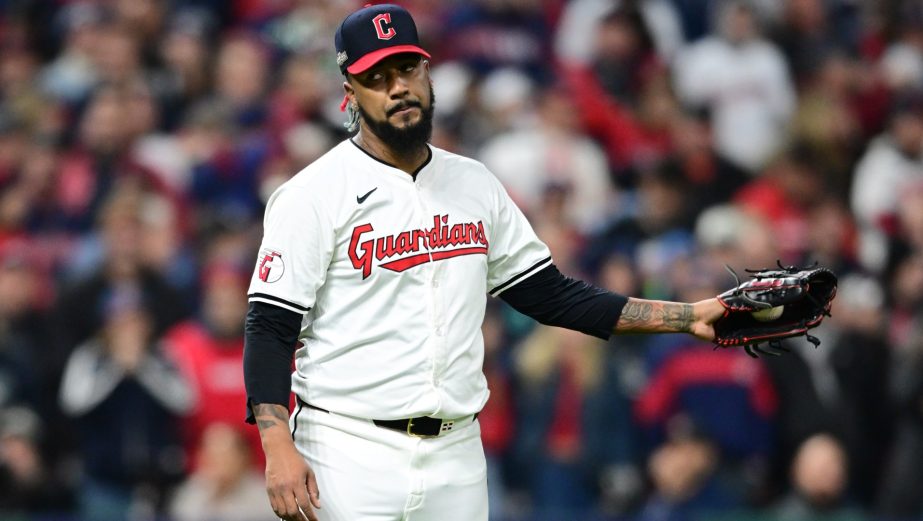
If Polymarket had last week posted a sports event contract on whether Cleveland Guardians pitchers Emmanuel Clase or Luis Ortiz will pitch in Major League Baseball this season, few would have been shocked. Many would have bought the “No” and kept scrolling.
That would have been a fairly tame market, anyway, considering some of the outlandish bettable things — world leaders being ousted, Jesus presenting himself — sites like Polymarket and Kalshi have offered since their ascendancy.
But Polymarket is apparently out of the outlandish bet business now, at least when it comes to MLB, having become on March 19 the league’s official prediction market partner, with a mutually expressed desire to guarantee fans and bettors a fair game. The deal came against the backdrop of MLB’s own insider trading scandal — albeit through legal sportsbooks — as it awaits Clase and Ortiz standing trial on Nov. 2. The two are accused of working with gamblers and manipulating pitches.
With prediction markets recently absorbing state-level losses over the legality of sports event contracts, and the insider trading aspect of the business generating negative public and congressional attention, Polymarket stands to benefit from the legitimacy of MLB as an institution. And MLB, stigmatized by more betting scandals than any other American sports league, got another chance to brandish the word “integrity” before Opening Day.
And, also, there was the cash.
MLB’s bold move comes with questions
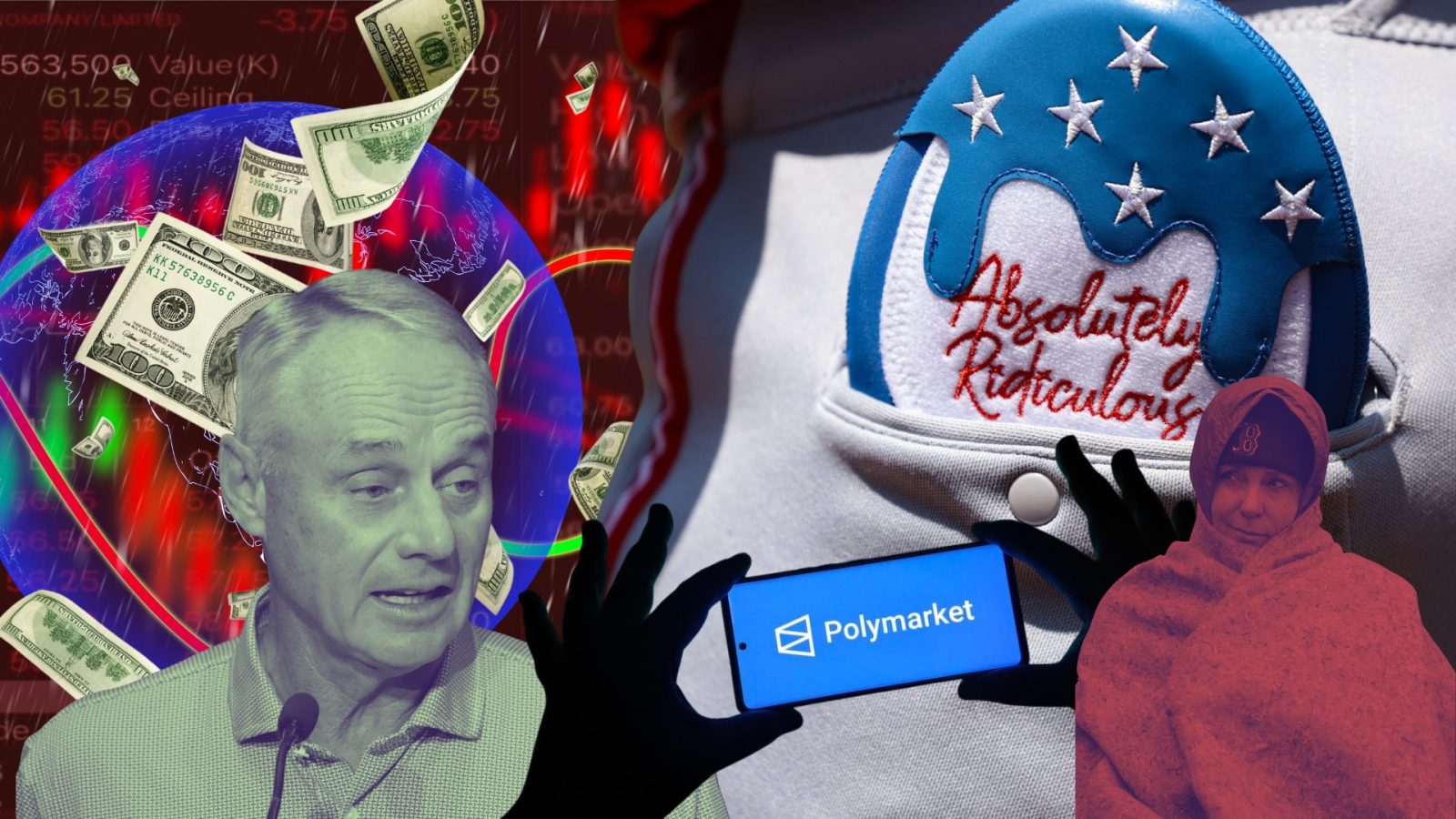
Two years after claiming that MLB was “dragged” into legal sports betting by Supreme Court case that made it a state-by-state possibility in 2018, Commissioner Rob Manfred birthed a deal that Front Office Sports reported as a three-year partnership worth upward of $300 million. MLB receives a major cash infusion. Polymarket’s nascent U.S.-facing site gains the right to league branding marks. Together they attempt to project a unified aura of thrustworthiness for fans and bettors.
This will be crucial for league that was raked by the 1919 Chicago White Sox and Pete Rose betting scandals and incurred more minor ones since it began taking on official gaming partners within months of the Professional and Amateur Sports Protection Act (PASPA) being nullified in 2018.
There does appear to be a cautiousness to the deal with Polymarket.
Sportico reported that Polymarket’s global site is not involved in the partnership, which figures to lessen impact, and MLB, according to ESPN, negotiated the right to exit if sports events contracts are eventually deemed illegal in the United States. Some observers wonder why the league would drift into potential foul territory with state-level politicians and gambling authorities before a resolution.
Irwin Kishner, a partner and a co-chair of the Herrick law firm’s Sports Law Group, told InGame that the escape clause “sort of jumps off the page a little bit.”
“That is somewhat of a suspect clause in the sense of, ‘Well, let’s do this, but if somebody says you’re not allowed to do it, it all gets unwound,’” said Kishner, who has represented numerous professional leagues and teams in partnership and sponsorship deals but was not involved in this one. “Even whether you say it or not, you can’t profit from a crime. It’s sort of like common law principles.”
Kevin Mercuri, the CEO of Propheta Communications, whose clients include several in the gambling sector, said that including the exit clause is unlikely to instill confidence in fans already concerned about other issues like insider trading and sports corruption. Mercuri’s company was not involved in the MLB-Polymarket deal.
“This is estimated at a $300 million partnership … but only if the court deems it legal,” he told InGame. “MLB placed the cart before the horse on this deal.”
The NHL announced Kalshi and Polymarket as prediction market partners in October. Terms of the deals were not announced, including if they include exit clauses.
MLB playing ball while the sun shines
Even with states recently winning a series of court victories against Polymarket competitor Kalshi, the legality of sports event contracts may not be determined for years, and according to numerous observers, likely by the Supreme Court. So in the interim, Kishner said, the MLB-Polymarket union is a case of a league exploiting a rare new revenue source while attempting to balance social mores.
“I think everybody’s approaching this with a very heightened awareness and doesn’t want to get out in a bad PR stance,” he said. “Sponsorships are a major part of running a sports organization. And for a long time, gambling was taboo. And for a long time, tobacco wasn’t taboo. Now it is taboo.
“Societal norms dictate how teams and leagues get out of the sponsorship or get forward with the sponsorship. And as that evolves over time, different revenue streams develop, i.e. the tobacco companies putting a big sign and calling it Marlboro Field, as opposed to Bank of America or AT&T or whatever it may be. I think for teams and leagues, it’s really what those societal norms dictate at that moment.”
For now, the general public in generally on board in regard to sports betting.
That said, online reaction to the announcement was definitely not on board.
Outside of prediction market partisans, the deal was largely pilloried by a unique coalition of fans still nurturing the fanciful notion of a non-gambling sports landscape, semi-informed hot-takers, and many who just couldn’t understand the risk MLB was willing to incur.
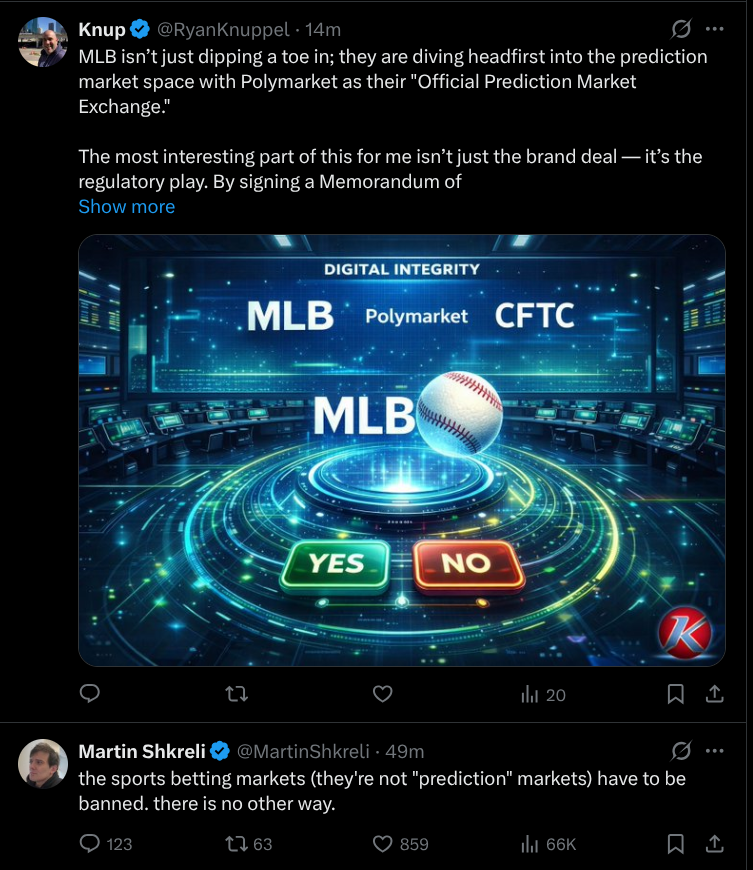
The deal even found the moral foul line for Martin “Pharma Bro” Shkreli, who served four years in prison for securities fraud.
Integrity in sportsbook, prediction market realm
MLB touted the deal as a sports integrity firewall for a league that is arguably more tarnished by gambling scandals than any other in American sports. The Commodity Futures Trading Commission (CFTC) announced, also on March 19, a new information-sharing agreement with MLB, its first with a professional sports league. The memorandum of understanding is meant to buttress the league and prediction markets from potential problems, with the help of MLB official global data provider Sportradar, and more quickly identify problems. Clase’s alleged pitch-rigging occurred over parts of the 2023-25 seasons before he was indicted.
As part of the deal, Sportradar will begin supplying data to Polymarket to resolve markets and, ostensibly, help root out further corruption. That same data is supplied to sportsbooks.
Kishner speculated that MLB likely was motivated by the appearance of proactivity. And by of the stigma from previous scandals.
“Given some of the things that had transpired with baseball last year, MLB wanted to sort of get ahead of those kinds of issues,” he said. “So I would imagine there’s a major integrity portion of this and you’ve seen MLB also interact with the CFTC on this. Wagering is part of the current landscape in sports. And having, if you will, appropriate revenue share that also has the appropriate part of the revenues going toward the integrity of the contest makes sense.”
Mercuri said the timing still wasn’t right for MLB, given prediction markets’ newness to this level of integrity need. Prediction markets have routinely settled sports contracts with results from online scoreboards because they lack official league data deals.
“The fact that Polymarket has had to partner with Palantir and TWG AI to deploy almost military-grade AI to detect illegal betting illustrates the enormity of the challenge,” he said.
MLB — and therefore the NHL — may have to “suffer through several betting crises until the prediction market gets a rein on this matter,” he said.
Sen. Murphy skeptical about MLB’s motives
MLB and Polymarket will reportedly work together to eliminate markets deemed more susceptible to manipulation. U.S. Sen. Chris Murphy wondered on the Pablo Torre Finds Out podcast on Thursday if commissioners like the NHL’s Gary Bettman and Manfred — who he said are “just in this for the cash grab” — will have the influence they envision.
“These are very powerful people. And so they probably do have a bit of a God complex,” Murphy opined on the commissioners. “They think that if they can get Polymarket or Kalshi in the room, they can convince them to ban bets on things that might be rigged. I think they’re naive. I think these are companies that are more powerful and more capitalized than the leagues themselves.
“And they’re going to offer whatever bets make them money. And it’s ultimately just going to lead to more corruption opportunities inside these leagues, not less.”
A day after the Polymarket announcement, MLB and the MLB Players Association announced that Clase and Ortiz would remain on administrative leave — this season unpaid — as they await trial for multiple federal counts involving sports corruption. They collected their salaries last year. The switch brings clarity to Clase’s persistent requests for a May 4 trial, until multiple maneuvers — including Ortiz asking to be tried separately — made that an impossibility.
Polymarket says it will eliminate risks
Prediction markets have slowly begun to address insider trading incidents that call into question the integrity of the platforms. MLB’s current sports betting scandal centers on an ultimate form of it: pitchers colluding with gamblers on when and how they would manipulate certain pitches for the purpose of winning in-game prop bets.
Polymarket Sports Business President Ari Borod told The Athletic his company and MLB are determined to protect each others’ interests.
“We will work collaboratively with MLB to identify what types of markets pose unreasonable integrity risks for the game of baseball, and try to get those out of the market, with the goal being, how do you protect customers?” he said. “How do you protect the game of baseball? And how do you protect the prediction market category broadly?”
Sportsbooks agreed to limit microbets to $200 after the Guardians’ indictments. It’s unclear what MLB will ask Polymarket to remove from its markets, but Borod told The Athletic that “props that are easily susceptible to manipulation, or that, again, raise unreasonable integrity concerns.”
He added that “we want to keep those out of the game as well.”
Predicting future of prediction market deals
Kishner believes that it’s “inevitable” that the NBA and NFL eventually take on prediction market partners. MLB’s timing and emphasis on data and integrity concerns, he said, also made sense.
And gambling, he said, isn’t going away. So why not capitalize?
“I think those are some of the competing forces at play here,” he said, “just simply being able to extract value for what’s going to inevitably be the case anyway, which is wagering on professional sports.”