I already lived through prediction markets more than a decade ago.
Okay, that’s not true, but I lived through the rise of daily fantasy sports (DFS). And on a lot of days, it feels like déjà vu.
To wit:
Not everything about the prediction markets industry is an exact match for what happened in DFS. But there sure are a lot of similarities. Below are some observations I have from living through both story arcs.
The duopoly
Before Kalshi and Polymarket, there were DraftKings and FanDuel.
I know it’s hard to believe a time existed when FanDuel and DraftKings weren’t online gambling behemoths, but around 2015, they were just … daily fantasy sports platforms. And while there were upstarts everywhere you looked, those two dominated the category. Everything else approached a rounding error.
Sound familiar? Now, Kalshi and Polymarket dominate their category, and everyone else is a rounding error. Will that persist? Time will tell. If the story ends the same as DFS, then Kalshi and Polymarket become the end bosses and household names. But there’s some chance for disruption here, especially as Robinhood is launching its own native prediction market that may not depend on Kalshi anymore.
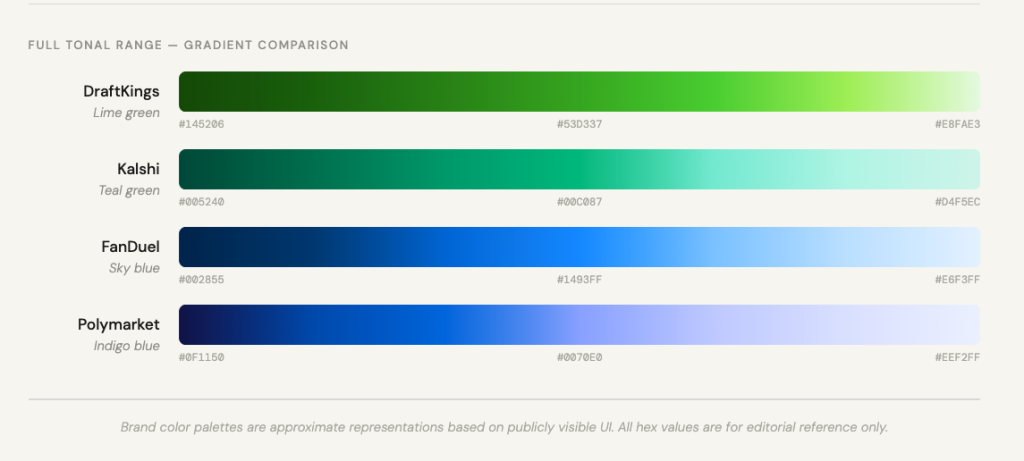
The similarities even exist for their color schemes: green and blue! Clearly we’re living in a simulation and/or the scriptwriters are getting lazy.
Regulatory, legal pushback
The DFS industry was flying high in 2013 through 2014. Until states started saying that DFS sounds a whole lot like gambling.
Starting in 2015, states were waking up to the existence of DFS, as billions of dollars flowed through contests at FanDuel and DraftKings.
The biggest moment was when New York’s attorney general sent cease-and-desist letters to the DFS operators in late 2015. Cease-and-desist letters, you say? I feel like prediction markets have gotten a few of those.
What resulted in the DFS era was an unprecedented lobbying effort that ended up legalizing DFS in a variety of states — including New York. That effort saved the category.
The difference here is that prediction markets are not really listening to or working with the states. They are just fighting them.
As of today, there are roughly 70 distinct docketed legal actions involving sports event contracts offered by prediction markets, most notably Kalshi, a number that has grown from a handful of cease-and-desist responses in early 2025 into one of the most sprawling regulatory litigation landscapes in American history. The cases span every level of the federal judiciary, more than a dozen state court systems, and now include the federal government itself (via the Commodity Futures Trading Commission) as an active plaintiff.
At this point, it’s an all-or-nothing endeavor on a crash course with the U.S. Supreme Court — either federal law allows prediction markets to do what they want by preempting state law, or it doesn’t.
Skill, or it’s ‘not gambling’
DFS is absolutely not gambling. Nor are prediction markets.
I tried to write all of that with a straight face. I wrote that DFS is gambling back in 2015, although there’s clearly skill involved in both DFS and prediction markets.
The question for both has been if it’s legal gambling, not whether the vast majority of users in both DFS and PMs are using the platforms to gamble.
Can you beat both DFS and prediction markets with skill? Yes! Are you likely to? No! The skill element mattered far more for DFS than it does for prediction markets. The legal basis for DFS is a combination of the Unlawful Internet Gambling Enforcement Act and state laws that deal with games of skill. DFS platforms argued those state laws covered them.
Skill doesn’t really matter in prediction markets other than for optics and framing. The CFTC says they are swaps. End of story. But people will say that skill matters in investing/trading/prediction markets and that’s part of why skill matters.
A quick side note: DFS has evolved well beyond the model FanDuel and DraftKings established. PrizePicks, Underdog, and others offer parlays based on player performances, which are legal in a large cohort of states now (or at least not clearly illegal). It’s certainly gambling, but the gambling may very well be legal! That’s pretty much the story of what is happening at prediction markets today.
Self-regulation
Prediction markets are regulated by the CFTC. But also, there is a lot of stuff the CFTC can’t or won’t do as a regulator. And we are seeing Kalshi and some of its competitors taking actions that are self-regulatory in nature.
In March 2026, Kalshi announced it would preemptively block athletes, coaches, and officials from betting on their own sports, and block political candidates from trading on their own campaigns. Then in April, Kalshi became the first active partner of a new initiative called SelfExclude, run by IC360, where users put themselves on a list spanning multiple leading exchange-betting apps. After a person joins the list, they cannot trade/bet anywhere partnered with SelfExclude.
And look at Kalshi’s latest work on young adults and underage people using prediction markets here. There are no rules or laws saying it has to do any of this. But it’s doing it because it’s a best practice and helps with optics.
Guess what DFS tried to do back in the day: You guessed it, self-regulate! From the Associated Press at the time:
The Fantasy Sports Trade Association announced Tuesday it would form the Fantasy Sports Control Agency led by former acting U.S. Labor Secretary Seth D. Harris.
The attempt to self-regulate comes as legal scrutiny of the daily fantasy sports industry led by DraftKings and FanDuel grows and questions are raised about consumer protections including what information employees have access to and when. Until recently, employees at one site were able to play on other sites.
Paul Charchian, president of the association that was started in 1998 and now represents about 300 companies, wrote in a separate email to the group’s membership that for those sites offering paid fantasy contests, “the necessity for some form of regulation is upon us.”
Casinos don’t like it
The American Gaming Association has made it clear it’s very much against prediction markets. The trade group is made up mostly of land-based casino interests, which see prediction markets as infringing upon state-regulated sports betting and gambling generally.
A decade ago, casinos saw disruption from DFS and didn’t like it. Here is former MGM Resorts CEO Jim Murren in 2015:
“But who in the world thinks that FanDuel or DraftKings — who’s going to tell me that’s not gambling? Of course it’s gambling. But people are doing it, they are doing it all over the place. It’s not regulated.”
Now, here’s this from BetMGM CEO Adam Greenblatt during the company’s Q1 2026 update on April 14:
“They call themselves prediction markets, and they are buying sports betting keywords as well as throwing money at any sports media property that will take it. They are targeting sports bettors directly in their marketing, thereby bidding up the cost of acquiring new OSB players and extending payback periods. Some of these companies even have ‘sportsbook mode’ in their product in an attempt to offer as close an experience as possible to sports betting.“
Gambling regulation has historically fallen under the purview of states via their “police powers” under the Tenth Amendment, allowing states to enforce order for public health, safety, and welfare of the citizens. Casinos pay lots of taxes and licensing fees and deal with dozens of state regulators for the privilege of offering gambling in a state. So when they see companies circumventing state regulatory bodies and scrutiny with a product that looks like gambling, the reaction should not shock anyone.
Going mainstream comes with criticism
FanDuel and DraftKings were still niche products until 2015. Then this happened:
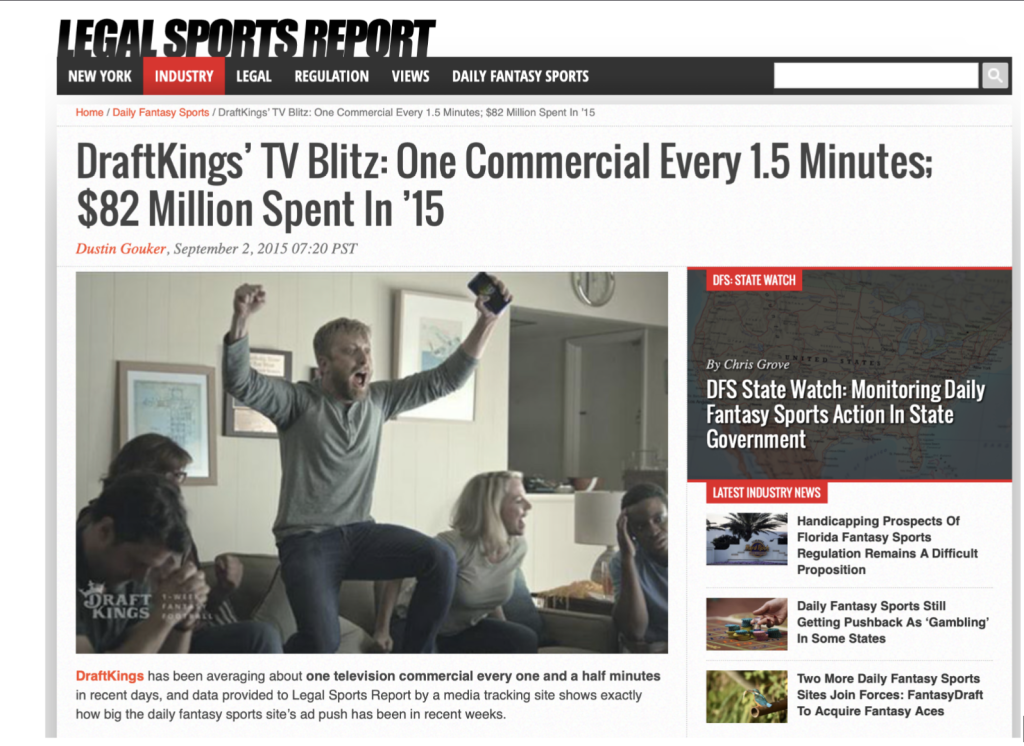
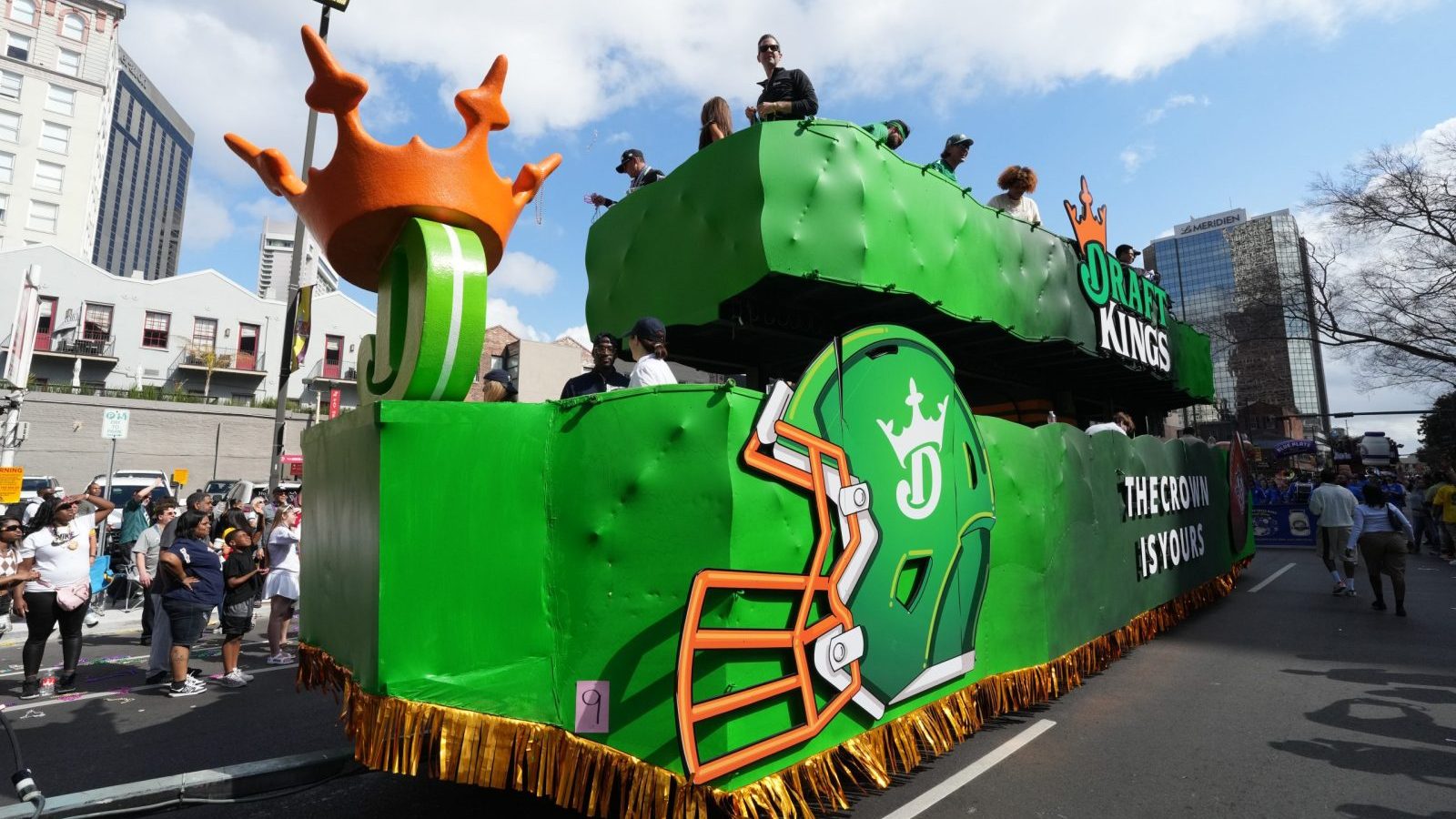
If you watched the NFL or football content that season, FanDuel and DraftKings felt ubiquitous. DFS was suddenly a huge part of sports culture.
That ubiquity came with a price, however. The New York attorney general saw the ads and took action. There were op-eds decrying a new form of gambling (sorry, not sorry). Pushback came in all sorts of forms.
Kalshi and Polymarket are dealing with the same thing over the past year. A niche industry became big quickly, and it’s invading our lives. And some people don’t like it. But this time it’s not just sports. It’s election coverage, it’s partnerships with media outlets, it’s on social media.
This time around, it feels the larger narrative in the mainstream is that there’s too much gambling in the world. Sportsbooks were facing constant pushback even before the rise of prediction markets. And into that world comes Kalshi telling us that not only can you bet on sports, but also all these other things. And that the grand plan is to let you trade/bet on everything. Financialize everything.
Today, there are so many questions. Will sports event contracts go away? Will Kalshi and Polymarket become bigger than the stock market, as evangelists have theorized? I am not sure.
What I do know is that the rise of prediction markets is eerily similar to the rise of DFS. We’ll see if the story ends the same way.
Dustin Gouker has been an executive, analyst, writer, and editor in the gambling industry for more than a decade after a career in newspaper journalism. He currently runs a gambling and content consultancy and publishes two daily newsletters: The Closing Line on the gambling industry and The Event Horizon on prediction markets.