
At 25, Isaac Rose-Berman is already learning what being the stodgy old man in the room is like. These kids and their prediction markets and their sports opinions and their get-rich-right-now schemes somebody on social media gave them, for whatever reason, for “free.” They’re a tough crowd to influence. At least in person.
When Rose-Berman, a professional sports bettor, lecturer, and fellow at the American Institute of Men and Boys, enters a classroom to discuss the potential perils of underage sports betting, particularly on prediction markets like Kalshi or Polymarket, he goes in with real-world experience gained not that long ago.
But with social media influencers, some roughly the same age or younger than these students and decidedly more internet famous, peddling decidedly more exciting, edgy, and lucrative advice all day and night on their phones, Rose-Berman sees firsthand a growing potential for harm. He also sees the divide between aspiration and reality, thanks to this messaging.
“I spend so much time when I go to high schools … it’s literally just me rebutting all of the misconceptions that people have about gambling,” Rose-Berman told InGame. “Many of them are because they have seen misleading marketing, whether it’s from sportsbooks or prediction markets, about how easy it is to win or how they can convert their knowledge or beliefs about sports into easy profit.
“And I’m like, ‘No. That is not how it works.’ But that is what the marketing wants you to believe.”
This broad but decentralized campaign has an approach for every niche of the coveted 18-to-25-year-old demographic, from those just leaving high school, to college-aged students, to young professionals. The target audience is largely male, but recruitment of young females has become a major push recently.
“You take this impressionable demographic, they’re influenced by their peers at school and in sports,” observed Laura Smith, the legal director of TruthInAdvertising.org. “This is an impressionable group of people.
“And then you put it on steroids and you bring in influencers who are wildly popular among this age group, who have huge followings. So that makes them seem even more convincing and even cooler. If they tell you something’s cool, and you’re impressionable, and you like them, you tend to believe it.”
Influence, immaturity in the gambling age
Young gamblers, especially those not yet 21 and not legally able to wager at regulated sportsbooks in most states, are increasingly drawn to prediction markets, where the expanse of sports and often outlandish pop culture or cryptocurrency bets makes for a titillating taste of the action. The promotion of these sites, largely online, using celebrities or prediction market-specific personalities like Gaeten Dugas and Kalshigirls, plays into the sense of youthful recklessness, getting away with it, doing it first. Making some money in the process sets the hook. Some of these influencers offer condolences on losses, but they often follow with encouragement to begin anew.
While state-regulated sportsbook companies spend millions in traditional advertising trying to present themselves as an extension of the fan experience — even as many open their own prediction markets — Kalshi, notably, relies mostly on these influencers, some compensated, some hoping to be, to amplify their message.
Damage, studies attest, is being done. Anecdotal evidence abounds of the harm inexperienced bettors with scant financial knowledge are causing themselves. Stories of young people squandering hundreds if not thousands of dollars have been the must-have accessory of mainstream media in recent months, coinciding with state regulators pushing back against prediction markets that wield the Commodity Futures Trading Commission (CFTC) as their federal-level overseer and shield.
Meanwhile, the general public is becoming disenchanted with gambling scandals and mental health harm worries nearly eight years after the fall of the Professional and Amateur Sports Protection Act (PASPA). Antagonism toward gambling in general builds as prediction markets commodify wars, government overthrows, and alien first contact (Kalshi offered a market about whether the U.S. government would admit that aliens exist) in a seemingly unbridled expansion.
Kalshi’s executives, meanwhile, continue to propose that prediction markets are not technically a form of gambling, but part of the plan of CEO Tarek Mansour (below left) to “financialize everything.”
Young adults, Smith said, are not prepared to handle this.
“When prediction markets blur the line between investing and gambling, marketing them to young audiences risks normalizing that high frequency betting behavior before they can fully understand the consequences,” she said. “As a child and teenager develops, their cognitive ability to understand marketing changes over time.”
Kalshi executives told The Wall Street Journal that only about 2-3% of the site’s volume was attributable to users between the ages of 18 and 20. That, Rose-Berman said, misses the point. Kalshi reported $23.8 billion in trading volume in 2025, according to Sportico.
“That’s still a decent amount of money,” Rose-Berman said of the 2%-3% figure. “Actually, 2%-3% of volume is not going to be the same as 2%-3% of losses would be. And I’m very confident that the average 20-year-old Kalshi user is losing at a higher rate than the average user in general.
“I would bet that translates into more in the 5%-10% of total fee revenue that’s attributable to those users. … But the thing is, 18-to-20-year-olds don’t have a lot of money to lose.”
Prediction markets find minors where they live
A 2026 Sensor Tower report commissioned by the American Gaming Association trade group found that Kalshi has become the most visible sports betting brand by digital ad impressions, with 5.2 billion in 2025. FanDuel was the next closest with 2.9 billion in the same period. Most of the Kalshi ads lacked responsible gambling messaging.
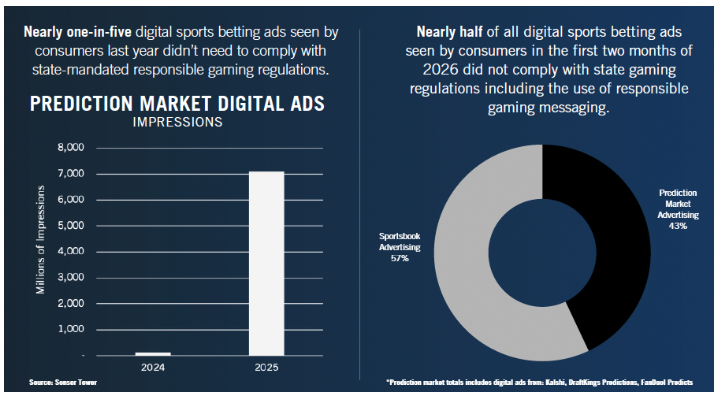
The cells of independent influencer/marketers complicates the policing of the content produced to promote prediction markets. Kalshi in August ended a relationship with InsiderWire, a branded and linked account that posted hate speech, but with in-house social media content often blurring boundaries of taste, influencers seem inspired to go even further as they mine for clicks they parlay into compensation through an affiliate model.
“It’s not just that you have Kalshi or Polymarket on social media, doing and posting egregious things, although to be clear, they are doing that,” Rose-Berman said. “But the sort of model that they have with affiliates and sponsorships, it means that they have a lot less control over what people are posting with, like a Kalshi or a Polymarket logo.
“You’re just really incentivizing outlandish content. And when you’re not the one who’s actually in control of it, then you’re going to have a lot of problems. … But that’s sort of the nature of the beast. They’re kind of at fault for engaging in this, because that’s the route that they’ve gone down.”
A Kalshi spokesperson described the relationship with InsiderWire as “a surface level advertising partnership, with no editorial aspect or control” after it was terminated.
Prediction market influencers can be paid either per social media post, according to their follower count, or by measured influence. Rose-Berman said he’s seen a per-post fee as low as $10 or as high as $1,000.
In 2024, Kalshi was found to have enlisted a group of influencers to defame Polymarket CEO Shayne Coplan after the FBI raided his residence, paying out thousands for derogatory posts. Among them was former NFL player Antonio Brown. This wasn’t marketing Kalshi’s product as much as dragging its expected top competitor in the United States, but the call to action was answered. With compensation.
Influencers, affiliates, wannabes abound
Some influencers are celebrities who post only occasionally, while others have more limited followings but become valuable megaphones due to their volume of posts.
Several, however, appear to brand themselves with Kalshi or Polymarket signage aspirationally, with one admitting that they have not been paid by either company, but sending in a direct message “if you want to reach out to them for me, that’d be cool.”
“I think the problem is that they’re just trying to become as well-known and popular as possible. And the way you do that is to quickly expand your media footprint,” Rose-Berman said of prediction markets. “And you do that by engaging all sorts of people and content creators and new strategies that are not going to be the most discerning.”
In September, Kalshi briefly heralded a campus recruitment drive for “ambassadors” to help it find its next 100 million users, but it removed the registration link without explanation. The concept of Kalshi U ran contrary to the spirit of laws in several states — such as Ohio — which strictly forbid gambling advertising near college campuses. Earlier sportsbook deals with university athletics departments — such as PointsBet with Colorado — generated such backlash they were rescinded, with some states eventually banning them.

No online prediction market spokespersons contacted by InGame agreed to be quoted for this article. Neither Kalshi nor Polymarket responded to interview requests.
Past litigation ominous for prediction markets?
Lance Oliver is admittedly no expert on prediction markets. But as winning co-counsel in both Berger v. Philip Morris USA, Inc. in 2014 and State of New Mexico v. Meta Platforms, Inc. in March, he is a keen observer of — and dismantler of — corporate entities endangering minors through their business practices.
In the case against Big Tobacco, Oliver and his team landed a $27 million settlement for a woman claiming her addiction began at 14, in part because of deceptive marketing. In the Meta case, a jury found that the platform’s design features “enabled pedophiles and predators to engage in child sexual exploitation,” according to the New Mexico Department of Justice.
There are commonalities with the arc of prediction market marketing and that of Big Tobacco, the vape industry, and Meta, Oliver said.
“I think the parallels come in the sense that any business understands that if they establish a customer at a younger age, between the ages of 12 and 18, or 13 and 18, during these formative years, that they have a much higher likelihood that the customer will develop either a brand loyalty in the sense of a shoe, like Nike, and that they’ll carry that brand loyalty throughout their life,” Oliver told InGame. “I think there’s marketing evidence that shows that young customers will be the most loyal customers.
“When you’re talking about Nike or Reebok, that’s not a problem, right? You can be loyal to Nike. It’s not a problem. When you’re talking about a product that has the potential to either be chemically or behaviorally addictive, psychiatrists don’t really draw much of a distinction now.”
The Meta verdict has already been invoked by attorneys suing DraftKings and FanDuel in Massachusetts.
Academic research asserts that roughly 5% of gamblers develop problem behavior, but that number spikes for those aged 18-to-35.
Availability appears to be a key factor. Calls to the Florida Council on Compulsive Gambling hotline increased 138% from 2023 — when legal, mobile sports betting launched — through 2025. The 18-to-25-year-old demographic comprised 41% of all volume to the hotline, up 10 percentage points in a two-year span.
A study commissioned by the Ohio Casino Control Commission reports that upward of 6% of college students develop gambling addiction.
Can prediction markets be held liable?
Key, said Alan Feldman, director of strategic initiatives at the UNLV International Gaming Institute, is how licensed operators and influencers, in essence a vendor, are regulated. Feldman, who spent 30 years in the gambling industry with MGM Resorts, likens the dynamic to the Nevada Gaming Control Board penalizing casinos for illicit activities in nightclubs whose management they’d outsourced.
“The regulator sent out numerous letters saying to every licensee, ‘Just because you are renting out space to a nightclub doesn’t mean you are not responsible for what goes on there,’” he said.
Feldman sees a similar model for regulating influencers working on behalf of gambling outfits, if they’re found to be targeting a demographic younger than laws allow.
“I think regulators do have to step in and say to those that they regulate: ‘You are responsible for what the people who are presenting your product are doing,’” he said.
Kalshi briefly utilized an influencer who was found to have been 15 years old.
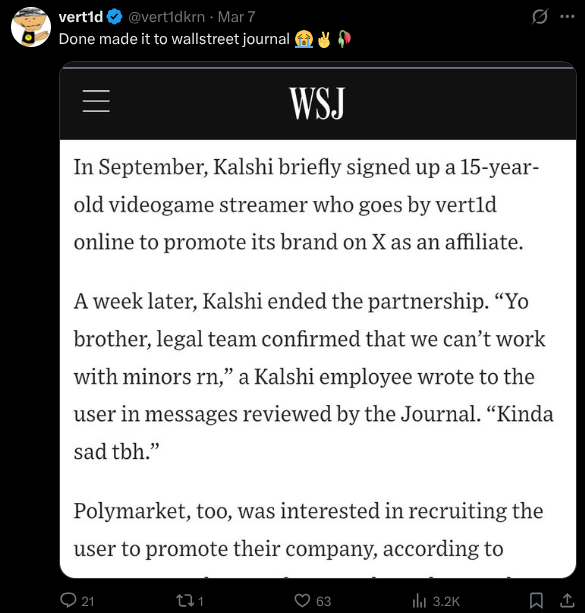
“How on earth anyone at Kalshi thought that was appropriate is beyond me,” Feldman observed. “But, Kalshi isn’t regulated like a gaming company. They’re regulated like a finance company. Who knows what the ethos is in that community?”
While state regulators have punished operators for various age-related malfeasances such as violating advertising laws or even allowing minors to bet through clandestine accounts, the CFTC has so far not acted. To the contrary, the federal government has sued Connecticut over its attempts to ban prediction markets — a ban attempted in part, state officials say, because they contend the prediction markets allow underage sports betting.
Being cool, first, addicted
Oliver sees direct comparisons between R.J. Reynolds’ Joe Camel and Philip Morris’ Marlboro Man and the army of prediction market influencers who will never appear on a billboard or on the back of a magazine. Even though many of the most prolific posters boast modest follower counts, they’re arguably even more powerful than print marketing because of their ability to interact.
Big Tobacco was famously found to have been harvesting the next generation of smokers as the current one died off. Prediction markets, Oliver said, beguile the young with the trappings of adulthood.
“A 15-year-old doesn’t want to be me, because I’m almost 50,” Oliver said. “They want to be that 25-year-old who’s got all the girls or boys or whatever, who’s got the cool car.
“There is a focus on the next level up. So for a 15-year-old, the next level up is to be 20, and have a car and have a girlfriend and be able to go to the football game on your own and have your own apartment and not be dealing with Mom and Dad. That is absolutely what they’re going for. But from a marketing perspective, these companies don’t want to just make you a customer at 20. They want you to be a lifelong customer.”
0008And as evidenced by a USA Today report detailing a spate of underage betting on legal sportsbooks in Arizona, this is not solely a prediction market predicament. As the father of a teenager, Oliver has heard anecdotally of minors accessing otherwise legal gambling sites. He said he “certainly would not be surprised that prediction market companies or gambling companies are targeting underage users.”
That’s not to say that apparel or tech brands can’t use the same exploitative tactics. They do. But there is a key differentiator with prediction markets, Oliver said.
“With a non-addictive product, I suppose that’s just the world we live in,” he said. “And it’s not great, but it’s not as dangerous. But when you’re talking about addictive products or addictive behavior that can have lifelong consequences for kids, that’s obviously when you get into really disturbing territory. In this case, it’s lifelong financial consequences.”
While there are comparisons to be made among Big Tobacco, the vape industry, and Meta — industries that pushed boundaries to mine young customers and prompted litigation — Feldman hedges on extending the comparison to prediction markets.
“The first most significant distinction is the prevalence of addiction with tobacco products,” he said. “When you use them as they are intended to be used, you will get addicted. With gambling, it’s far lower. Now, that said, with that [younger] demographic, it’s higher.”
Roadblocks to safeguarding youth
Oliver’s experience in social media harm cases has revealed a thicket of issues in preventing objectionable advertising from reaching minors. In some cases, prevention just didn’t work because of failings with design. Sometimes tools were intentionally not applied, as was found in the Meta case, because they could impede the company’s growth.
And kids have a way of finding what they want online.
“They have tools that will not serve a 15-year-old certain types of advertisements, like cigarettes or alcohol or gambling,” Oliver said. “The problem is, in order to make that tool work, they have to know what age you are.
“A lot of kids lie about their age when they get onto the platforms, and the companies understood that. And they didn’t do anything to prevent it.”
Rose-Berman said prediction markets’ social media marketing is definitely reaching children much younger than 18, as evidenced by his experiences inside schools. Prediction markets are using influencers as a firewall, he said.
“Especially when you’re talking about the internet and social media and TikTok,” he said, “so much of the audience is really young. If you’re not really careful with your marketing, it’s going to reach them and Kalshi will be like, ‘Oh, it’s not our intent.’ Like, ‘We don’t care. Whatever.’”
And young bettors don’t care about where they bet, as long as they’re able to, said gambling researcher Brian Petrotta, an assistant professor at the University of Nebraska’s mass communications program.
Petrotta told InGame his underclassmen students are “using prediction markets. They’re using Fliff. They’re really big into Underdog and PrizePicks. They don’t differentiate, really, between Underdog and DraftKings. To them, it’s sports betting.”
Only retail betting is currently legal in Nebraska.
Matthew Bakowicz, the director of the sports management program at American University’s Kogod School of Business, said it cannot be discounted that in 18-to-20-year-olds, prediction markets have a demographic to target that sportsbooks can’t legally touch in most of the 41 U.S. jurisdictions that have legalized sports betting. Just eight U.S. jurisdictions allow bettors as young as 18. So the easiest way for people that age to bet in most of the country without a VPN is on prediction markets.
“If there’s only one restaurant on the entire block, you know where you’re going to eat at. And that restaurant can charge whatever they want for their products,” Bakowicz said.
New mediums, new enforcement problems
Litigating against endorsers has become a popular legal tactic in recent class action lawsuits against sweepstakes casinos, but attempts to hold Ryan Seacrest (Chumba Casino), and Drake and Adin Ross (Stake.us) accountable have so far yielded nothing for plaintiffs claiming a celebrity enticed them into damaging gambling behavior.
To be sure, regulated sportsbooks employ celebrity endorsers too, with the NBA Collective Bargaining Agreement allowing LeBron James to shill for DraftKings’ sportsbook while an active player, as long as it doesn’t involve basketball content. But sportsbooks, supervised by state regulators of varying tenacity, have generally better conformed to age-related rules, according to analysts of the industry.
And even if they’re not always betting, Rose-Berman said, this young “digitally native” generation is likely spending more time on platforms obsessing over market fluctuations than previous generations.
“I have talked to many high schoolers who are using Kalshi prediction markets who are not losing large amounts of money, but it is not good for them and not healthy,” he said. “I don’t think it’s good for a 17-year-old or an 18-year-old to be obsessively checking Kalshi while watching every sporting event while all their friends are just enjoying the game.
“It’s just not healthy to be spending five hours a day on Kalshi.”
Traders, or chum for whales?
Prediction markets aren’t the pure, peer-to-peer landscape of trader utopia dreams. Rival companies use them to hedge. Bots rule the terrain.
Bakowicz said one of the most perilous aspects of younger adults dabbling in prediction markets is likely a basic misunderstanding of the concept, a trait they would share with much of the population.
Market orders, liquidity, implied probability — more complicated than a sportsbook, and likely confusing for those not familiar with traditional finance apps.
“Even if you are the most novice sports bettor in the world, there’s the moneyline,” Bakowicz said. “You bet the moneyline, your team wins, you win. You don’t need to tell them anything else.
“The explanation of a prediction market is insanely complicated. And when things are complicated, it leads to mistakes. Its ambiguity is a strength right now, these markets, because without a lot of people knowing what they are, nobody can step in and say, ‘Hey, hang on a second. We got to make some improvements.’ They can kind of do whatever they want. And that’s kind of the pattern we’ve seen. They pretty much do whatever they want.
“Nobody’s really told them no.”
This ambiguity makes prediction markets and apps — like Robinhood — that allow for low friction movement of bank funds into prediction market speculation particularly dangerous for young adults, Feldman said.
“In general, the prediction market is a very cloudy and unclear situation for the customer. I don’t know yet that customers understand how those work as opposed to sportsbooks,” he told InGame. “I don’t know that they understand, even, that they’re placing a wager.
“I don’t think the human brain can make a distinction between that which is legally considered gambling and that which is legally considered a financial wager or a financial prediction. And the fact that prediction markets, many of them, are able to even transact business with people who are under 21 is troubling.”
Expert: You’re no expert, not going to get rich
Rose-Berman said one of the more egregious aspects of prediction market advertising is the assertion by Kalshi’s Mansour and others that everyone possesses an expertise that can be monetized on platforms like his.
“I bet on sports professionally,” Rose-Berman said. “I do a lot of market making. I can tell in basically five to 10 seconds if someone knows what they’re talking about. I can tell in five seconds that they’re just lying. I’m not saying it’s impossible that the person bet on a team and they won. Obviously, anybody can get lucky early on.
“But the idea that it is going to be a sustainable way to profit is just so, so not true, and so dangerous to promote. Because, obviously, if someone thinks that they are a profitable trader, or have an edge gambling, they’re going to be far more likely to exhibit problematic, dangerous behavior that’s going to be devastating for their financial bottom line in the long run.”
The go-fast, break-things ethos that creates and bankrupts tech entrepreneurs and inspired young males to help re-elect Donald Trump as president in 2024 seems to mesh well with both the gonzo marketing methods and edgy offerings of prediction markets. There is the feeling that Mansour and Coplan would have literally fought over Tyler Durden.
Quickly monetizing cool makes capturing the imagination of this group even easier, Bakowicz said.
“Kids in that demographic between 18 to 25 love being first and they love knowing about the latest and newest trends and getting on the bandwagon of who this person is early on,” Bakowicz said. “The prediction markets are exactly like that. They’re doing something nobody else is. It’s a bit of a brag to say, ‘Yeah, I’m involved in the prediction markets. I made all this money doing this.’”
Breaking: Kids don’t always think it through
Young adults were making impulsive decisions and life-lesson mistakes long before prediction markets and sports betting apps allowed them to literally pay for them. But the ready access to these platforms, and so-called “everything apps” that allow for low-friction movement of money between them and financial assets, have heightened the peril for the current generation.
That said, the law affords some grace, Oliver explained.
He noted that the same “eggshell plaintiff rule” applied in the Meta case would prevent a theoretical prediction market plaintiff from arguing that they weren’t responsible for the immaturity of young customers. The long-established legal principle says that a party can still be held liable even if a pre-existing condition exacerbated the damage they caused.
“Anything that carries a risk of addiction or addictive behavior, [companies] cannot use as an excuse the idea that teenagers take risky decisions,” Oliver explained. “You cannot present them, you should not present to them the opportunity. … You don’t make that vulnerability worse. … I think it’s incumbent upon companies operating in these markets to understand that in a way, they may be operating an attractive nuisance.
“They may be operating a swimming pool without a lifeguard. They know it’s going to attract kids, therefore they need to take precautions to make sure above all costs that somebody is not, some teenager is not harming themselves or irreparably making a decision that they can’t get out of very easily when they would never make that decision as an adult.”
Bakowicz said not enough time has passed since the rise of sports events contracts to truly judge broad societal impact for this demographic, acknowledging ubiquitous and heartbreaking stories of financial ruin and addiction that have become mainstream fodder.
“We’re seeing an increase in individuals with problem gaming and addictive behaviors. While that’s 100% true, what’s not being discussed or researched is it needs to be compartmentalized,” he observed. “There is expansion [of gambling].
“Are we seeing an increase that is higher than normal trends prior to the expansion? Yes, you had addictive gambling behaviors when we had gambling in the past. You now have 41 [jurisdictions] that are involved in this. Is the trend staying the same in terms of now that we have 3 million people gambling we still see the same percentage, or is it an increase that’s a higher percentage? That question needs to be answered to really determine where that goes.”
Academia studying influencers’ impact
Research on the impact of prediction markets’ social media influencers is largely anecdotal. While the pitching of wares happens right out in the open on X, Instagram, and TikTok, academia is just now attempting to ascertain if the intended audience is buying or just watching.
The topic has become of particular interest to Feldman. Learning more, he told InGame, is crucial for operators crafting business strategies and regulators as they define risky and perhaps illegal practices.
Influencers aren’t necessarily a new phenomenon, he noted. Those offering enrichment advice are just an evolution of touts selling picks, he said. They’re really not that much different than CNBC’s Jim Cramer, who turned lampoonish investment advice that cost some dearly into a career.
But this new age, Feldman explained, is more complicated, because the quick-hit nature of social media leaves the consumer to decide for themselves the shill’s motives and expertise. There is no paper trail or television network to hold responsible.
“Does the customer today have an understanding of what kind of influencer they’re dealing with? Is this someone who’s making a prediction based on study and analysis?” he pondered. “Is it someone making a prediction based on the number of clicks they think the prediction will get them? Is it someone making a prediction based on sponsorship? How much of that is disclosed?”
Feldman said the proliferation of influencers is likely far “deeper” than even a few minutes of rabbit-hole diving on social media suggests.
“These people have very significant numbers of followers. It’s a cottage industry and no one’s paying any attention,” he said.
Groomed to gamble: Kids ready to bet
Prediction markets’ incursion into the social media lives of children is a concern on multiple levels for Smith. At TruthInAdvertising.org, she’s increasingly focused on how these platforms promote themselves to all age groups. And as mother of an 11-year-old, she was aghast when she learned that both Polymarket and Kalshi were offering markets centered around YouTube megastar MrBeast.
These platforms’ appeal to youth is multi-faceted, she said, from MrBeast mention markets to young adults attempting to solve their financial woes. She noted a TikTok ad in which a young woman confesses to her friends that she’d been able to make rent because of a successful trade on Kalshi.
The ad helps point out prediction market promotions’ ethical problems, Smith said.
“It frames prediction markets as a solution to everyday financial stress, and the peer group social setting, and the aspirational payoff,” she said. “There are potentially several deceptive marketing issues going on here, including blurring the line between investing and gambling.
“[Another] is advertising activities that are for adults only in a way that makes them seem appropriate for teens and kids. For example, using topics or influencers that are appealing to them.
“And [one more] is presenting these activities as ways to make money quickly without disclosing the related risks involved or the likelihood of making money.”
For a generation that has been exposed to gambling and arguably conditioned to gamble through games like Roblox, Candy Crush, or others utilizing loot boxes for enhanced play, prediction markets found primed customers by “turning betting on real-world events into this participatory gamified extension of online youth culture,” Smith said.
Rose-Berman said the combination of being prepared, unwittingly, to become gamblers and a prevailing grim outlook on their futures has made the 18-to-20 generation ripe for prediction markets.
“There’s this sociocultural phenomenon of the younger generation, this sort of sense of financial nihilism where it’s like, ‘I’m never going to be able to get ahead. The economy is bad. I’m never going to be able to buy a house. I might as well gamble and try to hit it rich,’” he explained. “And you see that with sports betting, you see that with crypto, with meme stocks. And so I think it’s the combination of the sociocultural environment that they’re in, then also the actual sort of gambling mechanics that have been integrated into all areas of their life, that make them more primed to gamble.”
If a product is legally or socially considered adult-oriented, it should be clearly advertised that way, Smith said. Prediction markets are failing — intentionally or not — in this regard, she said.
“When you are marketing to someone, whether it’s a child or a teen or an adult, the marketer needs to make that distinction in the marketing clear and conspicuous to its audience,” she said. “So if the audience is a kid, you need to make it in such a way that the kid’s going to understand it.
“Same thing with teens and adults. So there is this blurring of lines between marketing and entertainment, and in the case of these prediction markets, also blurring the line between betting and gambling and entertainment.”
And the prediction markets are putting themselves in legal jeopardy, Smith believes, by presenting themselves, in essence, as a fast and reliable way to pay the rent.
“In addition to this influencer marketing, if these platforms are being presented as a way to get rich quick, there’s a whole different issue legally, which is, you can’t make income claims to consumers,” she said. “If you’re going to make an income claim to consumers, you should be only marketing typical results. And that’s required by the [Federal Trade Commission]. So if you’re marketing atypical results, you are required to clearly and conspicuously disclose what it is. You should be disclosing the risks. This is not a sure-bet income stream. It is betting. And they’re required to make that clear. So presenting themselves as a get-rich-quick has its own issues.”
So now what?
Influencers continue churning out foolproof plans for riches, smartly edited graphics, and squiggles supposedly validating some trend they implore their followers to exploit on a prediction market. There will be new posts very soon, regardless of the success of the last one.
Whether there will be ramifications for influencers or the prediction markets they represent for damage caused remains to be seen in a space that remains very hard to keep pace with, much less regulate.
Smith believes that a coalition of state and federal agencies will eventually be able to “rein in” their practices.
Rose-Berman, on the other hand, believes it likely will require a high-profile tragedy involving a young person who couldn’t cope with financial ruin, either on a prediction market or a sportsbook.
“How close are we to that? That already happens, to be clear,” he said.
Rose-Berman also believes that “people are exhausted with gambling,” but concedes that in a business environment where Donald Trump Jr. is an advisor for Kalshi and an investor and advisor for Polymarket and where the CFTC has displayed a hands-off approach to prediction market expansion, the status quo will remain. And painful lessons will be learned regarding the rise of both state-regulated sportsbooks and the prediction markets that spun off their success.
“I’m quite confident that in like 10 years, we are going to look back and be like, ‘How the hell did we have LeBron James pushing gambling on national television?’,” he pondered. “Are we there yet? No.”
Until then, it’ll be more classrooms. More frustrating conversations, attempting to undo the influence.