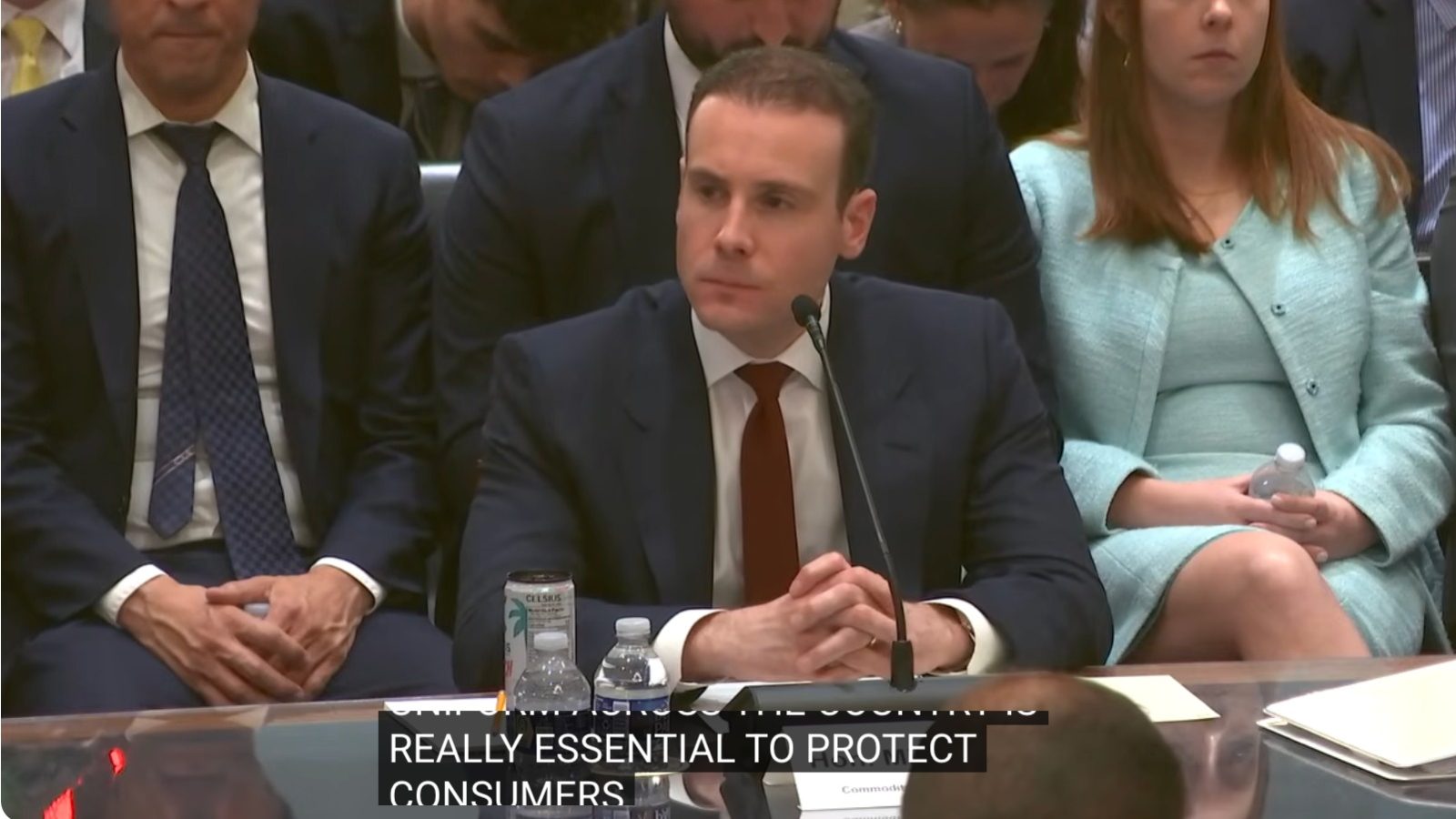
House Democrats Thursday peppered Commodity Futures Trading Commission (CFTC) Chairman Michael Selig with questions about the legality of prediction markets, President Donald Trump using “public office for private profit,” agency staffing, and a host of other hot-button issues during a House Committee on Agriculture hearing on Capitol Hill.
Republican committee members asked Selig if his agency needed more staff, more space, or anything else that Congress could provide. They also commended him on a job well done while looking out for agricultural interests and those involved with traditional commodities trading.
The cadence of the hearing was hot and cold as Democrats accused not only Trump but also Selig and his agency of wrongdoing while also attempting to illustrate how the rise of prediction markets has violated the law and hurt Indian gaming. Per the committee chair, questions came from alternating parties, keeping Selig from having to deal with a Democratic onslaught.
Committee members also asked questions about how the agency can function with a single commissioner, the CLARITY Act, geofencing, reauthorization, and more.
Multiple representatives suggested that President Donald Trump is leveraging his position, and his son’s position as an advisor to Kalshi and Polymarket, for financial gain.
“We have a zero tolerance policy when it comes to insider trading, fraud, and manipulation,” Selig said in response to a question from Democratic Rep. Eric Sorenson of Illinois. “And we will take action against any bad actors in our markets.”
Selig leaned into that phrase “zero tolerance policy for insider trading, fraud, and manipulation” to almost every question about those issues, rather than answering directly. He also repeatedly referred to the CFTC as the “cop on the beat” in terms of enforcement and opted out of answering questions about the future of event contracts. He said that as head of the agency in the process of an advanced notice of rulemaking, he did not want to taint the waters, and that due to current court cases he could not comment on certain issues.
Selig also appeared to contradict comments from former Acting Chairman Caroline Pham to Indian Country in May 2025. At that time, sources on a tribal conference call said Pham told participants that in its 50 years of existence, the CFTC has never denied or taken action against a contract, and that under her watch it would continue that stance. Asked Thursday if the agency has rejected any markets since he was seated in late December, Selig said, “We regularly reject contracts,” though he declined to reveal any markets under investigation or declined.
Since Selig stepped into the position, he has remained the sole commissioner at the agency, which has a mandate for five. California Democrat Jim Costa told Selig that “no one has determined that you are Solomon-like or king,” as he and others repeatedly argued that Selig should not be making decisions in a vacuum.
This ‘smells like corruption’
Massachusetts Democratic Rep. Jim McGovern put the finest point on the belief by some that CFTC actions are clearing the way for the Trump family to get richer. During questioning, McGovern cut Selig off several times as he made clear he believes that Trump is exploiting his office.
McGovern: Mr. Chairman, are you aware that President Trump’s son, Donald Trump Jr., has been hired as an advisor for both Kalshi and Polymarket, two competing companies?
Selig: Congressman, I am aware of this.
McGovern: Would you say that it is accurate, then, that the Trump family has a stake in how these prediction markets are regulated?
Selig: Congressman, I believe this hypothetical you are trying to engage in is a political exercise …
McGovern [interrupting]: I don’t know how this is hypothetical. The president’s son is involved with both of these companies. He makes a lot of money for it. Of course, he has a financial interest in all of this. … So it seems to me like the only reason two competing companies would hire the same person is that he must be really, really, really valuable. And I wonder why they would think that. Mr. Selig, has anyone in the White House ever asked or insinuated that you should drop the CFTC’s probe into Polymarket.
Selig: Congressman, we treat all market participants alike. We do not pick winners and losers or engage in favoritism or bring politics into any of these matters. We take them very seriously. And I think it is insulting that you are insinuating that we would …
McGovern [interrupting]: No, I’m worried because this smells like corruption. … You said in your testimony just now that anyone who engages in fraud, manipulation, or insider trading in any of your markets will face the full force of the law. Just before 7 a.m. on Monday, March 23, someone placed $500 million in oil and equities future trades, betting that oil prices would plummet and the market would rally. And at 7:04 a.m., President Donald Trump posted on Truth Social that the U.S. had begun cease-fire talks. Now, whoever placed that bet knew what the president was about to post and made a lot of money off that. Made a lot of money off of that. You and I know that the odds off of that bet is like a billion to one. … There was no public information of cease-fire talks, this decision was made in the White House, at the highest levels, decisions that very, very few people know about until the president posts them. So, Mr. Selig, do you think the president’s top staff would have that information about a cease-fire?
Selig: Congressman, as I said in my opening statement, we have a zero tolerance policy for anyone who engages in fraud, manipulation, or insider trading, and anyone who does will face the full force of the law.
McGovern: Do you think the president’s family would have knowledge of that? What about Donald Trump Jr.?
Selig: Congressman, I am not going to play speculation games with you, but I will tell you that we have a zero tolerance policy when it comes to fraud, manipulation, and insider trading, and we will bring actions …
McGovern [interrupting]: So yes or no, are you aware of public reporting that the net worth of the Trump family, meaning President Trump and his immediate family members, has gone up by $1.4 billion since he took office a little over a year ago? Because it has. And I believe that this president is using public power for private profit and I think he and his family are lining their pockets with insider information, and I think Donald Trump Jr. is trading his access for money, and I think this is the definition of corruption, and I think that your actions to deregulate this market are helping them do it, and I think it is wrong.
Tribes losing out
Sports event contracts were a key theme, with committee members from both parties asking whether or not they should be allowed. Several representatives from Indian gaming states shared concerns that prediction markets are taking money from tribes and pointed out that money from tribal gaming is used for fundamental services like education, child care, and first responders.
New Mexico Rep. Gabe Vasquez, who brought props to the hearing, made the case for Indian Country — and for states rallying against the rise of sports event contracts.
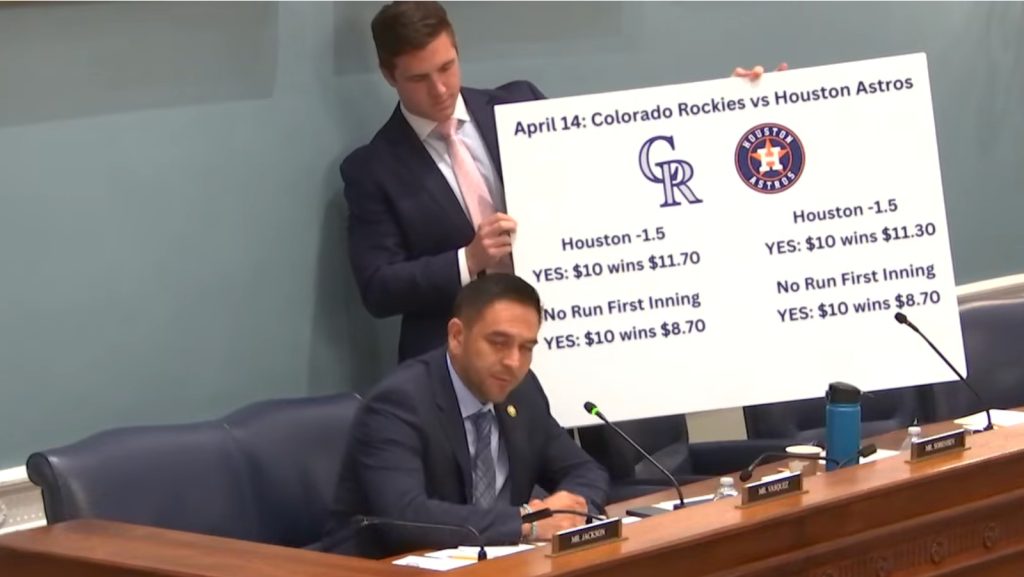
A board held behind him broke down event contract markets and sports bets for a Colorado Rockies-Houston Astros baseball game. The following line of questioning ensued:
Vasquez: I’d like to ask you, can you identify which betting line is from a regulated major sportsbook and which one is an event market from a prediction market?
Selig: Congressman, I am not an expert on identifying betting lines, so I’m not certain. Why don’t you please enlighten me?
Vasquez: Well, it’s clear to me that you can’t tell, and that’s the problem, because the average consumer also can’t tell.
Vasquez then revealed which was from a prediction market and which was from a sportsbook.
Vasquez: Here you see that the … results from the prediction market and the state-regulated gaming entity, and the lines that are put on these sports bets aren’t much of a difference, yet they are regulated completely differently, and although the odds are functionally the same, the outcome for the consumer is the same. Consumers couldn’t care less if they are using an official sportsbook or if they are engaging with a prediction market. The purpose of engaging in the activity for monetary gain is the same.
He went on to explain how tribal nations in New Mexico have compacted for the right to have exclusivity for gaming on their land. Those tribes — as well as Indian Country across the U.S., and states — have crafted frameworks around compacts, licensing, integrity rules, age verification, and consumer protections, he noted. Prediction markets, he said, violate those laws and sovereignty.
Vasquez: So when a federal agency like the CFTC allows prediction markets to bypass these established long-standing legal requirements, but under a different label, and uses loopholes to evade regulation and consumer protection standards, it undermines tribal sovereignty and state protection. … Does a contract on a single player’s performance on a single statistic really hedge any kind of economic risk?
Selig: Congressman, there are many risks that could be hedged through various contracts in our markets. The bottom line is that these markets need to be well functioning and comprehensively regulated by the CFTC, and we’ll continue to do it.
Vasquez: Well, commissioner, with all due respect, I don’t think this is hedging. I think this is a bet. … So let me make this clear, the CFTC was not created or intended to regulate sports gambling. … At the end of the day, are we regulating real economic risk or are we allowing prediction markets to steal billions of dollars in an unregulated free-for-all with no consumer protections as Congress and the CFTC turn a blind eye? The CFTC should focus on ensuring that the integrity of derivatives and commodities markets, ensuring that farmers and businesses receive fair prices and protections, and preventing our country from facing another financial crisis. That should be the focus, because I believe the CFTC does not have the know-how and it doesn’t need to be focused on sports betting.
Costa, who noted he was in office when the 2010 Dodd-Frank Act was put into place, made clear that Congress did not intend for sports betting to be allowed under the act, and that it did not set up guardrails for wagering. He also agreed that “event contracts undercut tribal sovereignty.”
What constitutes war, assassination?
Inquiries about allowing contracts on war, terrorism, and assassinations were also prevalent Thursday. The Commodities Exchange Act and CFTC explicitly ban such contracts, and California Republican Rep. David Valadao asked if the CFTC has blocked any contracts that fall into those categories — or sports.
“In our regulated markets, we have not allowed for any war, terrorism, or assassination contracts,” said Selig, who also added that his agency is “evaluating” sports event contracts. “The questions as to what the public interest analysis should look like and what sort of products are not allowed in our markets, and which ones are” should be answered via the latest rulemaking comment period.
But Selig’s answer begs the question of what qualifies as a contract on war, terrorism, or assassination. While Polymarket’s international platform has been most in the news for offering contracts on former Venezuelan President Nicholas Maduro’s capture, for example, Kalshi has been sued over a contract that asked if Iranian leader Ayatollah Ali Khamenei would be removed from office by March 1. While the market may not have been directly a market about war or assassination, it proved to be at least adjacent, as U.S. and Israeli forces assassinated him Feb. 28.
Kalshi ultimately voided the market using a “death carveout,” per Reuters, and is now being sued for failing to pay out $54 million.
“This is nuts,” Costa said. “I don’t believe this is innovation, I think this is profiting from tragedy.”
More federal bills coming
At least two committee members said Thursday they will be filing legislation around prediction markets. So far, about a dozen bills about prediction markets have already been filed in Washington, D.C., but none have gained traction. Congress appears to be circling the issue, but it’s not clear what action the body might take.
The question of whether or not event contracts qualify as gambling may well be determined by the courts — Kalshi has sued more than 12 states, the CFTC has sued three states, two tribal groups have sued Kalshi, and two states have sued the entity in state court.
Many stakeholders believe the Supreme Court will ultimately take up the issue. Lower federal courts are split — a district court judge in Nevada has banned Kalshi from operating in the state, but other district courts have found in Kalshi’s favor. The highest court to rule on a case involving Kalshi to date is the Third Circuit, which found in favor of the company.
With regard to issues other than prediction markets:
- Selig said it is “essential” that the CLARITY Act move forward, otherwise consumers will be pushed “offshore.”
- In response to questions about staffing, Selig asserted that his agency is running “effectively and efficiently” in its current posture.
- Selig called companies like Kalshi the “first line” in the certification process and the CFTC the “second line” and said the agency will “continue to work together with exchanges.” He went on to say that he “inherited” many of the contracts currently in place, but did not indicate what changes he might make.
- Rep. Angie Craig of Minnesota, the committee’s ranking Democrat, asked if Selig would stop the rulemaking process until there were more commissioners. After Selig’s response, she said, “You just confirmed that you will not stop any regulation as the only sitting commissioner, and I think this points to continued partisanship.”
- On the relationship between the CFTC and the SEC, Selig said the agencies are “committed to work together on shared ideas of joint regulatory interest.”