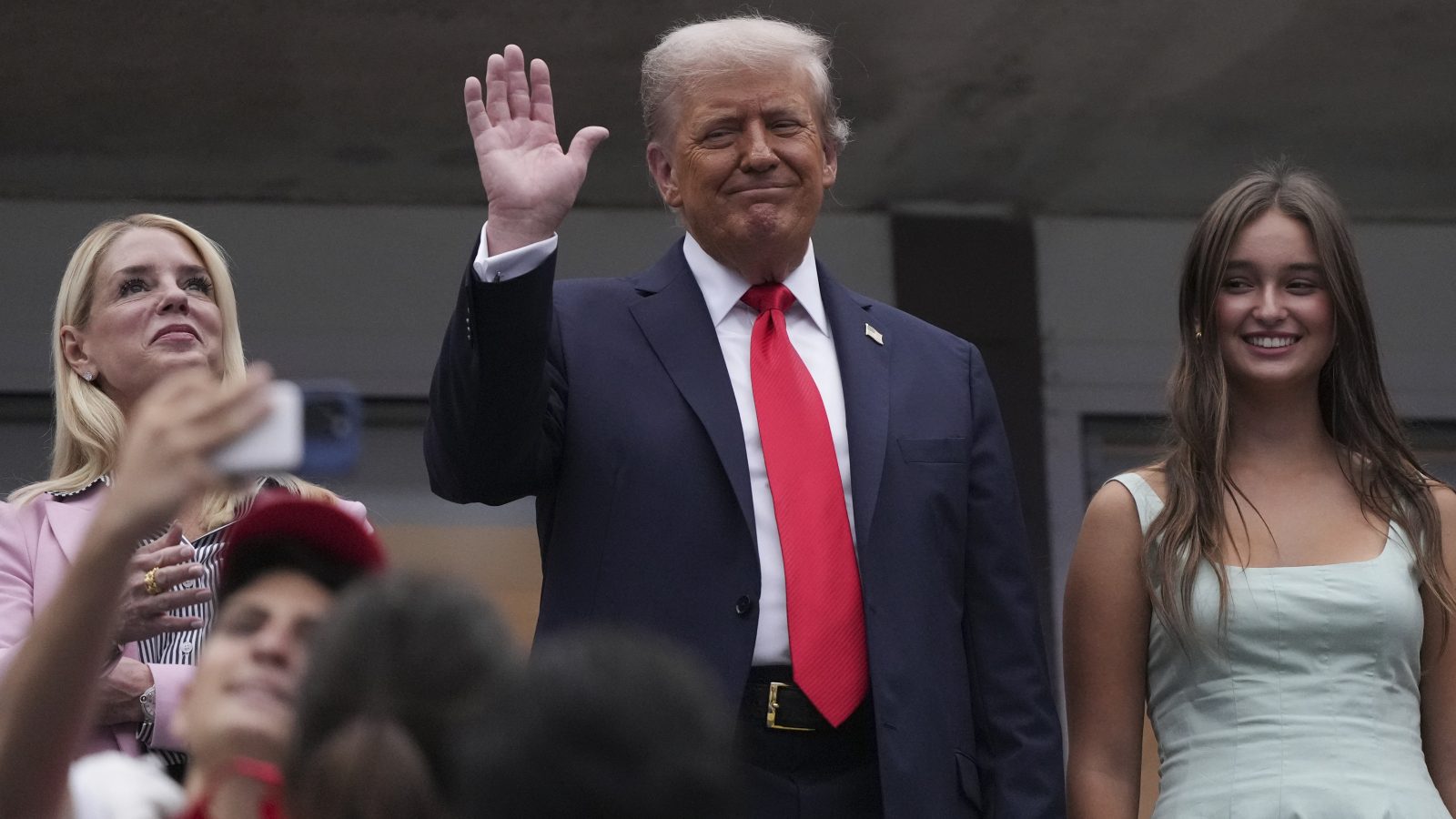
While it is notable that the president of the United States has once again publicly weighed in on prediction markets, the state of play is such that the latest from Donald J. Trump is also effectively meaningless. Or at least Trump’s comment Tuesday is entirely consistent with what we had already believed was his administration’s position and the president’s general disposition.
But first, let’s review the “Truth” post, one of about 20 dispatches he transmits per day, on average.
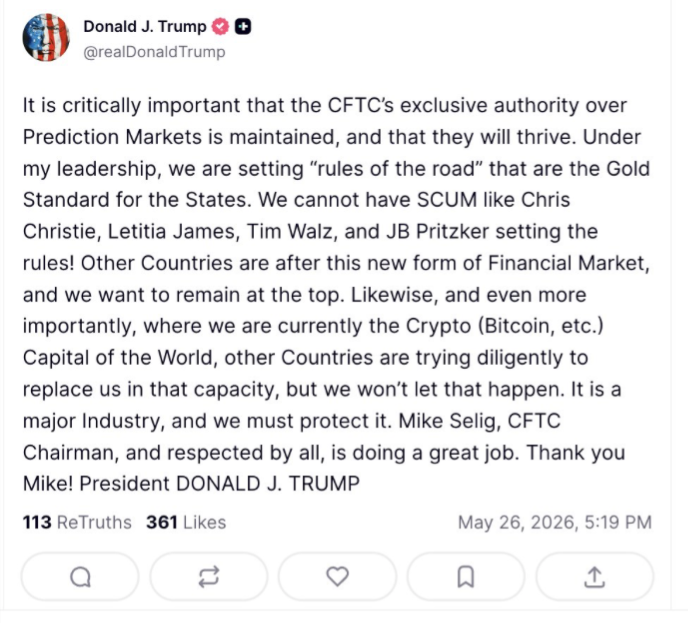
First up, President Trump reasserts that the executive branch has “exclusive authority” over prediction market activities and operations. In the context of the sprawling legal entanglements about this dynamic, this is also framed as “exclusive” jurisdiction belonging to the Commodity Futures Trading Commission (CFTC), a federal agency.
Trump may have had a moment of doubt several months ago amid an insider trading scandal that resulted in the indictment of Gannon Ken Van Dyke, a master sergeant with the U.S. Army Special Forces alleged to have used sensitive classified information to make multiple bets totaling about $34,000 on Polymarket (the international version of the site) in the lead-up to a military operation on Jan. 3 that resulted in the capture of Venezuelan President Nicolas Maduro.
In response to the indictment in late April, Trump said: “Well, you know, the whole world, unfortunately, has become somewhat of a casino. And you look at what’s going on all over the world, in Europe and every place, they’re doing these betting things. I was never much in favor of it. I don’t like it conceptually, but it is what it is.
“No, I think that I’m not happy with any of that stuff,” he continued. “But they have all these different sites. They have predictive markets. It’s a crazy world. It’s a much different world than it was.”
It’s a crazy world indeed, and it’s kept on spinning.
‘Rules of the road’
Second, Trump references the CFTC rulemaking process that is underway. On April 30, the window for public comments on the CFTC’s proposed rulemaking around prediction markets closed, and now the actual rulemaking is in progress for the CFTC’s sole commissioner, Michael S. Selig, and his staff. (Here we discuss notable comments submitted at the deadline and next steps in that process.)
Third, what’s a Trump post without lambasting political opponents? The president trained his fire here on a stable of public officials who are advocating against prediction markets (Chris Christie) or taking state action (JB Pritzker, Tim Walz, Letitia James) to attempt to prevent the proliferation of prediction markets or entities in that space.
Perhaps the most revealing aspect of Trump’s post (although it was something already suspected) is the remark that advancing the crypto industry is, to Trump, the higher priority for his administration. The CLARITY Act, which will determine general market structure and regulatory jurisdiction (SEC and CFTC), has passed the House and is over to the Senate for further discussion and squabbling. Part of the hesitation is over ethics rules (mainly from Democratic lawmakers), especially considering the Trump family’s crypto holdings and industry involvement.
The Trump family is heavily involved in prediction markets, too. It’s widely known that Donald Trump Jr. is a strategic advisor to Kalshi and also an investor in Polymarket via 1789 Capital (as of August 2025) as well as a member of its advisory board. Meanwhile, Truth Social had been working on implementing prediction markets via “Truth Predict,” but that one is shaping up more like a marketing collaboration.
In Trump Media & Technology Group Corp.’s latest quarterly report for the period ending March 31, the company wrote: “While Truth Predict remains in development, we currently expect that upon launch, it will primarily entail marketing and promotion collaboration with OG.com — a new prediction market experience announced by Crypto.com in February 2026.”
Trump also reiterated his confidence in CFTC Commissioner Selig, who remains a vocal proponent and ideologue in favor of prediction markets, reflecting the president’s own views and desires.
Add it all up, and there’s nothing new or surprising here. It’s an affirmation of the Trump Administration’s policy priorities. If anything, more inaction by Trump, by foregoing additional commissioner nominations to the CFTC, would maintain the consolidation of power with Selig as the sole commissioner. This, of course, is the opposite of what many members of Congress are urging him to do.
Wrote Reps. Glenn Thompson (a Pennsylvania Republican) and Angie Craig (a Minnesota Democrat and the chair and ranking member of the the U.S. House Committee on Agriculture) to the president on May 15:
As the Commission carries out its work, the public, the markets, and the agency itself will be best served by a full five-member commission. This will result in better regulations, more durable rules, and more sensitivity to the divergent views of key derivatives market stakeholders. Similarly, a full commission will complement your Administration’s request for an increase in the Commission’s budget, making a welcome pairing of bipartisan leadership and essential financial resources.
We encourage you to nominate a full panel of bipartisan Commissioners to join Chairman Selig in implementing the agenda charted for the Commission. Ensuring the Commission is well-equipped as the leading derivatives markets regulator in the world is a bipartisan priority for the members of our Committee. A complete commission will allow the agency to best fulfill its mandate of promoting integrity, resilience, and vibrancy of U.S. derivatives markets and will advance U.S. leadership.
Notably, Trump in his social media posting does not make any mention of the multitude of federal bills introduced in both chambers of Congress, some of them with bipartisan support. Safe to say, any of them that manages to journey to Trump’s desk will be met with a veto if does not align with his position.
Even if the Democratic Party claims majorities in both the House and Senate in November 2026 (about a 43% probability per the latest trading at Kalshi), there may be a gauntlet of hearings and investigations centered on insider trading or other market machinations, but the net result (barring some unlikely veto-proof majority) probably will leave market operations unchanged. And that will be true until at least until 2028 (or January 2029), when a new president and administration takes the helm.
The ultimate trajectory of prediction markets, their regulation in the U.S., and the long-term viability of sports event contracts within them are on a crash course with the U.S. Supreme Court. A case is likely to arrive there sometime in 2027.
Until then, most of the rest is just noise.