
It appears the call from activist investor HG Vora has been heard at Penn Entertainment. The company Monday revealed in a Securities and Exchange Commission proxy filing that it is focused on cost cutting, reorganization, and shifting focus.
HG Vora last year pressured the company to change its structure, contending that under the leadership of CEO Jay Snowden it had wasted billions on two failed online sports betting attempts: Barstool Sportsbook and ESPN Bet.
At Penn’s annual meeting last June, two executives put up by HG Vora were seated on the company’s board of directors. A third was not seated as Penn shrunk its board from 10 members to nine. The company has since added a 10th member.
According to the filing, Penn’s main focus will be its retail and online casino offerings, with plans to “accelerate” online casino growth and continue to expand and invest in retail locations. Online sports betting will remain a pillar of the company, but as compared to the last five years, it appears Penn will decrease its financial investment in it.
The headline news in the proxy filing ahead of this June’s annual stockholders meeting is a major shift in how and how much Snowden could be paid.
The company’s compensation committee is suggesting cash and incentives that would pay Snowden up to $17.4 million in 2026, down from the proposed $25.3 million in 2025. Investors balked at that package last year, and ahead of the 2026 meeting, the committee is offering up a heavily reduced long-term incentive plan (LTIP) and an overall cut in salary for investor consideration.
Per the filing, the compensation committee made its recommendations in response to investor input.
Snowden oversaw Barstool, ESPN fails
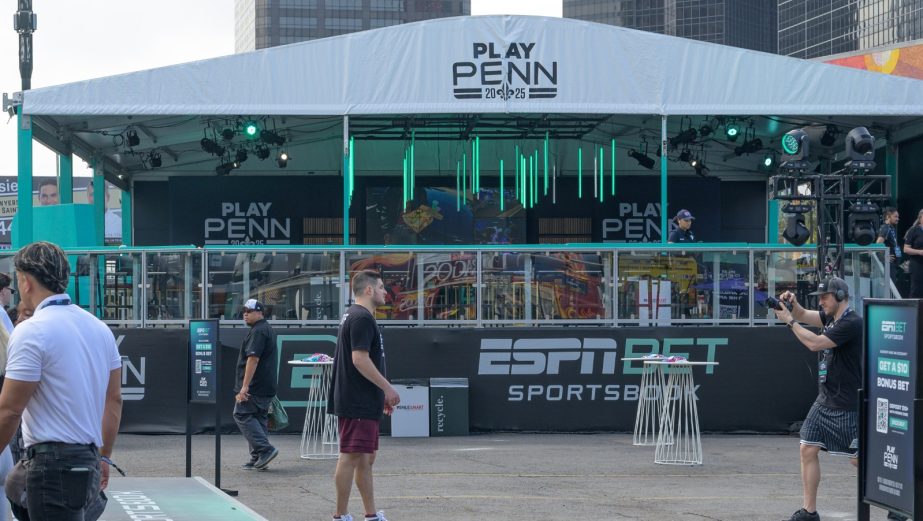
Snowden, who has been in the position since 2020, oversaw the company’s purchase — and eventual return — of Barstool Sports, and a $1.5 billion partnership deal with ESPN to create ESPN Bet. Neither platform garnered significant market share and Penn opted to exit the ESPN deal after 18 months. In 2025, the company finally turned to its in-house wagering platform, theScoreBet, which it purchased from Canada’s Levy family in 2021.
The shift to theScore Bet in the U.S. has already netted returns. In its Q4 earnings call in February, the company reported a lower investment and higher return for the vertical.
In the proxy filing, Penn wrote the change “allowed us to unify our sports betting offerings across both the U.S. and Canada while continuing to build on the momentum of our Hollywood branded iCasino product in the U.S. By aligning our digital strategy with theScore’s established media ecosystem, we have enhanced our ability to deliver integrated, personalized customer experiences while improving cross-sell opportunities and marketing efficiency and maximizing our ability to deliver long-term value.”
Before the decision to abandon the ESPN deal, analysts from JP Morgan said ESPN Bet had “fallen short of expectations” and that Penn should “start signaling intent to wind down the ESPN partnership over the next few months.”
HG Vora’s comments weren’t as kind. In a court filing last year, the company called out Snowden for “risky decision making and mismanagement” all while receiving “grossly disproportionate” pay.
“Despite years of effort and investments totaling more than $3.4 billion, Penn’s foray into the online sports betting world has been a complete failure,” HG Vora wrote in the complaint.
Snowden will have to put up to be paid up
Snowden’s compensation package jumped between 2023 and 2024. In both years, his salary was $1.8 million, but he was awarded $3.4 million in stock options in 2023 and $16.9 million in options in 2024. His total compensation package in 2024 was $26.7 million. Investors did not approve a new deal for Snowden last year.
The current proposal would brings Snowden’s package back in line with with 2023 levels — and a bigger part of the package is based on performance. It represents a 31% cut against 2025. The company proposes to leave total compensation packages for CFO Felicia Hendrix and Chief Strategy and Legal officer Chris Rogers unchanged.

At its peak under Snowden’s tenure, in February 2021 Penn’s share price was $129. In February of 2026, it hit a low of $11.65. At noon Thursday it was $17.86.
In the filing, Penn’s executives wrote that in the 2026-28 “performance cycle” Snowden and others will see compensation tied more closely to “the achievement of a cash flow from operations goal[…] This incentive structure is designed to drive cash generation across our retail and digital operations, support disciplined capital allocation and better align our long-term financial performance with shareholder interests.”
Penn board members earn between $80,000-$110,000 in cash compensation and are awarded varying amounts of stock options. The board of directors in total owns 3.24% of the total Penn stock available, and Snowden owns 2.9 million shares — 2.15% of all available shares, or about two-thirds of the board of directors’ overall ownership.
Better comps
Penn Entertainment is considered a regional gaming company — it has a presence in 27 North American jurisdictions, including Illinois, New York, and Ontario. The company has announced plans to enter the Alberta market, which is scheduled to open July 13.
Since the 2025 meeting, the board — as HG Vora suggested — has been “refreshed” with five appointments in the last year. Positioning 2025 as a “transitional year,” the company made sweeping changes, including using an independent search firm for new board members and more carefully considering the mix of skills and experience board members bring to the table. The company also dramatically shifted the list of companies it uses to compare executive compensation packages.
Two gaming companies — Churchill Downs and Light & Wonder — were added to the comparison list. Five digital and entertainment companies were replaced with six casino, gaming, and hospitality companies.
Other key notes from the filing:
- Penn is making “enhancements” to its anti-money laundering policies and industry-wide review of major enforcement actions.
- The company is exploring “regulatory implications” of skill games, sweepstakes casinos, and prediction markets. To date, Penn, like other land-based casino companies, has not joined the prediction market fray, and Snowden during the company’s 2025 Q4 earnings call referred to the platforms as a “major threat” to state-regulated sports betting.
- Penn says it has increased communication with investors and considered their input.