As federal court cases around major sports betting scandals in Major League Baseball, the NBA, and the NCAA continue to play out, two key North American sports governing bodies last week became the most recent to ramp up education on the topic.
The headline news was the Southeastern Conference’s decision to require all its athletes to view a “custom-designed” sports betting educational video ahead of the start of their sports seasons. The video, per an SEC press release, “will provide clear, practical guidance on recognizing risks, understanding Conference and NCAA policies, and knowing how to report concerns.” It will be “incorporated” into every athlete’s educational requirements.
The requirement is on top of tools provided by the NCAA to educate athletes about the risks of gambling — but the NCAA does not mandate the training. All U.S. professional sports leagues require some sort of gambling education, but much of it is digital. Some teams add an additional layer of in-person education.
“I’m very encouraged that the SEC is making it a mandatory training,” problem and responsible gambling advocate Brianne Doura-Schawohl told InGame. “And I can’t believe we are eight years after PASPA and the conferences are just now adding this.”
In-person gathering suggests importance
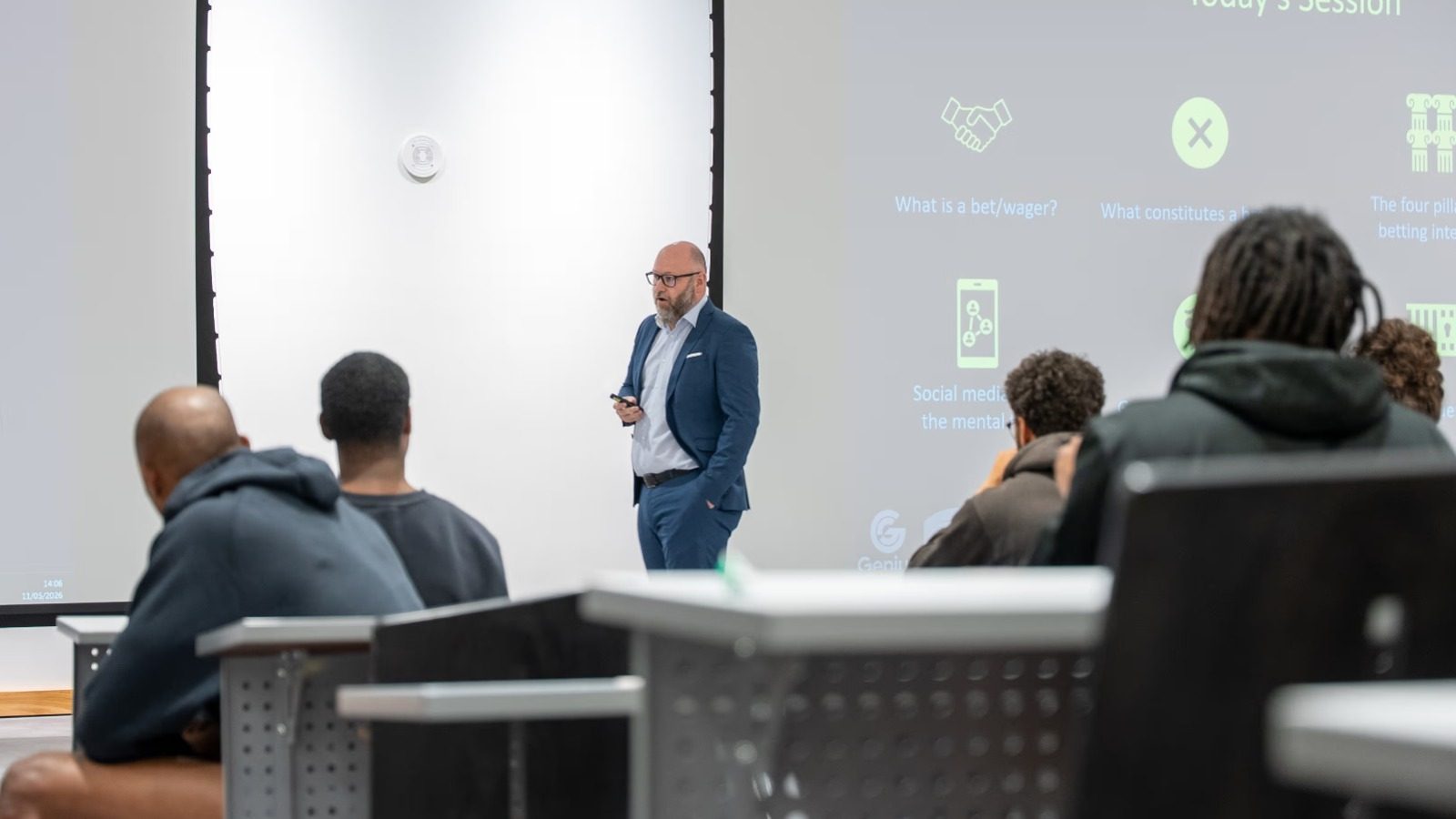
Under the radar is a new sports betting education program instituted by the Canadian Football League (CFL) that includes in-person seminars led by experts from the International Betting Integrity Association (IBIA) and data provider Genius Sports. Jean-François Reymond, IBIA’s education ambassador and a former French basketball player, and ex-NFL, CFL, and European Football League (EFL) player Anthony Mahoungou led the sessions. Mahoungou played for the Ottawa Redblacks in 2021-22 and won two EFL championships with the Frankfurt Galaxy and Rhein Fire.
The sessions, which were required for every player on every CFL team, took place this year ahead of the start of the season Thursday. Currently, the only province with a live, competitive online sports betting market is Ontario, home to three of the CFL’s nine teams — the Hamilton Tiger-Cats, Ottawa Redblacks, and Toronto Argonauts. Two of the nine teams — the Calgary Stampeders and Edmonton Elks — are in Alberta, where legal online sports betting is set to launch July 13. In between, the World Cup, which has venues in Canada, Mexico, and the U.S., starts June 11.
While the new SEC program is in the form of a video — and the NCAA provides universities with e-learning modules and a connection to EPIC Global Solutions for in-person education — the new CFL program is interactive, and that’s a critical difference, Doura-Schawohl said.
“There is a reason we have retreats in business bringing colleagues together, or bringing in a speaker,” Doura-Schawohl said. “When you bring people together, there is this insistence that this is of the utmost importance … and there is nothing in a digital forum that could replicate that human connection. When you are talking about something that carries a lot of stigma — and in gambling, shame — having a person in front of you who is vulnerable, it makes a difference.”
Reymond and Mahoungou did workshops with all nine CFL teams that allowed for questions, answers, discussion, and real-world stories. Some U.S. professional teams do similar programs, but the governing bodies do not always require an in-person component.
“There is a real role here for former athletes to be hearing from those who are walking in these shoes today,” Doura-Schawohl said. “It’s not just about gambling. … I’m encouraged by what the CFL is doing, and it would be great if it could become universal here in the U.S. and elsewhere.”
More value in in-person training?
Per a Genius Sports press release, the CFL “training focus[ed] on practical scenarios, helping athletes to identify, resist and report approaches linked to match-fixing, the misuse of inside information and other forms of betting-related corruption. By prioritizing prevention through education, the program aims to address risks before they escalate.”
Reymond said “integrity measures don’t work on paper alone, they work when athletes understand them, trust them, and use them.”
In-person sessions for gambling education — or really, any kind of training — resonate more than watching a video. It’s an experience we’ve all had at one time or another when starting a new job — the information that sticks is often the information shared by another person. No matter how interactive companies try to make videos, the two-dimensional screen is far less engaging than a three-dimensional human being sharing a personal story or critical piece of information.
“The stakes are too high when it comes to gambling, integrity, problem gaming, and we need not only to be providing more content, but content that has impact,” Doura-Schawohl said. “There’s no doubt that whether we are talking about gambling or regular curriculum, when you are engaged with another human being — and one that has experience or a personal anecdote to share — it is going to leave an impression, it is going to be with you in a more powerful way. There is also accountability in a personal situation.”