
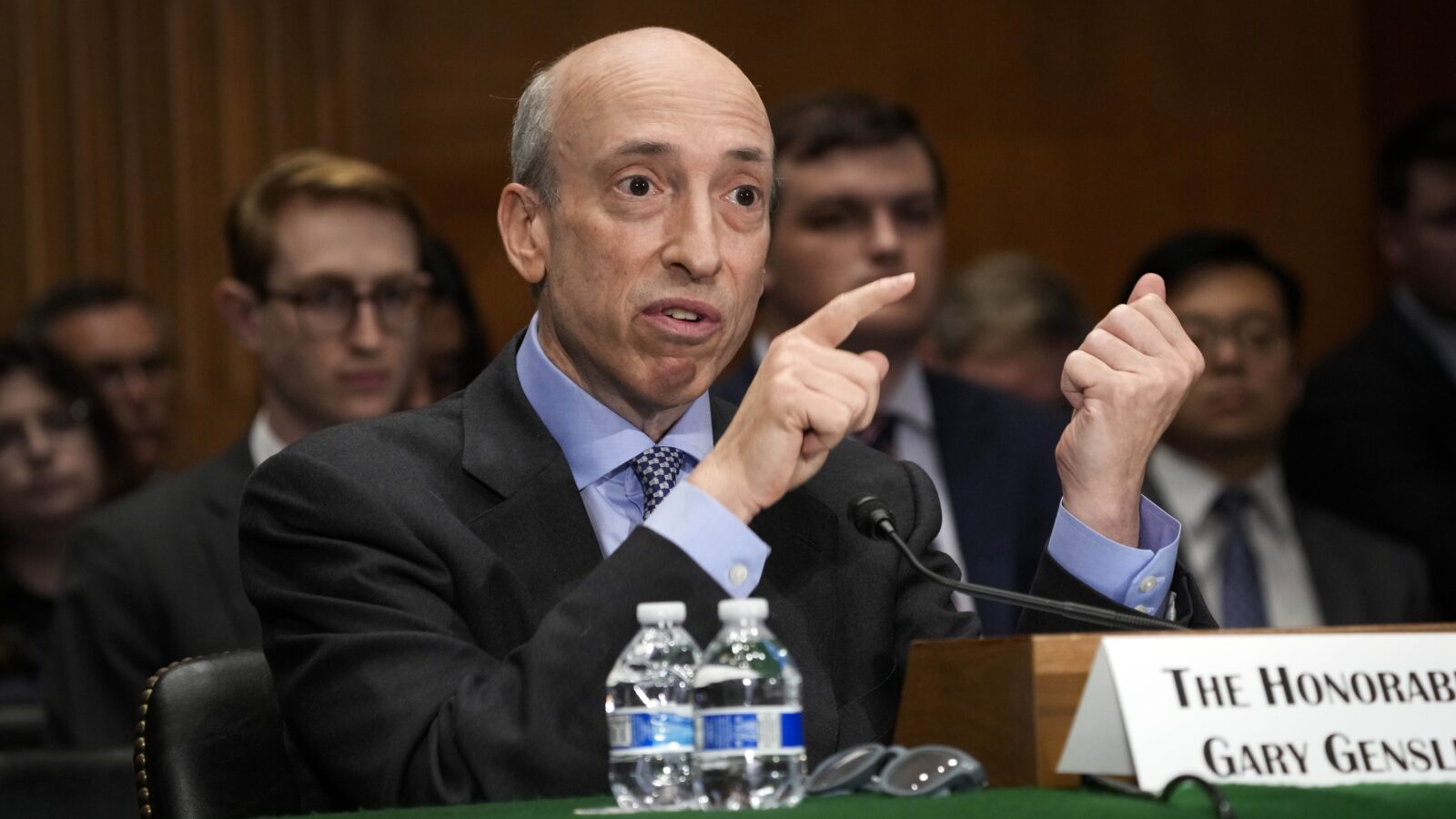
Prediction markets’ legal arguments ignore the fact that the reforms that brought event contracts under Commodity Futures Trading Commission (CFTC) jurisdiction existed to prevent another financial crisis, according to the agency’s former chair Gary Gensler.
Gensler was speaking as the guest on Wednesday’s edition of the Indian Gaming Association’s (IGA’s) The New Normal podcast, hosted by Indian Gaming Association (IGA) Conference Chair Victor Rocha and Executive Director Jason Giles.
Gensler was chair of the CFTC from 2009-14, and then chair of the SEC from 2021-25.
Gensler discussed the amicus brief he submitted in the U.S. Court of Appeals for the Sixth Circuit June 11. He said that he submitted the brief because he felt that prediction markets’ arguments did not reflect his work or that of lawmakers he worked with.
“I’m not being paid by anybody, I just wanted to honor my good friends and colleagues who worked on something that had to do with the financial crisis,” he said.
History of commodity futures
Gensler started with a discussion of the early history of commodity futures, going back to the first rice futures in Japan.
Generally, it has been prediction markets like Kalshi that have tried to invoke the full history of commodities trading in the argument over the legality of prediction markets. In legal briefs, Kalshi has pointed to states’ attempts to argue that traditional corn or grain futures were gambling, arguing that this means that when Congress wrote the Commodity Exchange Act (CEA), it always intended to preempt state gambling laws.
However, Gensler discussed the history of traditional derivatives in order to explain how swaps had initially been seen as distinct, but were brought under the CEA due to the impact of the 2007-09 global financial crisis, in which swaps — not a CFTC-regulated product at the time — had played a significant role.
“We had this big financial crisis, and at the center of it was this big unregulated field called swaps: interest rate swaps, credit default swaps,” he said. “In 2010, when we were looking for a swap definition, we wanted to bring into federal jurisdiction these swaps that had been part of the financial crisis.
“I would contend that no one who was talking to any of us at the time thought sports betting was part of that swaps definition.”
Gensler repeated the reminder that the 2010 Dodd-Frank Act, and the movement of swaps under CFTC jurisdiction in particular, was a reaction to the financial crisis at other points during the webinar.
“We had a financial crisis, millions of people lost their jobs, let’s not forget ourselves,” he said towards the end.
Elephants in mouseholes
Genlser worked closely with Senate majority leader and Nevada Senator Harry Reid at the time of Dodd-Frank. He noted that as a former Nevada Gaming Control Board chair, Reid would never have intended to have his party approve a bill that took away the state’s power over sports betting.
“Harry would have thrown me out of his office if I’d said these words meant the CFTC is the federal sports gaming commission,” he said.
Gensler added that if Congress had intended such a change via the Dodd-Frank Act, it would have been more clear.
“Ever since a famous case where Justice Scalia wrote that ‘Congress doesn’t hide elephants in mouse holes,’ that’s become the law of the land,” he said. “And so you look at the statutory words in Dodd-Frank, that definition of swap, you have to squint really hard at the words to say, ‘Can I see the words sports betting in one prong of swaps around event contracts?’”
“And then this whole prediction market thing is whether someone makes a three-point shot, or a parlay on this game and that game.”