
In a 37-page complaint filed in Delaware Chancery Court on Tuesday, the company from which Underdog Sports procured two licenses to operate its own prediction market platform, Aristotle Exchange, is alleging that Underdog and the company that acquired it “manipulated [Aristotle] into selling its CFTC-licensed subsidiaries for less than their fair market value,” among other claims including breach of contract and fraud.
On July 30, Underdog and the London-based global financial tech company IG Group announced that the latter had acquired Underdog for $1.3 billion with potential for Underdog employees to realize a collective $850 million if the company hits certain EBITDA targets in 2028 ($400 million) and 2029 ($700 million).
“Aristotle is already making more money from their sale of their non-operating DCM/DCO licenses than anyone else has recently, yet they are litigating for more,” said Underdog founder and CEO Jeremy Levine, who is also a named defendant in the case and publicly remarked on the lawsuit before the complaint dropped last week. “Not a surprise given their reputation, but still a bummer. Like I’ve already said, this will amount to nothing more than noise.”
Here are price tags for transactions involving prediction market players over the past 13 months:
| Company | Acquired | Licenses | Deal terms | Date announced |
| Polymarket | QCEX | DCM + DCO | $112m stock + cash | July 21, 2025 |
| DraftKings | Railbird | DCM | $50m + $200m possible in performance incentives | Oct. 21, 2025 |
| Kraken | Small Exchange, Inc. | DCM | $100m in stock | Oct. 16, 2025 |
| Robinhood & Susquehanna | MIAXdx | DCM + DCO + SEF | Under $100m | Nov. 25, 2025 |
According to the complaint, Aristotle received 7,381,191 shares of the company’s stock and 3,505,521 in C-1 preferred stock. While the exact amount Aristotle might realize is unknown, Levine appears to be suggesting that the percentage share would eclipse the Polymarket purchase of QCEX’s licenses for $112 million in stock and cash.
Incentive plan scrutinized
One of the sticking points, from a reading of the heavily redacted complaint, appears to be the treatment of the $850 million “Management Incentive Plan” (MIP) and whether it constitutes financial consideration carved out from the sale price, or is more like contingent upside and performance targets.
The complaint was available on the Delaware court’s website for a period on Tuesday morning, but as of this writing, is no longer publicly available. The MIP is described as such in IG Group’s announcement of the proposed acquisition of Underdog:
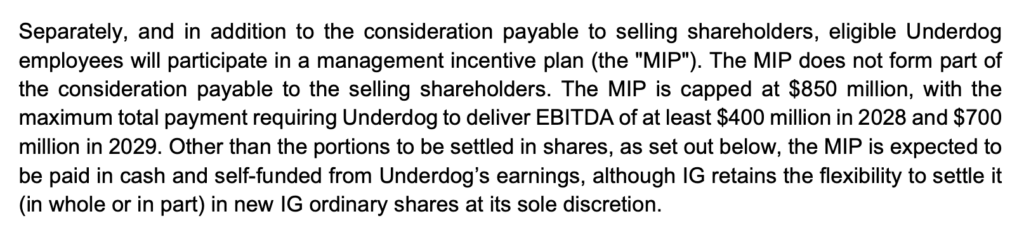
According to Underdog, all employees of the company would be eligible to participate in this pool, if Underdog does meet the targets for 2028 and 2029.
Aristotle alleges in the complaint that “a significant portion of the consideration for the acquisition of Underdog is otherwise payable to common stockholders shall be paid to a subset of common stockholders only – i.e., the beneficiaries of the Management Incentive Plan. The result of this is that the other common stockholders like Aristotle are excluded from those distributions as opposed to sharing in them on a pro-rata basis as required by the Certificate of Incorporation.”
Underdog’s trajectory today as a prediction market operator is trending up, however it and every other competitor remains miles behind Kalshi. Speaking of Kalshi, its success or not in keeping the sports events contracts category open for all, as the primary actor in a multi-theater legal battle with various states and tribes, would seem to be a limiting factor on that MIP getting realized. That legal question is separate from what a new Congress in 2027 or a new presidential administration might do to constrain prediction market operations.
Aristotle alleges that Underdog made material representations during its negotiating window with the company, and also that Underdog as well as IG Group participated in stringing Aristotle along when Aristotle otherwise might have pursued another partner and/or devoted time and resources to competing via its platform PredictIt.org. The platform was one of the earliest prediction market players, launching originally in 2014 under special circumstances.
According to an Underdog representative, every other investor agreed to the terms of the Underdog-IG Group acquisition when the company advised shareholders of the intention to enter the agreement.
It’s unclear whether and to what extent this new litigation might delay, or derail, the IG Group acquisition.
Reached for comment last week about the allegations, an Aristotle representative told InGame that “we believe the filing speaks for itself, and we don’t have any comments outside of what is in the filing.”
Among other remedies, Aristotle may be seeking to make an equitable tender of the consideration it received under the agreement, in exchange for the return of the licenses it sold.