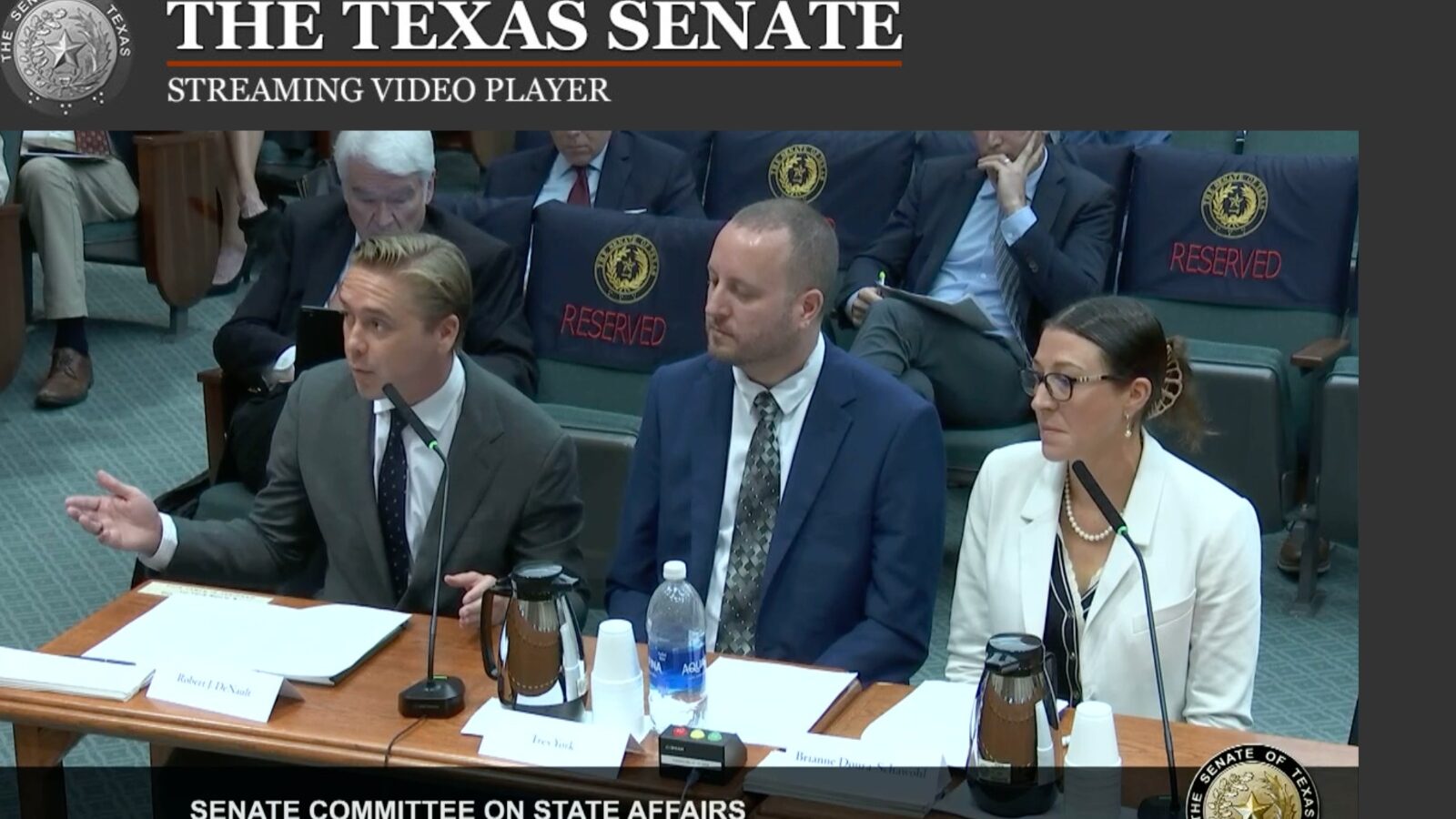
As Texas lawmakers began Tuesday to educate themselves about prediction markets — in particular, sports and election contracts — it was clear what at least one senator thinks of allowing them in Texas.
“That’s kind of like we’re going to give you some drugs so when we cut your throat, it won’t hurt so much,” Sen. Bob Hall said during a hearing held by the Senate State Affairs Committee. “Our job is to protect the consumer, this is not anti-business in any way at all, it’s an evil business that hurts people and … our job is to protect the people from predators, and the gambling industry across the board is a predator.”
The hearing came four months ahead of the 2027 session, which is set to begin Jan. 12. The legislature meets only in odd years, and it has entertained discussions about legalizing gambling, including sports betting, in the 2025 and 2023 sessions. But Lt. Gov. Dan Patrick, also president of the Senate, has repeatedly come out in opposition to legalization and has said he wouldn’t call a vote on any gambling bill unless the Republican majority is behind it.
Patrick, who is up for reelection in November, has made keeping prediction markets out of Texas a priority in his campaign. In March, he included “Closing Gambling Loopholes” on a list of issues he wanted the Senate to focus on.
The committee heard from five witnesses: Texas Values Director of Policy Jonathan Covey, Kalshi Head of Enforcement and legal counsel Robert DeNault, problem and responsible gaming advocate Brianne Doura-Schawohl, pediatrician and representative of the Texas Medical Association Dr. Lindy McGee, and American Gaming Association Vice President Tres York.
A similar House hearing in that chamber’s State Affairs Committee immediately followed the Senate hearing.
Though it didn’t have a representative testifying in person, Texas Policy Research, a non-profit that analyzes legislation, submitted written testimony focused on freedom of choice.
PMs, books same — just ‘different costumes’
Much of the back and forth between DeNault, York, and the committee was about the differences between prediction markets and traditional sportsbooks. DeNault defended his company’s right to operate as a federally regulated entity, and York argued for state protections around traditional gambling and a ban on prediction markets.
Hall said there is little difference and that the state constitution doesn’t allow for legal wagering in any format.
“They’re just dressed up differently,” he said of sports event contracts. “They’re different costumes on gambling is what it is. Wearing a different costume to the ball. Some have high heels and a tiara and others have on miniskirts or a bikini.”
In his opening remarks, York told the committee, “Prediction markets think they can mess with Texas. I hope you prove them wrong and show them that everything is indeed bigger in Texas, including the consequences of violating their laws.”
DeNault used his opening remarks to explain what kinds of products Kalshi offers and compared it to other federally regulated exchanges, including the Chicago Mercantile Exchange. The two companies have the same regulator — the Commodity Futures Trading Commission (CFTC) — but offer very different products. Kalshi and other prediction markets argue that their products are financial products defined as “swaps.” The definition of a swap and whether or not sports event contracts fit into it is a question being considered by courts across the U.S.
“In many ways, all derivatives products resemble what state law might characterize as a bet,” DeNault said. “But Congress passed a law that says that when these products are traded on federally regulated exchanges, these products are regulated as swaps, not as gambling.”
DeNault also said that all exchanges, from crypto to finance, have considered what a swap is, but that “this sort of glib comparison that it’s all gambling because it feels and looks like gambling, that’s something we’ve wrestled with in the United States, and this issue of preemption … for a long time.”
43% of sports contracts are from CA, TX
Kalshi was first approved as a prediction market by the CFTC in the fall of 2024 ahead of the November presidential election, and began offering sports event contracts in January 2025. Since then, state-regulated sports betting operators have argued that the sports event contracts offered by Kalshi and other prediction market operators mimic sports betting while circumventing state law.
Kalshi is offering event contracts, including those on sports and elections, in 47 states — state courts in Michigan, Nevada, and Washington have allowed those states to enforce their gambling laws and ban certain contracts. Texas, the second biggest state in the nation by population, is a critical jurisdiction for Kalshi.
According to the April Prediction Market Monitor from Eilers & Krejcik Gaming, 43% of all sports event contracts on prediction markets originate in California and Texas, the two biggest states in the U.S. Neither has legal sports betting, though both have tribal casinos. In California, there are 100-plus tribes and more than 65 tribal casinos. Indian Country will likely be the driver behind the legalization of online sports betting. California’s tribes are adamantly against allowing prediction markets to continue to offer sports event contracts and could include language prohibiting them in the voter initiative they are aiming to have on the November 2028 ballot.
In Texas, there are three tribes, all of which offer bingo or casino gaming, but the decision about the legalization of sports betting and the fate of prediction markets will lie with state lawmakers in Austin.
‘Brain doesn’t care’ what you call it
Throughout the two-hour hearing, committee members heard about the differences between state-regulated sports betting and prediction markets, including what appear to be more lax know-your-customer (KYC) protocols used by prediction markets and that the legal age for betting in most states is 21, but is 18 for prediction markets.
Covey said that prediction market KYC, anti-money laundering, and other regulations are “largely exchange rules that are enforced by Kalshi themselves, so that asks the question, ‘Why should Texas entrust gambling-like activity involving Texans to the internal compliance department of the company that’s profiting from those contracts?'”
DeNault used some of his time to shine a light on the offshore gambling market, suggesting that is where the state should focus its efforts, rather than on federally regulated derivatives platforms. But Doura-Schawohl pointed out that Texas — or other states or the federal government — can’t control black-market operators and would be better served regulating what they do have access to.
“The offshore illegal market is existential here in the U.S. or globally, but are those people who are really going to comply with your concerns? These are people who have a flagrant disregard for the law, they’re not going to care,” she said. “You’re never going to compete with them, but you may be able to ask the questions about what is happening here to those that are licensed by the CFTC, whether you agree or don’t, maybe asking if those controls are enough because … are those KYC controls stringent enough that you’re comfortable?”
The committee also heard about the harm either trades or bets could cause. Doura-Schawohl pointed out that “the brain doesn’t distinguish about all these legal nuances … but the brain doesn’t care whether you call it a DCM [designated contract market] or a sportsbook, it’s about that experience,” and that gambling addiction has the highest rate of suicide among recognized addictions.