LAS VEGAS — Louis Rogacki’s Global Gaming Expo (G2E) panel Monday was one that didn’t have the words “prediction market” in the title. But the New Jersey Division of Gaming Enforcement deputy director couldn’t let the moment for a fist pump pass.
“Shout-out to the Ninth and Sixth circuits for a great weekend,” Rogacki said when introduced. Applause broke out as the audience in the filled room acknowledged that U.S. appeals court decisions on cases involving states, tribes, and Kalshi are swinging more and more in favor of states and tribes.
In the last two weeks, the Ninth Circuit overturned a lower-court ruling in a decision that could ultimately lead to prediction market sports event contracts being banned on tribal land, and the Sixth Circuit issued an opinion that states can enforce their gambling laws on the platforms.
New Jersey has been at the forefront of the nationwide dispute over the contracts, and so far it is the only state to lose at the circuit court level. The Third Circuit in April found in Kalshi’s favor, and New Jersey officials have since petitioned the Supreme Court to hear their case.
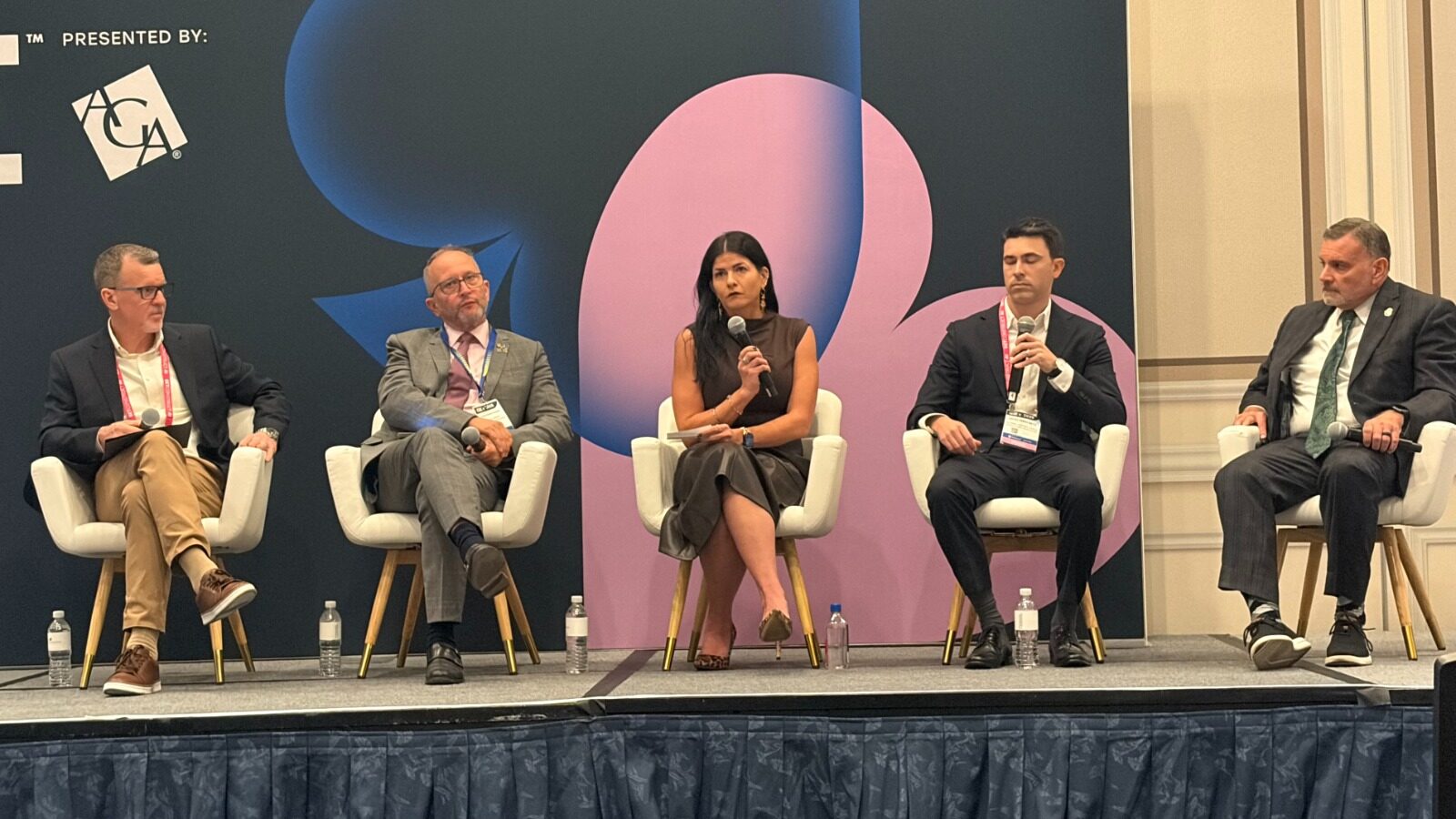
While prediction markets and how they have upended the legal gambling industry are a popular topic at this week’s G2E, the panel Rogacki was on was tasked with shedding some light on how state-regulated sportsbooks deter, detect, and enforce against those attempting to violate legal sports betting regulations. He was joined by BetMGM Vice President for Compliance Sarah Brennan; NFL Director, Global Sports Betting Keith Perschetz; and Genius Sports Chief Government Affairs Officer Chris Dougan. Karben Consulting founder Karl Bennison moderated the panel.
‘We all have to work together’
In a word, the panel said teamwork is the key to shutting down suspicious activity. More broadly, the group explained that each entity — data providers, operators, regulators, and leagues — plays a specific role, and that none can be successful without the others. Third-party integrity monitors are also part of the equation — in most U.S. jurisdictions, operators and data providers are required to report to independent third-party entities.
“It’s an ecosystem,” Brennan said. “Compliance is paramount to all of us, but we have to all work together. BetMGM, while we have the data points, can’t come to resolution on its own. We need to work together.”
Regulators often act as the quarterback of an integrity investigation, gathering data from each of the other players. Operators and official league data providers like Genius can flag what looks like an unusual bet or suspicious line movement, and both can do some investigating on their own, but they won’t have a complete picture. For example, Brennan said, an operator knows who placed a bet, where the bet was placed, and how much the bet was. Once questionable activity is identified, Brennan said an operator will “jump into action.”
A data monitor, Dougan said, can precisely tie the moment a bet “is struck to the event in the game to the sports bettor or consortium of sports bettors.” But neither it nor the operator is tasked with enforcement or contacting the proper law enforcement authorities — that is the job of a regulator.
“It’s all about information sharing,” Rogacki said. “Reports of suspicious activity can come from any of the people on the stage or from the public [or elsewhere]. Our role is to make sure once the information comes in that it goes to the proper place. It’s more of a triage mode, to make sure everything runs seamlessly.”
Pro leagues educate
Professional and college leagues also have a role on the front lines of maintaining integrity, and most rely on education as the foundation. U.S. professional leagues and the NCAA each have their own set of gambling rules — and some version of “no betting on the league you play in” is at the top of the list. The NFL’s gambling education, Perschetz said, is in the form of teaching players, staff, officials, and anyone associated with the league what is permitted and what is not. He said that 20,000 people a year are involved in the training, including 2,000 players.
Rookies go through the training twice, and the NFL pulls in well-known retired players who have been there, done that, in an effort to give the training extra weight.
“Our top priority is that our games are fair and that the public can trust the games,” Perschetz said. “There are clear rules that everyone who touches our league has to abide by.”
Dougan said his company provides the PGA with similar training that includes a five-step program that everyone associated with the Tour must complete.
Beyond that, the NFL works with “external” agencies, including the FBI and other law enforcement personnel, particularly during games to monitor activity on the sidelines or anywhere else that violations could occur. NFL players are prohibited from sharing “non-public information” that could influence player performance or the outcome of a game.