Tribal leaders weren’t shy Monday about reminding their gambling industry counterparts that, not so long ago, Indian Country wasn’t welcome at the Global Gaming Expo (G2E) or as partners with the American Gaming Association (AGA).
But unusual times call for unusual measures. And alliances.
“I think back to the [former AGA President] Frank Fahrenkopf days when tribes were absolutely not welcome at that table,” Holly Cook Macarro, a tribal advocate and political strategist, said at G2E in Las Vegas. “I remember back when we were opposed, as [Indian Gaming Association Executive Director] Jason [Giles] said, by state attorneys general, by the commercial gaming industry, by Nevada [groups] opposing every move of the California tribes.
“This coalition is extraordinary, and the theme of this panel is to talk about unity. We’ve learned about the power in unity. That’s something Indian Country has long held to. … We’ve always been at our strongest when we fight together. … And now that the industry has come together against what has become the existential threat of the illegal sports betting of prediction markets, I hope this coalition continues.”
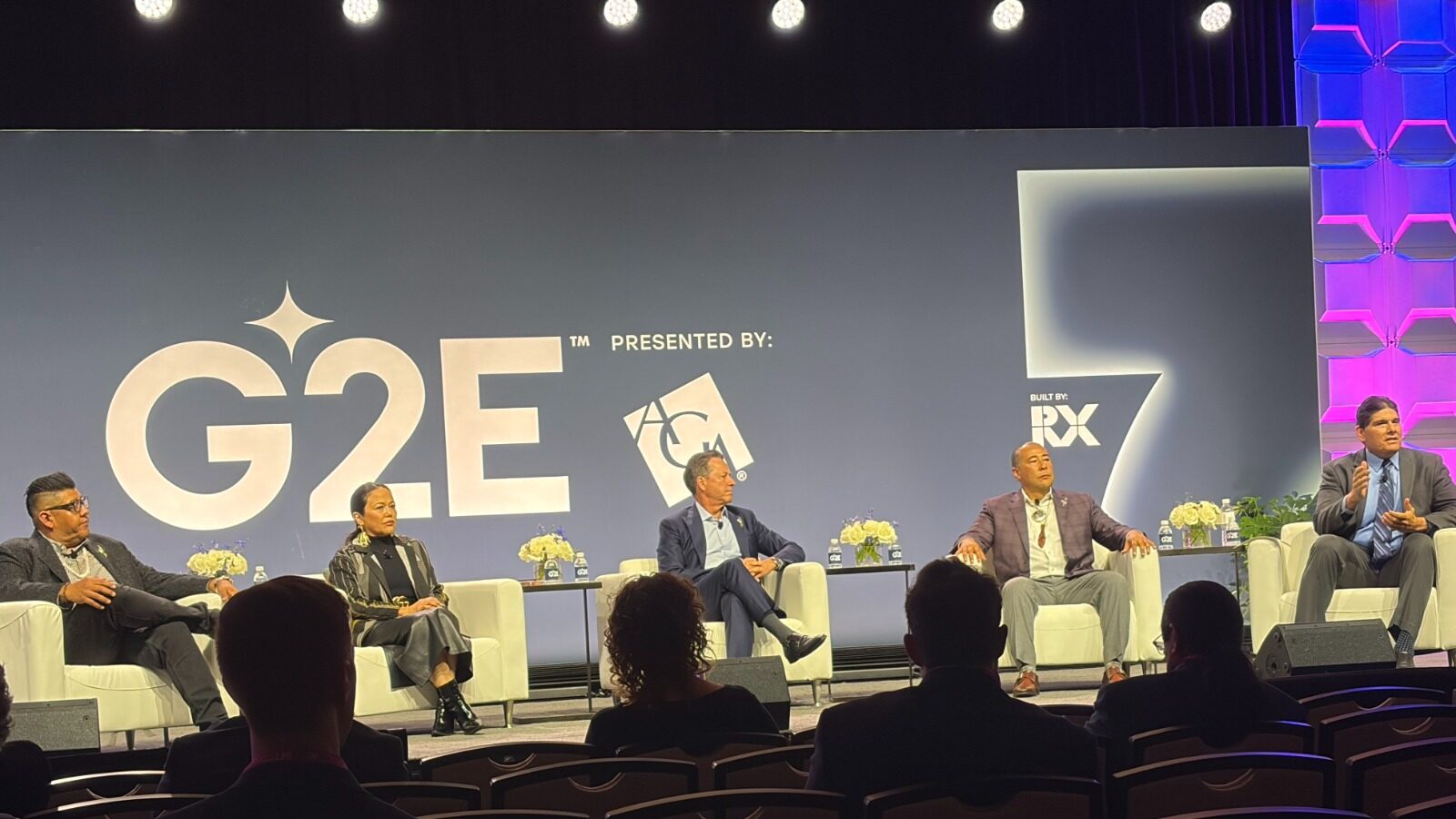
As the saying goes, the enemy of my enemy is my friend, and so it is that four nationally known tribal representatives sat on either side of AGA President Bill Miller as he moderated a Main Stage panel titled “The Power of Unity: Confronting the Prediction Markets Challenge” at the biggest U.S. gaming conference. Miller and Macarro were joined by California Nations Indian Gaming Chair James Siva, IGA Chair David Z. Bean, and Giles.
Bean credited his predecessor, Ernie Stevens, who passed away suddenly Sept. 25, 2025, for laying the groundwork for the relationship with the AGA, as well as Indian Country’s experienced presence on Capitol Hill.
The group focused on banding together against prediction markets, in particular the sports event contracts they offer. Indian Country, along with many in the commercial industry, say that the federally regulated markets are illegal and are cutting into gambling revenue for states and tribes.
Prediction markets offer trading on sporting events that two circuit courts so far have ruled so closely mimic sports betting that they should be overseen by state gambling regulators. In total, there have been three circuit court rulings favoring states or tribes — two different Ninth Circuit judge panels ruled that the state of Nevada can enforce its gambling regulations on sports event contracts and that two California tribes can do the same. In addition, the Sixth Circuit ruled the regulators in Ohio and Tennessee could do the same.
The pendulum in courts across the country seems to be swinging in favor of states and tribes. The state of New Jersey — which the Third Circuit said in the spring could not enforce its gambling laws on Kalshi — appealed its case to the Supreme Court. The industry is anxiously awaiting the decision of whether or not the court will take the case.
What a difference a year makes …
In the meantime, Indian Country, the AGA, state attorneys general, and myriad other interested parties continue to refine their arguments and marshal their forces. Siva said the rise of prediction markets has only “unified” not just Indian Country, but the entire legal gambling industry.
The landscape has changed dramatically in the last year — besides the clear animosity for Kalshi and Polymarket, 2026 marks the first time in recent memory that former members DraftKings, Fanatics Sportsbook, and FanDuel are not part of the event.
DraftKings founder and CEO Jason Robins and former FanDuel CEO Amy Howe had turns on the Main Stage last October. But last November, DraftKings and FanDuel suddenly exited the group after the AGA’s Public Policy Committee had a meeting discussing how prediction markets fit into the gambling landscape. Fanatics resigned shortly after.
At G2E in 2025, prediction market discussion was more about awareness and education. On Monday’s panel — and one featuring CEOs from Caesars Entertainment, MGM, and Wynn Tuesday morning — it’s clear that the industry has moved into combat mode.
“We want to take you from where we were last year when they were looking too big to fail, they were making all of this money — the fact that they are making more money this year than they were last year — and we had a lot of questions about what should we do?” Giles said. Tribes, he said, were wondering if prediction markets were a “new technology we should get into.”
Giles continued: “But everyone on this stage held the line early, this is nothing more than your corner bookie offering bets on the internet against state law, federal law, every kind of law. … With social media and your phones, and the quick and easy access that the youth have today, of course this was going to explode. And with a government that was lying prostrate over it letting the CFTC do whatever it wants, it was going to be a tough slog, and we knew that right from the start.”
Giles then read from opinions from the Sixth and Ninth Circuits, calling the Sixth Circuit decision “a strong statement” and said Kalshi was “going to lose either way” in the Ninth Circuit, after the most recent decision favoring Indian Country. But Giles and Indian Country aren’t just watching the decisions; they are reading and analyzing briefs and opinions.
Calling an argument in the Ninth Circuit “probably the most offensive thing prediction markets have argued,” Giles shared this vignette: “They argued in court that it would be infeasible to geofence a ‘handful of small, geographically irregular tribal reservations.’ Setting aside [what this] kind of pin-prick geofencing is, you have quite an indication of what they think of Indian Country right there. We didn’t ask for irregularly shaped reservations. Sorry they didn’t give us Kansas, a perfect square.”
NIGC absent
The panel spent considerable time taking shots at the CFTC and its chairman, Michael Selig, but it also once again called out the National Indian Gaming Commission (NIGC), the federal agency tasked with managing Indian gaming.
The agency, which, like the CFTC, is short on commissioners, has been silent on the prediction market front. The agency is mandated to have three commissioners, but has been operating with two and no chair. The core power lies with the chairman. Billy Kirkland, who is doing double duty as the assistant secretary for Indian Affairs, is the vice chair, and Sharon Avery is an associate commissioner.
“Normally, we would just go to the NIGC,” Giles said. “There’s illegal gambling? They take care of it. But what happened to our friends? Where did they go?”
Bean pointed out that the NIGC is funded by contributions from Indian Country, not the federal government, making it even more confounding that the agency has stayed on the sidelines. The Trump administration considered one potential chair, but didn’t follow through, and there has been turnover since Trump took office in January 2025. The administration has made no moves since to appoint a chair. The situation at the CFTC is similar — Selig is flying solo, but is a Trump appointee.
“The federal government is not looking out for us,” Bean said. “Wouldn’t it be great if the NIGC would advocate on our behalf the way the CFTC is advocating for prediction markets? But they have been silent.”
Louisiana deal just a speed bump
With or without the help of the NIGC, Indian Country continues to press. Giles and Bean are regularly lobbying in Washington and educating in Indian Country. Siva and CNIGA have been building a coalition in California in preparation for a 2028 online sports betting initiative, and along the way have been rallying tribes against prediction markets.
In mid-September, a Louisiana tribe announced a partnership with Kalshi, but that changes nothing, everyone on the panel said. “A tribe participating in this illegal activity does not make it legal overnight,” Giles said. But national tribal representatives are perplexed by the deal.
The Louisiana agreement, however, is viewed as merely a pothole. Miller said the “best days” are behind Kalshi and other prediction markets offering sports event contracts and that “the walls are closing in.”
But with two circuit courts falling on the side of states and tribes so far, Indian Country is confident, righteous, and remains ready to fight.
“From the early court losses it seemed like things were going the wrong way,” Siva said of a New Jersey district court and Third Circuit decision. “Now we’ve certainly had a lot of strange partnerships, and the importantance of those types of relationships resonates with those on the Hill.
“They are losing because what we are doing is right, and because what we have built up is too imporant … to let money be the deciding factor.”