LAS VEGAS — Wayne Gretzky, hockey’s GOAT and a responsible gaming ambassador for BetMGM, wouldn’t call himself the “right person” for a motivational speech.
In his hometown of Brantford, Canada, there is a hockey arena with his name on it. He told (jokingly) a standing-room only crowd at Global Gaming Expo (G2E) Tuesday that he at one point was asked “not to come back.”
Gretzky went to the arena to help set up for an annual tournament his dad ran. A coach from one of the teams asked him to give a motivational speech. Gretzky tried to decline, but found himself in a locker room full of 7-year-olds.
“When you are in a 7-year-old locker room, there are mothers in there tying skates, dads wrapping sticks, so it’s like 30 people,” Gretzky said. “So I said, ‘Welcome to Brantford, I love this city. Have fun. And remember, you guys are seven, it doesn’t matter who wins or loses, it matters how many goals you score.’
“And the coach just looked at me. And I told him, ‘I said I wasn’t the right guy for this.'”
But that speech is a window into the mindset of “The Great One.” And, potentially, a lesson for the gambling industry. To be the best, you have to put your performance first. You have to prioritize your goals. And you have to stand up for what you believe in.
Miller: AGA ‘on war-time footing’
The gambling industry of late has found itself at a place in time where words like “battle” and “war” are commonplace and casino executives find themselves drawing a clear line in the sand.
“At the AGA, we are operating on war-time footing,” American Gaming Association President Bill Miller said in opening remarks about the rise of prediction markets. “They are trying to prop themselves up and buy legitimacy.”
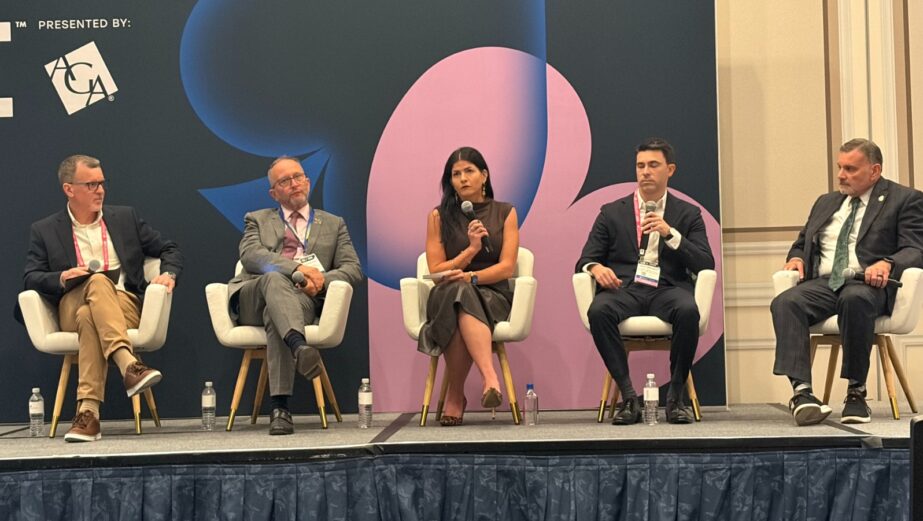
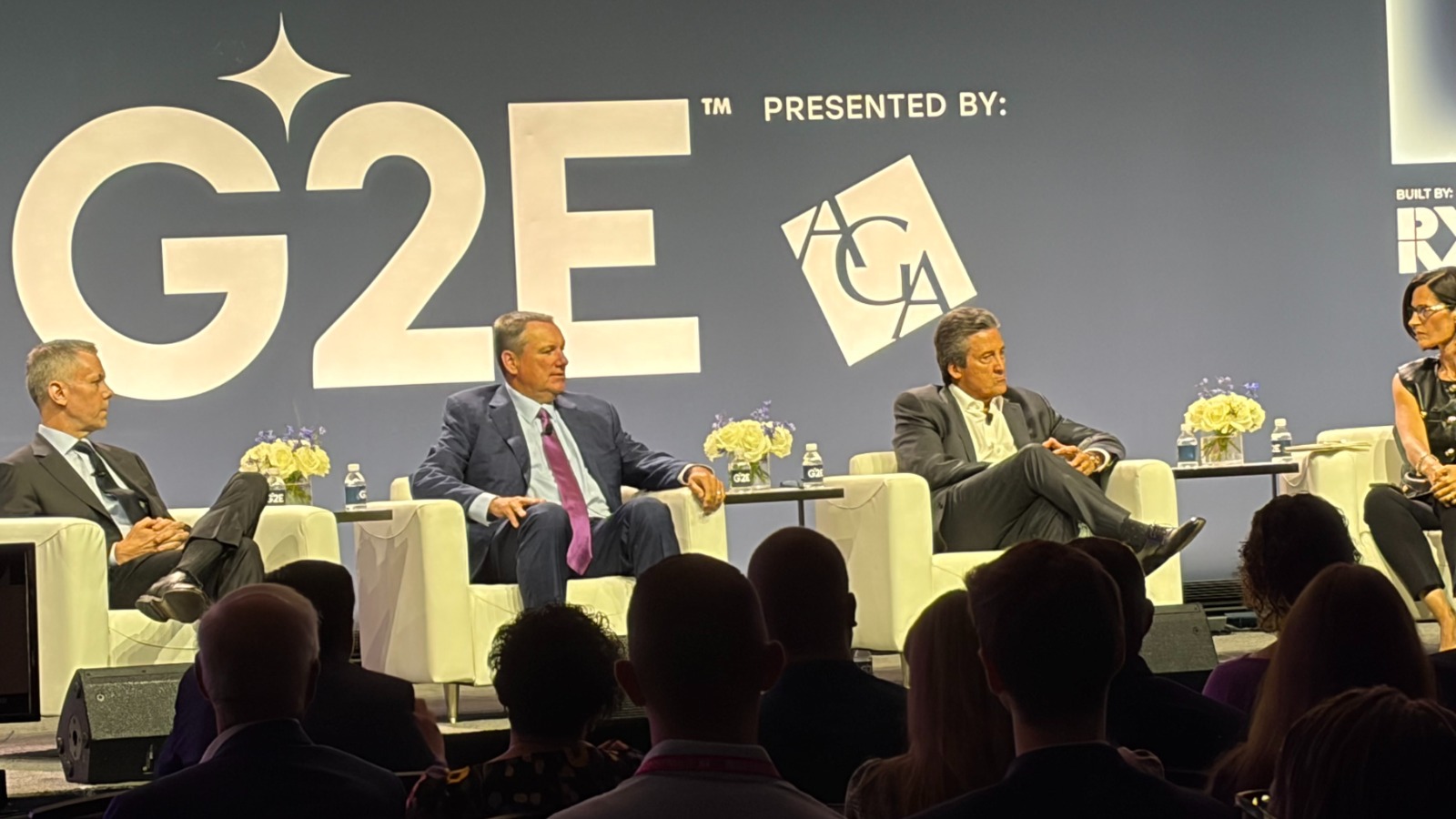
Miller’s comments preceded a discussion between Caesars Entertainment CEO Tom Reeg, MGM International CEO Bill Hornbuckle, and Wynn Resorts CEO Craig Billings, during which the three presented a unified front in the gambling industry’s fight to keep prediction markets out of their space. CNBC’s Contessa Brewer moderated the discussion.
None of the three companies offer prediction markets, in part for fear of losing licenses domestically and abroad.
Reeg’s presence — Caesars is not an AGA member and the company rarely, if ever, has had a presence at G2E — was a statement in and of itself. The CEOs of three of the biggest, most powerful casino companies in the same room, aligned on the same subject, was unique.
Billings said Las Vegas casino companies and the broader legal industry have experienced fighting against new competitors and coming out ahead. Brewer, who also pointed out that sports betting operators DraftKings, Fanatics Sportsbook, and FanDuel are also offering prediction products, asked if Las Vegas companies would fall behind as companies like Kalshi and Polymarket sign up younger customers.
“We’ve lived through this before with DFS,” Reeg said. “Where DFS operated in a gray market, and PASPA was repealed and sports betting was legalized, and those that operated that business had a head start. And that would be the same, if places that do not have regulated gaming moved to regulated gaming and prediction markets are no more. Those that operated that in this current situation would benefit.
“But from our from our perspective, this is illegal. The fig leaf is that [a contract] is a ‘swap.’ It’s ludicrous.”
Being in predictions could risk licenses
As an example, Reeg said that Kalshi offered a market about whether or not Caesars would be sold in 2026. Shareholders last week approved a $17.6 billion acquisition by Tilman Fertitta.
“But there was nowhere in their rules that said I couldn’t place a bet,” Reeg said.
Brewer asked, “Did you?”
Reeg said he had not, but Billings said, “Bill and I did,” drawing laughter.
All joking aside, all three CEOs kept are focused on defending what they believe in — maybe channeling Gretzky’s advice to prioritize your own performance and let everything else fall where it may.
“That culture wants nothing to do with gambling,” Hornbuckle said of prediction markets. “The age is 18. No taxes, no jobs, and the cavalier approach by these guys [is harmful] to the industry. If they want to play by the rules and come to Nevada, god bless ’em.”
Brewer directly asked Hornbuckle why his company wasn’t in the game.
“There’s got to be principles,” he said, and pointed to concerns about putting the company’s international locations in Japan (not yet open) and Macao at risk. Nevada regulators, Hornbuckle said, “have absolutely said to us, if you stretch out and do this, it’s going to impact your licensing, and we decided pretty quickly after that” not to get into the prediction business. The status of a license in any jurisdiction can affect license status in another.