

Shares in FanDuel owner Flutter and in DraftKings keep tumbling to their lowest levels in years, and the two companies’ market value could soon be barely over half of Kalshi’s as the prediction market looks to raise money at a $40 billion valuation.
DraftKings shares hit their lowest levels since early 2023 on Tuesday, and Flutter its lowest since 2020. Both companies are down more than 70% since their peaks in 2025.
Brazil drives Flutter sell-off
For Flutter, the biggest hit in recent days has been from news outside of the U.S. Brazil banned online gambling just two years after legalizing it, forcing Flutter to shut down its Betfair and Betnacional brands in the country. On Monday, Flutter published a profit warning, anticipating that the Brazil ban would cause its revenue to be $70 million lower than expected and its adjusted earnings before interest, tax, depreciation, and amortization to be $20 million lower.
“Flutter is extremely disappointed by this development and is reviewing all available options, including the potential to appeal,” the announcement said. “Flutter continues to engage constructively with the Brazilian authorities on sensible, effective regulation to protect customers from the risks of the unregulated market.”
Flutter shares closed down 7.5% Monday. They lost as much as 3% more Tuesday, hitting $74.39, valuing the business at $12.9 billion. At its peak, the company was worth more than $55 billion.
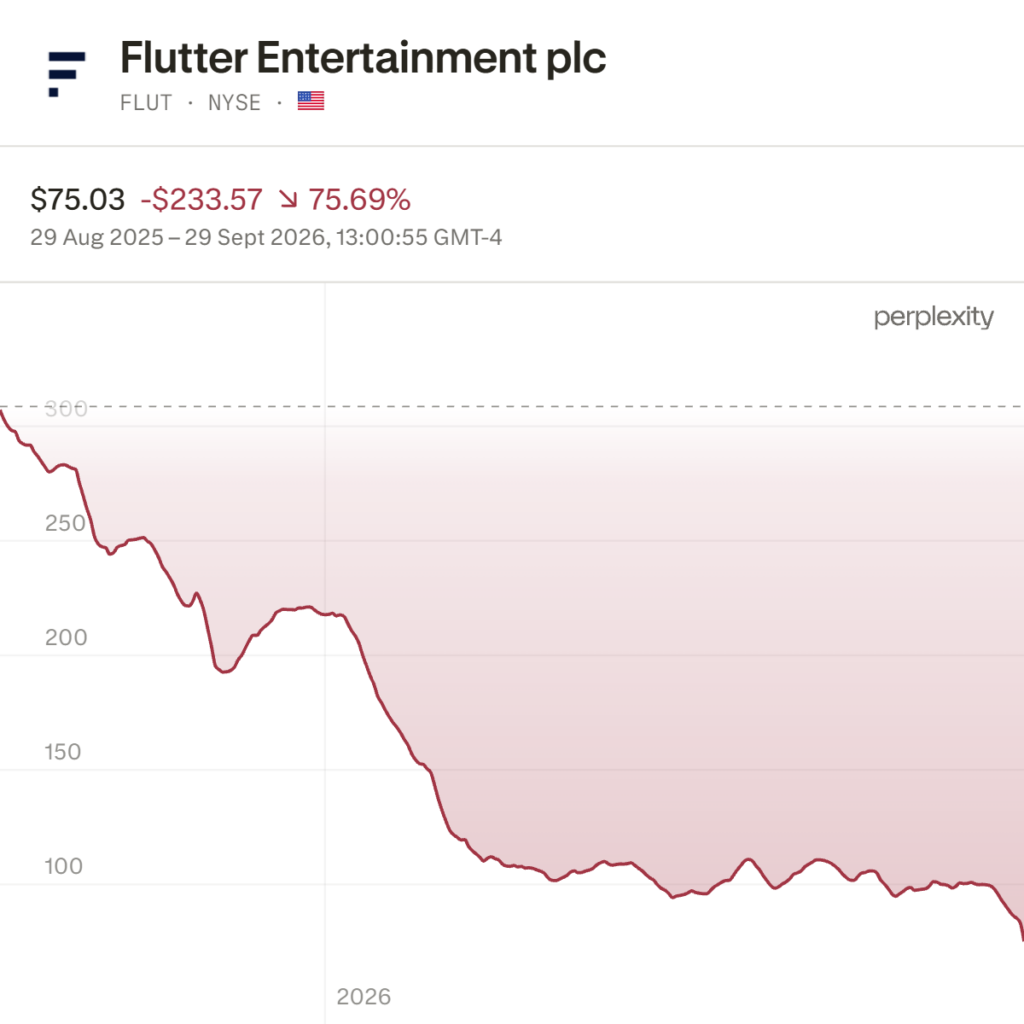
The shares have now fallen by 76.2% since their peak in August 2025. The Tuesday lows were the lowest level for Flutter shares since March 2020, at the worst point of the Covid-19 stock market crash when sports events across the globe were suspended.
Flutter is down more than 25% in the last month.
New competition and lower hold
While news outside the U.S. explains Monday’s steep fall, much of the decline in the past 13 months has been due to competition from prediction markets.
Alongside new competitors, Flutter is dealing with low hold percentages in the opening weeks of football season. According to Jefferies analysts, Flutter is on course for a 39% decline in online sportsbook gross gaming revenue in New York through the first three weeks of September. The Jefferies analysts wrote in a note to clients that Flutter requires a hold percentage in the high teens this weekend to be in line with its guidance.
Citizens analysts Jordan Bender and Isabelle Slavin have noted that prediction markets have generally offered better prices than DraftKings and FanDuel on straight bets, though not on parlays.
“Prediction markets may be competing with sportsbooks on more than their novelty, with users pointing to other differences in the product,” they wrote in a note to clients Monday. “According to an Outlier survey, 35% of respondents cite softer prices as a reason for choosing prediction markets over sportsbooks, while 31% cite better liquidity/no maximum bet limits, and 30% each cite market availability and the ability to exit positions before settlement; 29% prefer the trading/exchange experience.
“Overall, these results highlight the advantages we have written about historically as to why and where prediction-market companies could pressure traditional sportsbooks in states with legal sports betting by offering bettors greater pricing efficiency, liquidity and flexibility, particularly as markets scale.”
FanDuel has gotten involved in prediction markets but does not own its own exchange. Instead it directs its customers to other exchanges, generally Crypto.com for sports and CME for non-sports markets. Because it does not own its own exchange, the level of activity on FanDuel Predicts is difficult to measure. FanDuel is also market making on prediction markets.
Earlier in the year, when FanDuel only offered its customers contracts from CME, it appeared to be lagging well behind DraftKings in volume.
The Jefferies analysts wrote that Flutter CEO Peter Jackson — set to leave the role later this year — had told them that the “FanDuel Predicts B2C product is now on par with peers following the Crypto.com partnership, while market making continues to scale.”
Jackson also told the Jefferies analysts that handle has been strong for FanDuel thanks in part to greater generosity. After the 2025 NFL season, Jackson said FanDuel had been too reluctant to give customers promotional offers and said this led to handle tapering off.
Solo Cup owner loses billions on Flutter bet
Among the big losers from Flutter’s share price tumble has been Michigan-born billionaire Ken Dart, owner of the Solo Cup Company. Dart started buying Flutter shares right around their peak in August 2025 and kept buying as the price kept falling.
Dart currently owns a 31.4% stake in the company, worth about $4 billion, including both directly and indirectly-owned shares. He paid around $7.6 billion to acquire his directly held shares, and the indirectly held ones — which he may not have paid upfront for — were worth around $2.3 billion when he acquired his position. As a result, the impact of the share price decline has likely cost Dart around $6 billion.
Flutter is headquartered in Ireland, and Irish corporate rules require anyone who directly owns 30% of a company to make a takeover bid for that company. However, because some of Dart’s shareholding is indirect, he is still under the threshold.
DraftKings falls sharply Tuesday
DraftKings, with much less of a non-U.S. presence, has not fallen as dramatically in recent weeks, but has still struggled, and on Tuesday it had a particularly sharp decline.
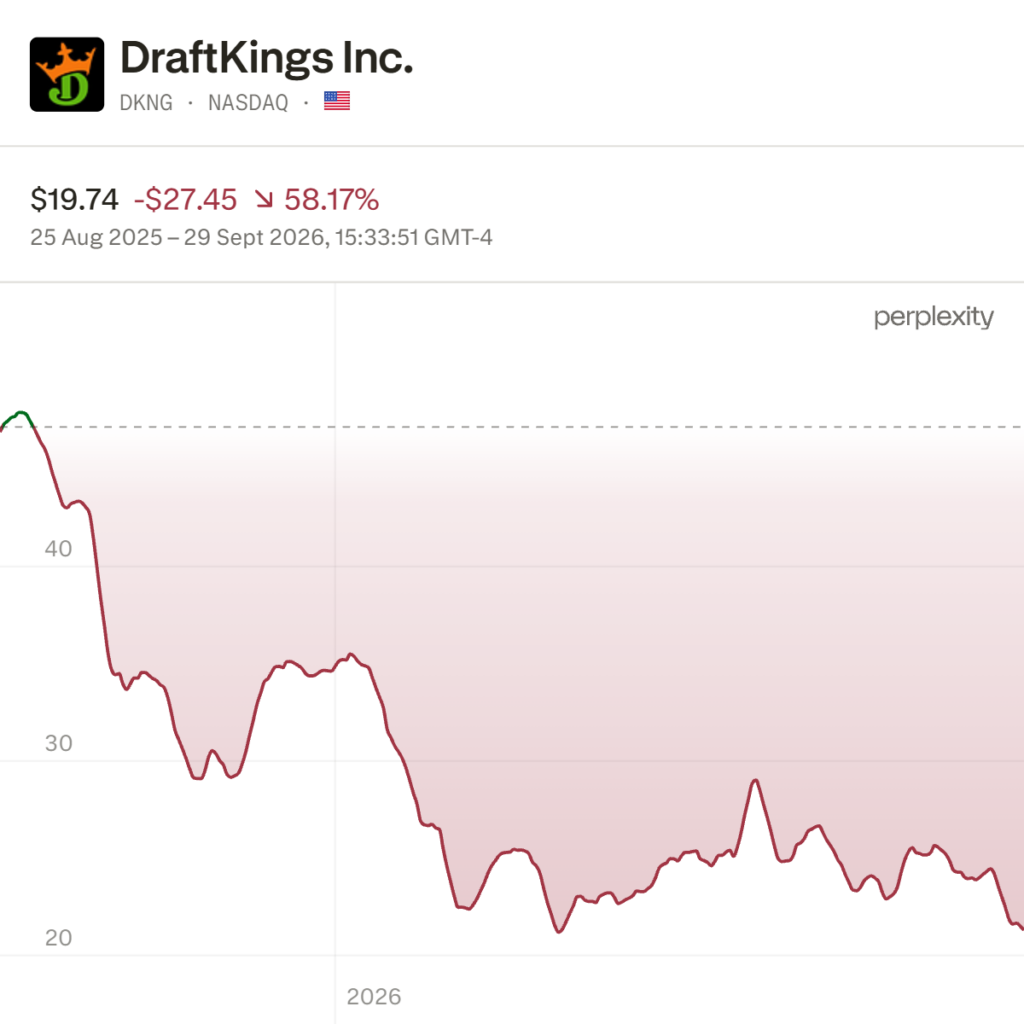
The shares fell by as much as 7.1% on the day to $19.63, their lowest since April 2023. DraftKings shares peaked at $71.98 in March 2025, but are now down 72.3% from that mark. At Tuesday’s share price, the business is no longer valued in the eleven-figure range, and is now worth $9.77 billion. The business was worth $35.8 billion at its peak.
Kalshi raising at $40 billion valuation
Also on Tuesday, Reuters reported that Kalshi is in “advanced discussions” to raise $1 billion at a $40 billion valuation. That would make the prediction market almost twice as valuable as Flutter and DraftKings combined.
Reuters reports that Tiger Global Management and Dragoneer Investment Group are both participating in the funding round, which is led by existing Kalshi investor Sequoia Capital.