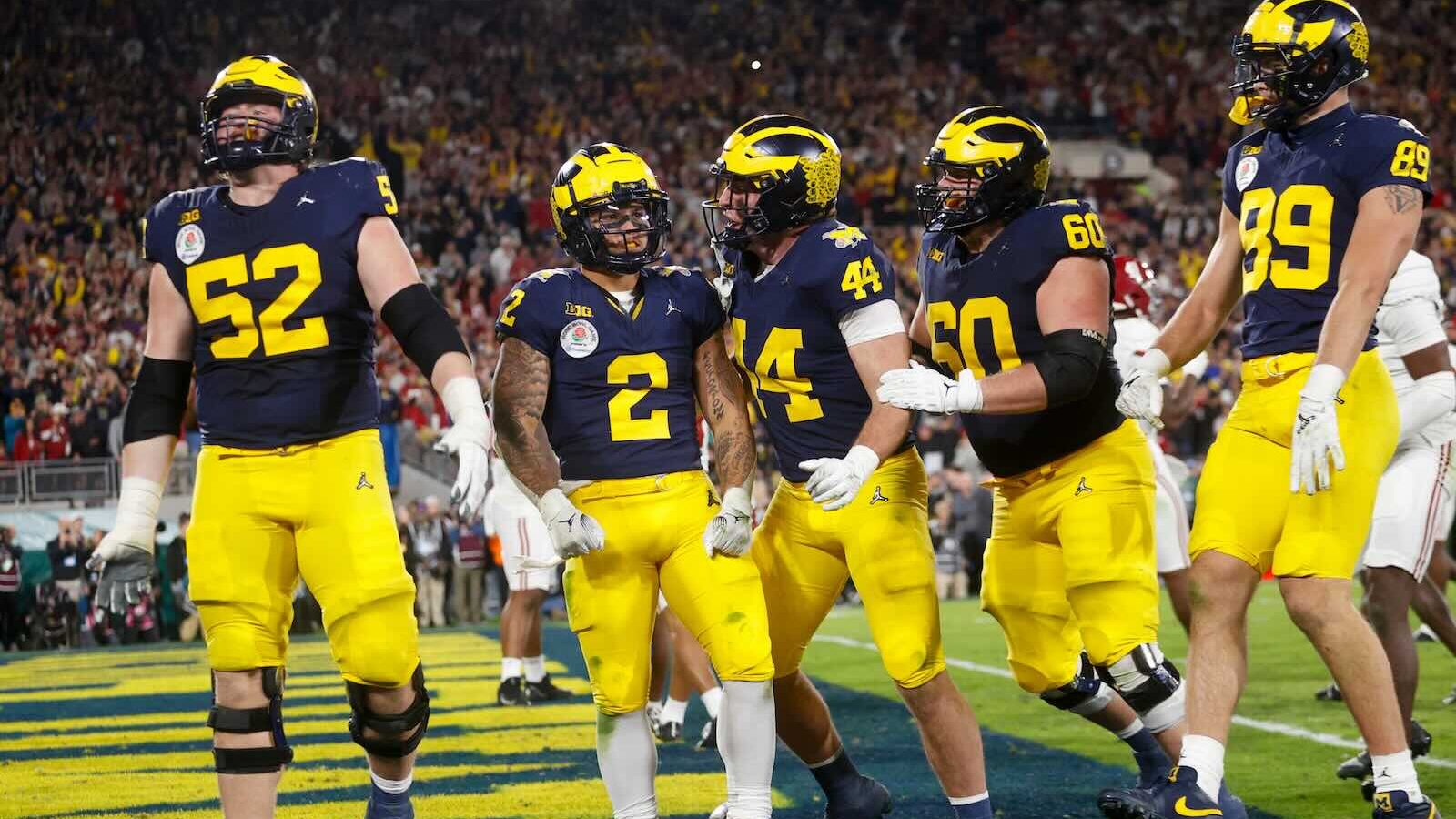
Kalshi’s trading volume continues to set new records on a near-weekly basis, but one potential accelerant is still missing from its menu, and from most of its competitors’ menus: player proposition markets on college football.
For a company that has built its brand by pushing boundaries and challenging the establishment, the obvious question is: Why not offer them?
On that point, a Kalshi spokesperson told InGame: “We don’t offer [college football player props] because they’re subject to manipulation.”
To be sure, the Commodity Futures Trading Commission (CFTC), which oversees designated contract markets (DCMs), has not prohibited licensed exchanges from offering college football player props. But in a March 12 “Prediction Markets Advisory,” the agency’s Division of Market Oversight urged exchanges to think carefully about some sports contracts. CFTC staff wrote:
… DCMs are encouraged to consider whether certain categories of event contracts create a heightened potential for manipulation or price distortion. For example, in the context of sports-related event contracts, such contracts could involve those that resolve or settle based on injuries to individual sports participants, unsportsmanlike conduct, or physical altercations between sports participants, as well as contracts that resolve or settle based on the action of a single individual or a small group of individuals, such as officiating actions occurring during a sporting event.
The advisory reminded exchanges that Core Principle 3 requires them to list only contracts that are not readily susceptible to manipulation, and it distinguished contracts by how they’re structured:
Sports-related event contracts and event contracts more generally have often been shown to be consistent with DCM Core Principle 3 where the settlement outcome depends on the aggregate performance of multiple participants over an extended period of play. The breadth of the outcome, in the typical case, reduces the ability of any single actor to manipulate the settlement value without material cost or substantial risk of detection.
The advisory also urged exchanges to engage with leagues’ integrity units and with “the governing bodies of non-professional sports organizations.” In college football, that means the NCAA, which opposes player props outright, both in the traditional sports betting realm and on federally regulated exchanges as sports event contracts.
Staff advisories, however, don’t bind the CFTC. And when the commission itself weighed in with its June 10 proposed rules on event contracts, it went the other way on full-game player props. The proposal treats contracts that settle on individual or team statistical performance as a factor weighing against a finding that a contract is contrary to the public interest. The categories it targets are narrower: player injuries, officiating outcomes, discrete in-game actions by specific participants, physical altercations, and “pre-collegiate” sports (e.g. high school). Nothing in the proposal distinguishes college athletes from professionals.
The NCAA has drawn that line on its own. In January, NCAA President Charlie Baker wrote to the CFTC asking it to suspend event contract trading on college sports unless stronger protections are put in place. At the state level, the NCAA has lobbied regulators and lawmakers to pull college player props from sportsbook menus. Roughly 15 states with legal sports betting now prohibit them. Arizona, Colorado, Massachusetts, New York, Pennsylvania, Tennessee, and Virginia have banned them since launching, while Louisiana, Ohio, and Maryland removed them at the NCAA’s urging. The campaign hasn’t succeeded everywhere: Last month, the Indiana Gaming Commission unanimously declined the NCAA’s request for a ban, saying the decision belongs to the legislature.
Kalshi has shown a willingness to defy high-profile, influential sports leagues. But it has drawn its own line, where the NCAA has, on college player props.
Meanwhile, Kalshi does list player props on NFL games, including passing, rushing, and receiving yards and touchdowns. Kalshi didn’t elaborate on why college props carry more risk than NFL props, though the NCAA has argued that player props expose college athletes to harassment and threaten the integrity of their competition.
Around the start of the 2025 college football season, a Kalshi spokesperson told InGame the company had no immediate plans for college player contracts. In March, amid criticism from the NCAA and Charlie Baker, Kalshi’s newsroom account posted that the company “has never offered a single college player prop.”
Where college player props are available
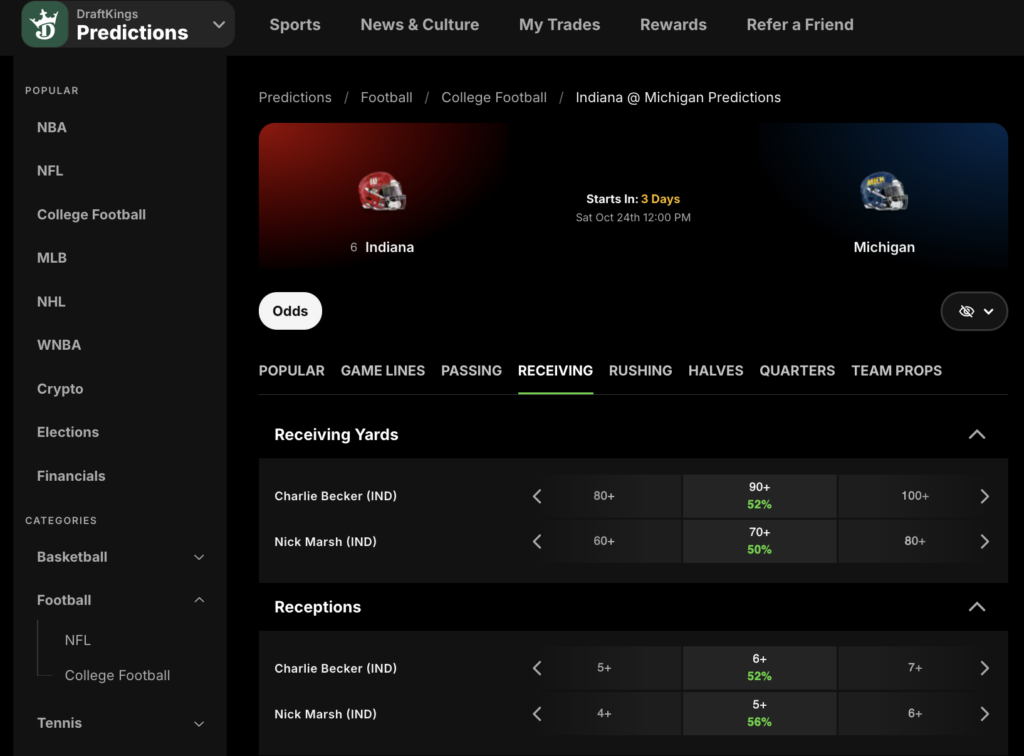
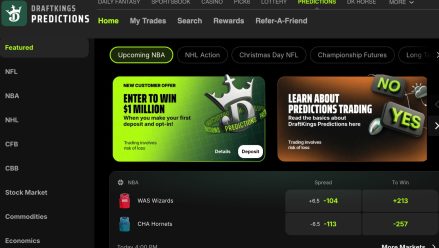
One exchange’s caution is an opportunity for others situated similarly but a bit differently. DraftKings’ DKeX as well as ProphetX both currently list event contracts tied to individual college football players’ performances.
DraftKings acquired Railbird in October 2025 and now runs DKeX through its own trading operation rather than relying on a third party. DKeX users traded about 1.3 million contracts of standalone college football player props last Saturday. That was about 2.6% of DKeX’s single-leg college football volume that day, and anytime-touchdown contracts were the largest prop category, at roughly 44% of prop volume. Each contract pays out a maximum of $1, so the figures reflect contract counts, not dollars wagered.
Those totals also exclude parlay-style combos, which made up about 74% of DKeX’s total volume last Saturday. DKeX’s daily report doesn’t disclose combo legs, so the volume tied to college football player props can’t be determined.
Both DraftKings and ProphetX declined to comment for this article.
| Market | Volume | Open interest |
|---|---|---|
| Anytime TD | 574,610 | 273,251 |
| Passing yards | 185,596 | 60,476 |
| Receiving yards | 184,733 | 68,096 |
| Rushing yards | 165,308 | 61,873 |
| Passing TDs | 102,360 | 29,295 |
| Receptions | 63,410 | 32,048 |
| Completions | 16,825 | 7,575 |
| Rush attempts | 15,220 | 30,447 |
| Pass attempts | 11,552 | 8,401 |
| Total | 1,319,614 | 571,462 |
| Share of single-leg CFB volume | 2.6% of 51.1M |
Source: DKeX daily market report, Oct. 17, 2026. Figures are contracts traded ($1 max payout each). Excludes combos, whose legs are not disclosed in the report.
Source: Logistics keeps some on sidelines
According to an industry source with knowledge of its operations, DraftKings attributes other exchanges’ absence from college football player props not to a lack of demand or any risk of manipulation, but to logistical hurdles. Those could be regulatory caution like Kalshi’s, or limits in market-making capacity.
On combating harassment or threats to game integrity, DraftKings has partnered with Integrity Compliance 360 for its full suite of products including ProhiBet BA (bad actors) program, which “identifies individuals who use DraftKings’ platforms to harass, threaten, or abuse athletes, coaches, officials, and other sports figures — including conduct tied to betting losses or unfavorable outcomes.”
Several exchanges rely on markets from Crypto.com’s derivatives exchange (CDNA), including Fanatics Markets, which does not currently offer college football player props. Fanatics acquired its own DCM via Water Street Labs in late July, but according to sources, that internal plumbing is not yet up and running. In the meantime, Fanatics continues to rely on CDNA for market-making infrastructure, and thus is currently without college football player props on its markets platform.
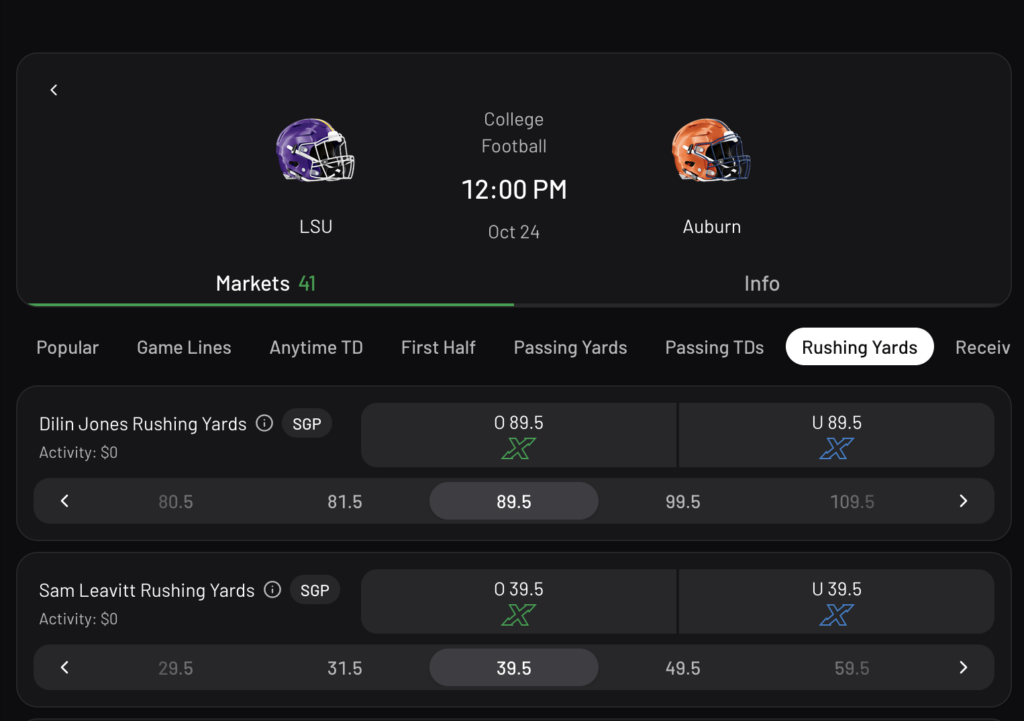
Other exchanges that post sizable volume but don’t list college football player props include NoVig, Polymarket US, and Crypto.com. NoVig declined to comment; Polymarket and Crypto.com did not respond to requests for comment.
From another vantage point, the college football player prop playing field could reflect what DraftKings sees as a win-win environment with prediction markets, even as investors continue to view prediction markets as more of a threat to its business than an opportunity.
DraftKings holds sportsbook licenses in most legal betting states, and a majority of those states (about 60%) do permit college player props in some form. That network of licenses and state-level compliance is one way DraftKings currently distinguishes itself from Kalshi, Polymarket, and other pure DCMs.
But DraftKings is not likely to draw the CFTC’s ire here. The commission’s own proposed rule signals that full-game player stat contracts are generally acceptable, with no carve-out for college athletes. The staff advisory urging caution is just that: an advisory.