Welcome back to “Midterm Market Monitor,” a recurring InGame feature between now and Nov. 3 in which we explore the latest and most noteworthy prediction market odds and trends related to the upcoming elections.
A recurring weekly article about election betting may be an ironic forum for sharing this news, but here goes: The American people don’t want their fellow Americans to be able to bet on U.S. elections.
So say the results of a Reuters/Ipsos poll released Monday, in which 4,506 adults in the U.S. were surveyed. On both sides of the political aisle, a clear majority of those polled objected to the existence of election wagering, whether at prediction markets or anywhere else.
Among Democrats polled, 69% don’t want election betting to be available, 12% do want it, and 18% are unsure. On the Republican side, the results came in 61% opposed, 16% in favor, and 23% undecided.
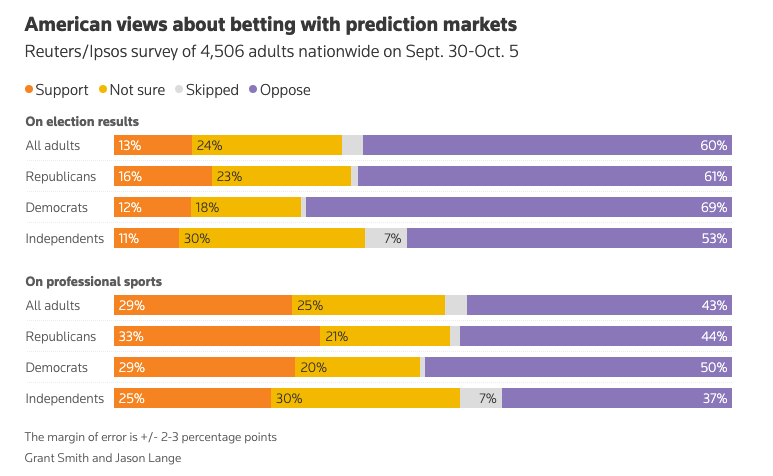
A couple of other noteworthy numbers coming out of the Reuters/Ipsos poll: Only 7% of those surveyed said they have risked real money on a prediction market, and 75% consider trading on prediction markets to be a form of gambling.
Well, whether people like it or not, election betting is happening all over the U.S. and around the globe, so here’s a look at the key markets and trends with Election Day a mere three weeks off.
Senate control
Maybe there’s an “October surprise” coming, but we haven’t seen it yet. And it sure seems it didn’t come in the form of Democratic candidate James Talarico in Texas battling an illness and assorted unsubstantiated rumors.
The odds for which party will hold the Senate majority (Democrats need 51 or more seats to clinch that, Republicans need 50) have budged a bit since last week, in a direction Republican backers and bettors can feel positive about, but mostly only by a percentage point or two. As of Tuesday morning, Democratic control was priced at 62% at Kalshi, 64% at Polymarket, 63% at Robinhood, and 64% at PredictIt. One week earlier, those respective numbers were 65, 65, 66, and 65.
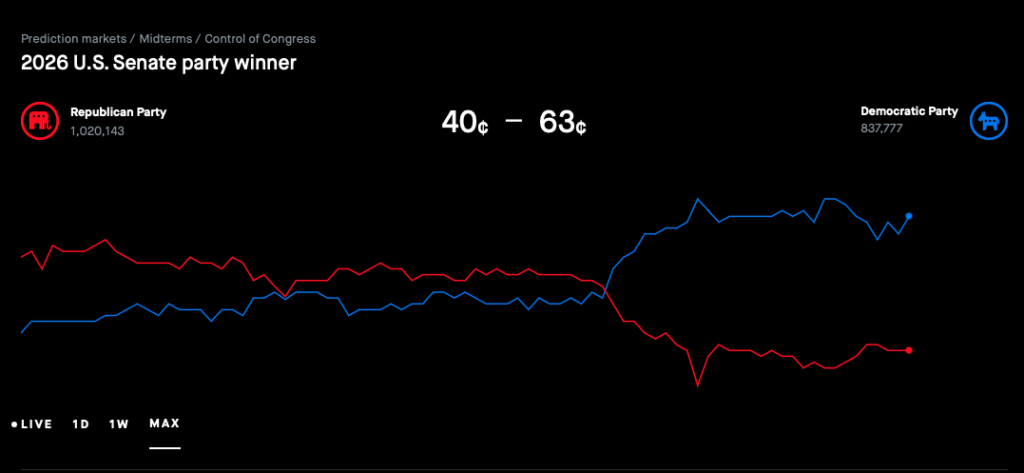
Back to that Talarico “drama”: Kalshi had him last Tuesday at 66% to defeat Republican Ken Paxton for the open Senate seat in Texas. He reached a low point of 61.2% on Sunday, and he has since rebounded to 65%. No Democrat has won a Senate seat in Texas since 1988, when incumbent Lloyd Bentsen was reelected. But the odds continue to point to Talarico snapping that losing streak, in what increasingly looks like a must-win race if Democrats are indeed going to capture the Senate majority.
House control
It seems there’s even less chance of an October (or November) surprise shaking things up in what’s forecast here, as the Democrats holding 218 seats or more is a steady, boring 90-91% at every major prediction market. Week by week, percentage point by percentage point, the political left has been widening its lead here ever since May, around the time it became apparent to many Americans that the military operation in Iran was not going to be a quickie and the associated rising costs of living were not about to stop rising.
Here’s a look at the last 90 days at PredictIt, for example:
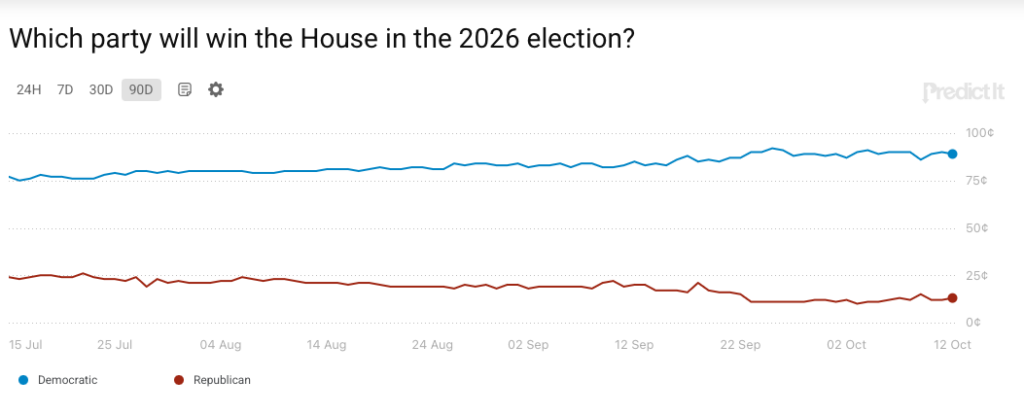
Pretty unexciting, huh?
Looking for a random competitive House election to get your pulse racing? The seat in Michigan’s 4th Congressional District, once fairly solidly red in favor of incumbent Republican Bill Huizenga, has reached coin-flip territory the last two months. As of Tuesday morning on Polymarket, Huizenga was at 53% and Democratic challenger Sean McCann sat at 49%.
Race to watch: Nevada governor
Speaking of coin flips … Nevada elections are always of significance to the gambling world, and this year’s gubernatorial race is as close as they come.
At Polymarket, Democratic challenger Aaron Ford leads Republican incumbent Joe Lombardo 55-46. PredictIt has the blue side up 51-48. At Kalshi, it’s 52-48 in favor of Ford. And at Robinhood, it’s a 50-50 dead heat.
The prediction market odds are largely just following the polls, all of which have the race within three points.
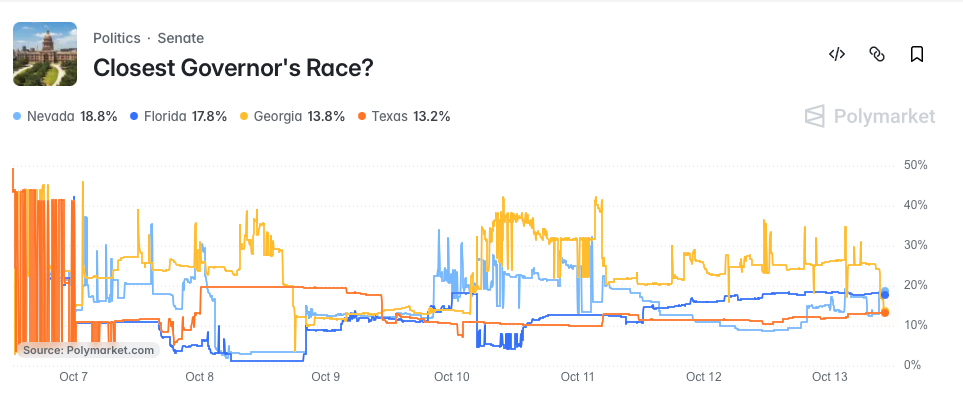
Polymarket has a fascinating related market posted, asking which will be the closest governor’s race in the country. The numbers are constantly changing (the market is less than a week old and there isn’t much money in it yet), but it’s shaping up for now as a four-way race between Nevada, Florida, Georgia, and Texas.
Presidential election odds
In the big picture for 2028, not much is changing week to week. It’s still JD Vance as the clear frontrunner for the GOP nomination, followed by Marco Rubio, with a more wide-open race on the Democrat side with Jon Ossoff, Alexandria Ocasio-Cortez, and Gavin Newsom clustered near the top.
But one fun way to bet on it — if you’re willing to invest in a market that won’t resolve for more than two years — is by wagering on the exact outcome. For sports bettors, think of it like taking +3000 odds that the 49ers will defeat the Chiefs in the Super Bowl next February. You can do the same with the 2028 presidential election.
At Kalshi, it’s crowded at the top between AOC defeating Vance, Ossoff beating Vance, Vance over Newsom, Newsom topping Rubio, Newsom beating Vance, and Vance prevailing over Kamala Harris. (For what it’s worth, I’m all over the “no” on that last one. The notion of the Democratic Party making Harris its candidate again seems borderline impossible.)
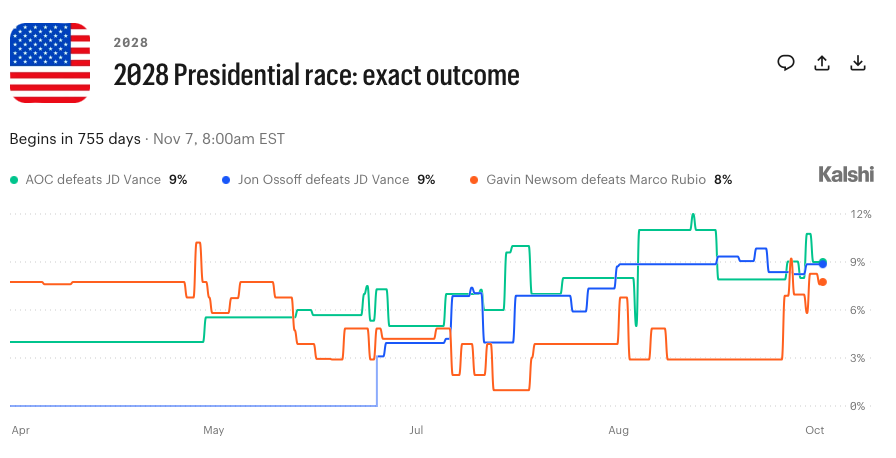
It’s worth noting that four of the top six scenarios would give us a Democrat beating a Republican. As of Tuesday, PredictIt’s market for “Which party will win the 2028 US presidential election?” had the Democrats at 60 cents and the Republicans at 41.
Wacky market of the week
There’s always a lot of Donald Trump-related minutia to bet on, and here’s a Kalshi market of interest that’s related to the midterm elections: “How many states will Trump visit this month?”
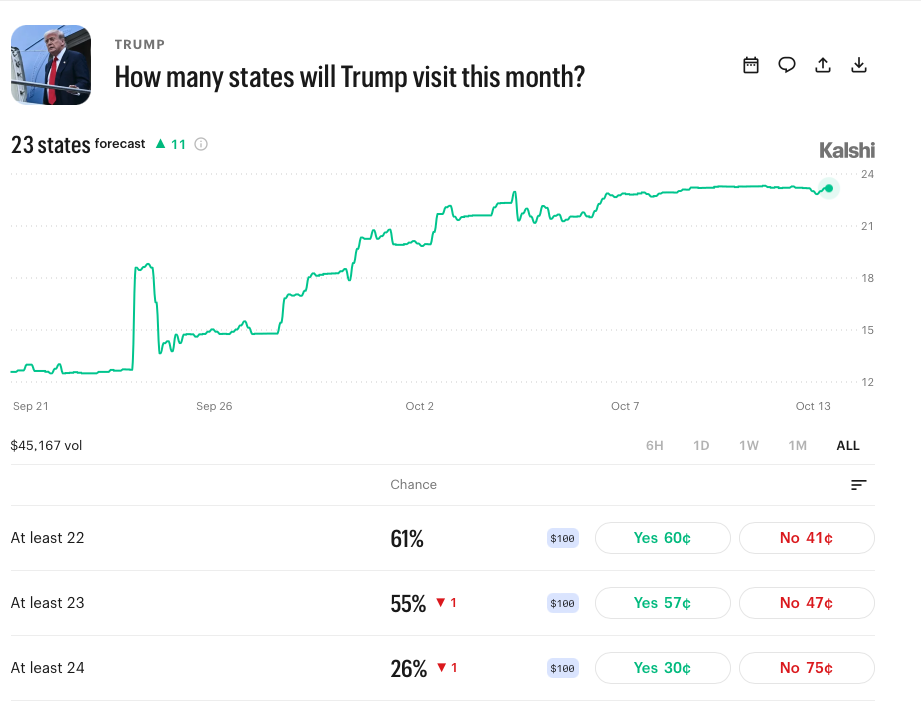
In the wake of #TeleprompterGate, you might think prediction markets would shy away from offering bets where people who work in the administration have informational advantages. But, nope, not so much. There are people who absolutely have access to Trump’s schedule for the next few weeks — although his current plans and his ultimate travel decisions may not align. It’s all subject to change based on his health, on certain states starting to look out of reach, on other states turning into battlegrounds, and on general Trumpian whim.
Notably, an internet search says he’s been to at least seven states through the first 12 days of October. So if you can still get the “yes” on “at least six,” we advise you to take it.