BetMGM has cut back its marketing in sportsbook-only states to focus on its biggest-spending customers, and it says the plan is working, as revenue grew and adjusted earnings more than doubled.
BetMGM CEO Adam Greenblatt explained the strategy on an earnings call after the operator’s third-quarter update Tuesday.
Revenue for the operator, jointly owned by MGM and Entain, rose by 7% to $710 million. Of that total, $483 million came from iGaming and $216 million from sports, up 6% and 7% year-on-year, respectively.
Targeted approach working, Greenblatt says
That came amid heightened competition, particularly from prediction markets.
BetMGM earlier this year lost its podium place among companies offering bets on sports in the U.S. to prediction market Kalshi. During Q3, Kalshi made $737 million in sports event contract fees, easily eclipsing BetMGM’s sports revenue.
On the company’s earnings call, Greenblatt noted the high level of competition to win customers and said some competitors were offering illegal sports betting.
“As we have previously highlighted, the competitive environment remains intense, particularly due to investment by unregulated and illegal operators offering sports betting,” he said.
Because of the level of competition in marketing, Greenblatt said that BetMGM went for a more targeted approach in aiming its spending.
“This has seen us focus on iGaming, multi-product states, as well as higher-value, higher-staking players particularly in OSB, while also reducing investment in certain lower-return, OSB-only markets,” he said.
“This more targeted approach is working.”
The number of active players dipped by 3% to 878,000. However, Greenblatt said that this was “entirely as expected and reflects intentional decisions” related to the company’s new marketing strategy, referring to a “value over volume” approach.
He added that he felt there was no risk whatsoever that the cutbacks to marketing spend could backfire.
“This question of under-investment, we spend no time thinking about it,” he said. “Have we gone too far? We don’t believe we have.”
Because of the lower marketing spend, more of BetMGM’s revenue flowed through to the bottom line. The company reported adjusted earnings before interest, tax, depreciation, and analysts described the adjusted EBITDA figure as “well ahead of expectations.”
Will Supreme Court bring relief?
Greenblatt said BetMGM expects the competitive atmosphere to last until at least mid-2027, when the business hopes the Supreme Court could potentially give states power to ban sports event contracts.
“I’m very much looking forward to this whole ambiguity being clarified by the Supreme Court. And the overwhelming majority of cases are being determined in favor of states and AGs and tribes, and we expect to see that from the Supreme Court during the 2026-27 session,” he said.
“I think the key test is whether this was the intent of Congress, and I think it will be shown to be not the case.”
The earnings call came days after the CFTC published a rule that would exclude event contracts on casino games from the definition of a swap, leaving them subject to state gaming laws. Greenblatt said he didn’t think this makes the risk of prediction markets on casino games completely disappear, because the CFTC could change the rule again as easily as it proposed the latest definition.
“I think that this is cosmetics in pursuit of survival,” he said.
Market reaction for parent companies
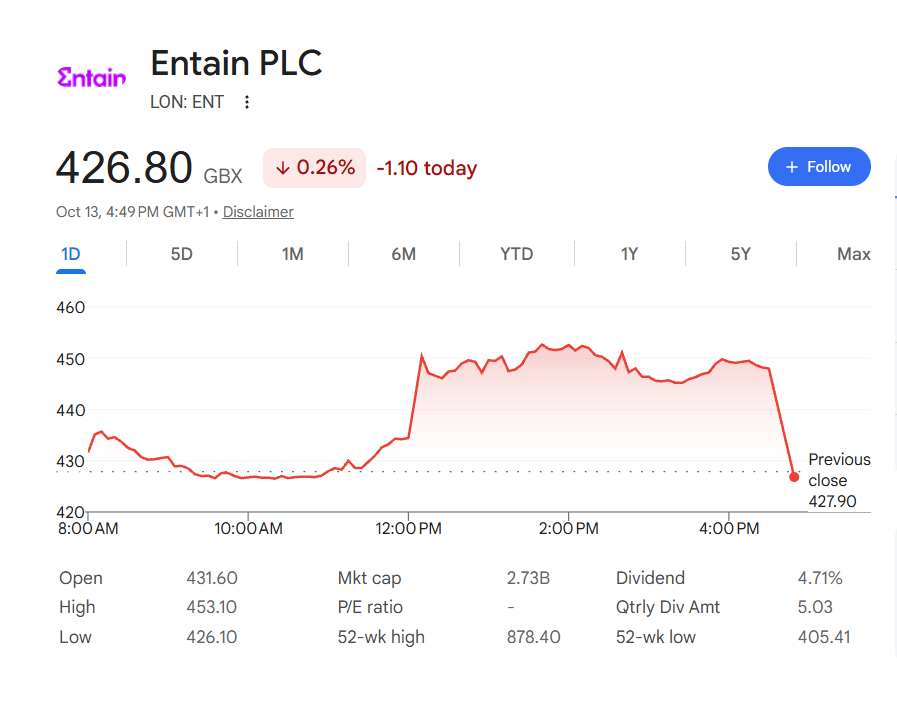
Upon publication of the results, shares in Entain surged by more than 5% in London, to £4.52 ($5.99). However, by the end of the trading day, they were back to where they sat before BetMGM’s results were released, at £4.27.
Shares in MGM were steadier, up 0.6% to $29.49.