DraftKings CEO Jason Robins says the company will still make a return on its $1 billion of planned prediction market spend, but Wall Street appears to have doubts as the company’s shares plunged by as much as 29% Friday.
Robins was speaking on the DraftKings earnings call Friday following the company’s release of its third quarter results after markets closed Thursday. The results showed signs of early success in prediction markets.
Prediction market success
During the quarter, DraftKings started routing customers to its in-house exchange DKeX. It also ramped up its marketing in states where sportsbooks are not legal but its sports event contracts are available, such as California and Texas. It self-certified parlays for DKeX in August, and they quickly became a major part of its offering.
October annualized “consumer volume” — similar to taker-side volume, and a closer proxy for sportsbook handle — from DraftKings Predictions was $10.1 billion, suggesting consumer volume of $842 million. Parlays made up 27% of consumer volume. October’s annualized total volume was $56.8 billion, suggesting volume of $4.7 billion during the month.
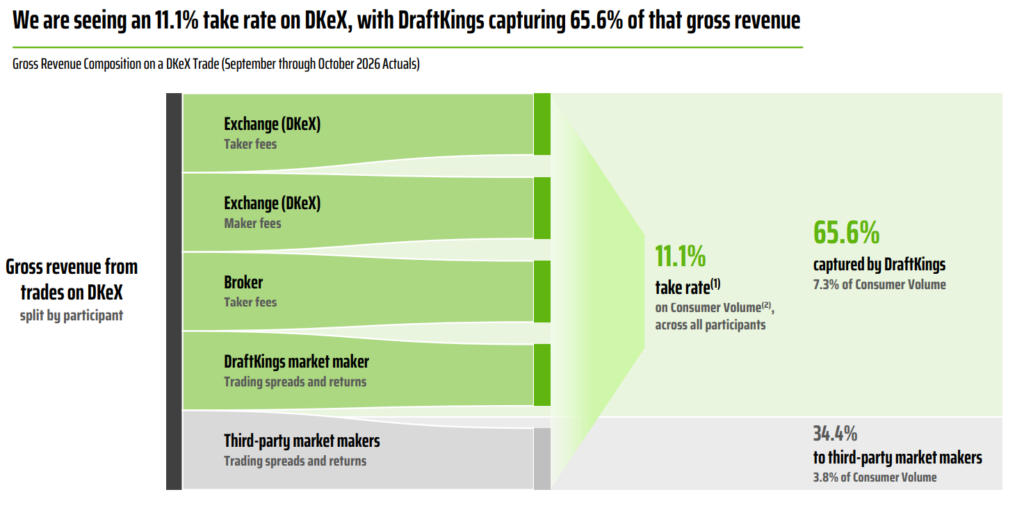
DraftKings said its revenue from prediction market customers should pay back the costs to acquire them sooner than expected. It said that the take rate from prediction market bets on DKeX — combining exchange fees, broker fees, and market maker profits — was 11.1%. DraftKings doesn’t always capture the market maker profit, because while it engages in market making on DKeX, other traders and firms do as well. It said it captured around two thirds of the 11.1% cut available.
More prediction market spending
Its success with customers has prompted DraftKings to spend more on prediction markets, which led to a huge sell-off in DraftKings shares.
The business now says it will spend between $650 million and $700 million on prediction markets this year. It will then spend between $250 million and $350 million on the vertical next year.
In previous results announcements, DraftKings had planned to spend up to $300 million this year on prediction markets.
The new spending plan meant DraftKings cut its guidance for adjusted earnings before interest, tax, depreciation, and amortization (adjusted EBITDA) for 2026 to between $175 million and $275 million. It had previously expected adjusted EBITDA between $700 million and $900 million.
Payback even with ban?
Robins justified the spend by saying the customers DraftKings Predicts acquires this year would pay back the costs to acquire them before a Supreme Court ruling on whether states can apply their gambling laws to sports event contracts.
He added his belief that the customers DraftKings acquires in 2027 would pay back acquisition costs even if sports contracts are banned. Robins said that is because many of those customers would still use non-sports event contracts or products like DraftKings’ Pick 6 daily fantasy game.
“Starting with 2026, we are going to get paybacks, we believe, in about 20 months,” Robins said. “Our base-case forecast is a mid-year 2028 Supreme Court ruling. So we should have those customers fully paid back by then. Obviously, there’s a chance that could accelerate and we weighed that. But even in that case, we’ll have very attractive paybacks there.
“The 2027 cohort we modeled out as also having very similar paybacks, probably better in the event that it’s a positive Supreme Court ruling or it gets delayed even further.
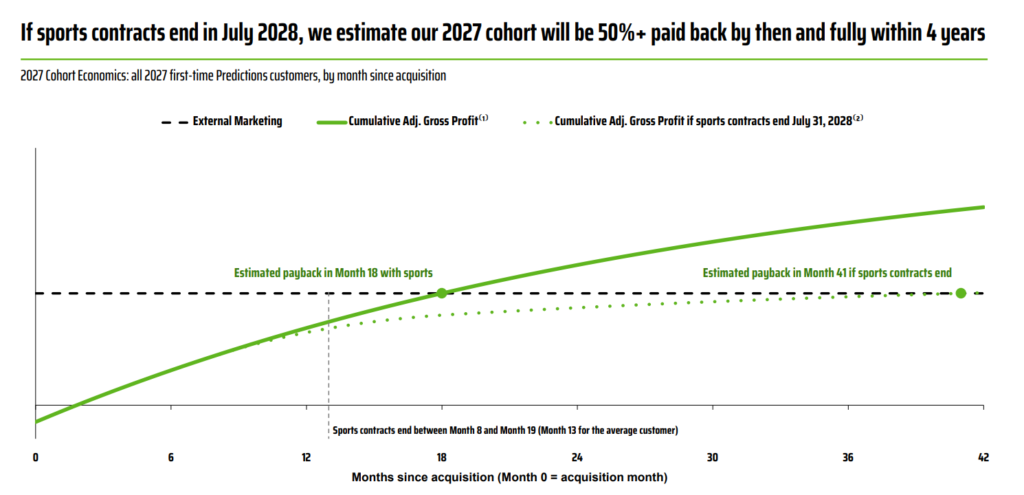
“But even if there is a ruling that shuts down sports predictions in July of 2028, we still think that cohort should pay back in four years or less. And that’s because of the excellent cross-sell we’re seeing onto other products we have, including the non-sports predictions.
“Obviously, we typically target three-year paybacks in our core business. So it’s a little bit longer than that, but that’s in the case where sports contracts go away. In the case where they don’t, it’s much faster than our core business.”
CFTC statement could have big impact on DraftKings
Less than an hour after DraftKings released its third-quarter results and its plan to lean into prediction markets, the Commodity Futures Trading Commission (CFTC) threatened to cause havoc for DraftKings’ joint sportsbook and predictions business model with a new interpretation of its “impartial access” principle.
The CFTC Thursday ordered all designated contract markets (DCMs) and intermediaries to stop geofencing states, or explain why they can’t do so.
DraftKings only offers its sports event contracts in states where it does not hold sportsbook licenses. Many states that regulate sportsbooks have threatened to revoke the licenses of operators that offer sports predictions within their states. If the CFTC does not permit DraftKings to geofence sportsbook states, it would likely have to choose between its prediction market and sportsbook licenses.
However, Robins said he did not believe that this situation would occur.
“As far as the CFTC thing, I wouldn’t make anything of that,” he said. “I don’t think that’s going to affect anything for us. There’s a process for demonstrating why you can only operate in certain geographies.
“So we’ve had a really good relationship with the CFTC, and I think that’ll be something that we can work through with them easily.”
DraftKings shares crash
The market reaction to the company’s spending plan was overwhelmingly negative. Citizens analyst Jordan Bender said that while Wall Street had expected to see higher spending, the numbers announced went beyond any expectations.
“Management cited higher investment levels during the quarter, but the actual result was beyond even the worst-case scenario,” he said.
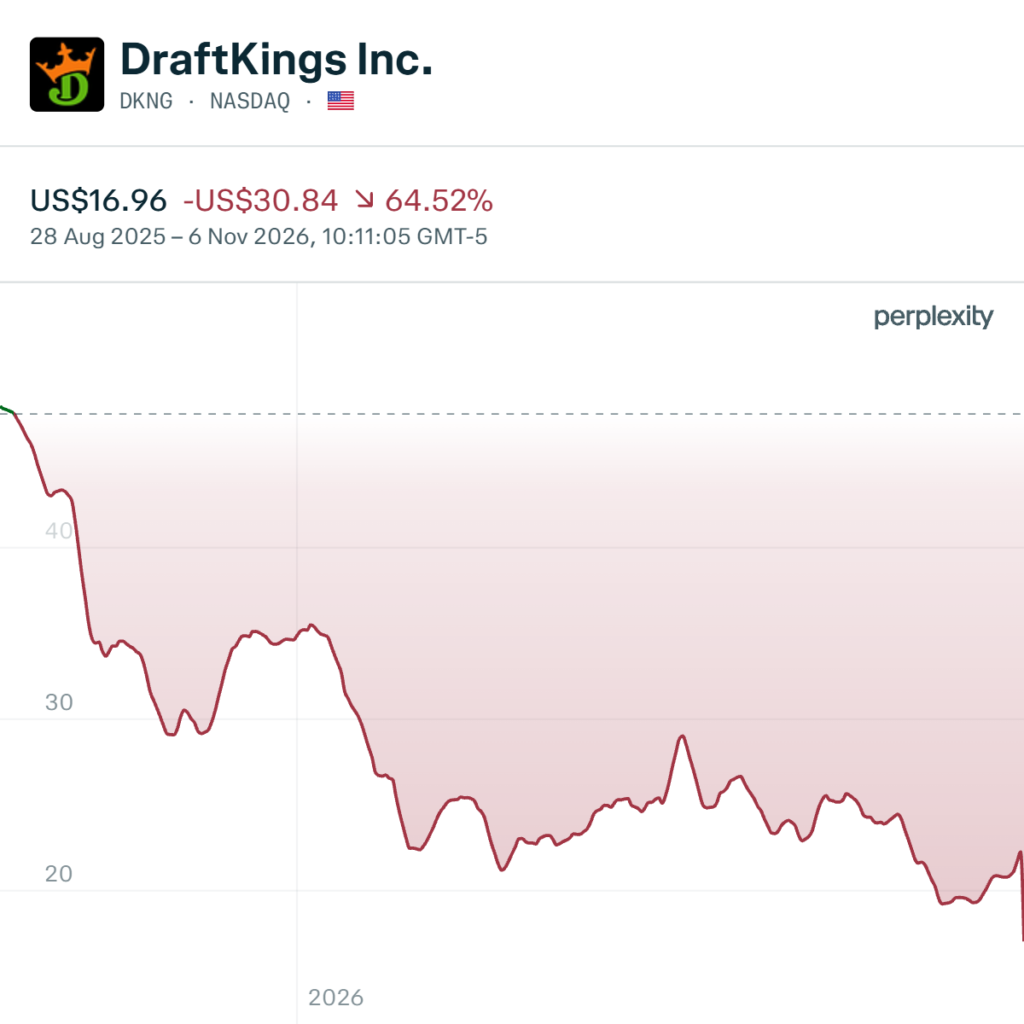
DraftKings shares fell by as much as a record 29% to $16.60, more than they fell on March 12, 2020, when sports leagues put their seasons on hold due to COVID.
The shares hit their lowest levels since early 2023, taking another $3 billion of DraftKings’ market capitalization, leaving the company valued at $8.4 billion. The shares are now down 65.6% since the end of August 2025, with $16 billion wiped off the company’s market value over that time period.
Third-quarter results
During the quarter, DraftKings reported revenue of $1.33 billion, with $783.6 million coming from sports (including predictions), $460.9 million from iGaming, and $84.5 million from other sources.
While the prediction market spend and CFTC announcement were part of the share price fall, Bender said that a disappointing iGaming performance played a part too.
“Another quarter of slowing iGaming growth was widely anticipated, but the miss was larger than expected,” he said.
The business reported an adjusted EBITDA loss of $316.9 million and a net loss of $468.7 million, as sales and marketing expenses grew by more than 68% to $605.6 million, mostly due to prediction market spend.