Every gold rush needs gold.
The prediction market version — the one where Kalshi, Polymarket, DraftKings, Underdog, FanDuel, NoVig, ProphetX, your Uncle Stu, CoinBase, Robinhood, and an ever-growing line of hopefuls have spent the past year sprinting to plant flags — is no different. And much of the gold, it turns out, is sitting in two states.
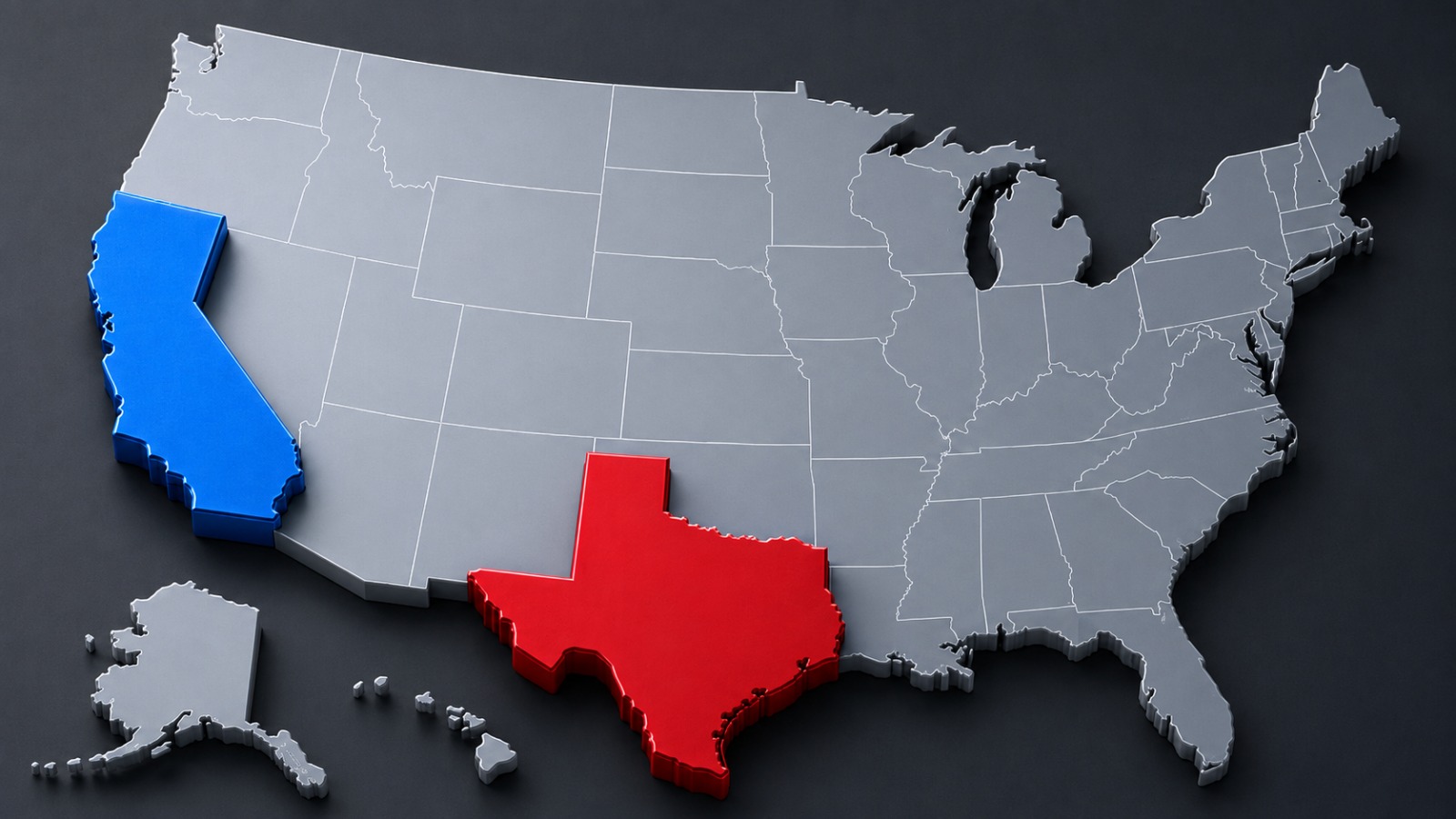
According to Eilers & Krejcik Gaming, 43% of all sports event contract volume in the country comes from California and Texas, which, for those scoring at home, are two states. And they are home to about 71 million people, or roughly 21% of the U.S. population. And nearly half the sports prediction market action.
Of course, those are two states where you can’t legally bet on sports with traditional sportsbooks.
But what if you could? What if California and Texas had done what some 30 other states have done in recent years and legalized online sports betting? Would there even be a gold rush to speak of?
The short answer, from a handful of people who watch this stuff for a living: Not like this.
No void, no rush
Let’s start with what the prediction markets are actually doing. EKG’s numbers suggest they aren’t so much eating the sportsbooks’ lunch as they are creating a whole new meal. In addition to the 43% number, a full 69% of all sports contract volume comes from the 19 states without legal online sports betting. In the mature, competitive states, Kalshi’s share of handle tops out around 2%.
California and Texas are the biggest holes on that map by a mile. Fill them in — give those 71 million people a legal, regulated app five or six years ago — and the ocean the prediction markets are so busy filling shrinks to a puddle.
The figures above come with an asterisk. They sit in EKG’s late-April Prediction Market Monitor, and they’re estimates — Kalshi doesn’t publish state-by-state volume, so the analytical firm builds them by taking the company’s public national numbers and slicing them with Google search trends, digital ad data, and its own competitive index, weighted against each state’s adult population. EKG updates the model quarterly and calls it a principled approximation, not a hard count. So treat the decimals with some skepticism.
But still.
Peter Hammon, an attorney with Vela Wood who counts a long list of gambling concerns among his clients, thinks the biggest change from legalization in California and Texas wouldn’t have been the valuations. It would have been who showed up to the party in the first place.
“I don’t think those companies would put the core business at risk by pursuing the prediction market opportunity,” Hammon said, meaning those like DraftKings, FanDuel, and Underdog. “If you have California and Texas all of a sudden, putting those two states at risk, and your relationship with those regulators at risk, is a hell of a lot different than putting a relationship with Indiana or Louisiana at risk.”
In other words: These companies didn’t wade into event contracts out of love for prediction markets. They waded in because California and Texas were sitting there, untouched, and the CFTC route was the only key that fit the lock.
The stock wrinkle
Jordan Bender, managing director, gaming equity research at Citizens, took the question somewhere unexpected. Ask him what happens to the DraftKings and Flutter share prices in that alternate world, and the intuitive answer might be that they’d be sitting prettier. Bender suggests the opposite.
“If the TAM, revenue and the EBITDA of these existing businesses was bigger than what it is today,” he said, “it’s almost like the perceived threat would cause them to fall harder, or the threat of cannibalization would be a bigger percentage of what these businesses are today. So I actually think the stocks would probably get hit worse.”
The logic: A bigger, fully legal sportsbook business is a bigger target. More to lose.
Bender also floated the theory that ties the whole thing together, and it starts at a trade show. At ICE in Barcelona in January 2025, he heard a rumor that Trump wanted to legalize sports betting across the country. It didn’t track at the time — Washington doesn’t legalize sports betting, states do. But looking back?
“Was this the plan all along, to kind of shove it through the CFTC and federally?” Bender said. “It sure feels like that was the thesis that we all missed when rumors were swirling that President Trump wanted to legalize betting across the U.S. in early 2025.”
Under that read, prediction markets aren’t a happy accident that filled a void. They’re the void-filler by design, the federal end-around for the states that wouldn’t budge. Either way, the punchline lands in the same spot: No California, no Texas, no $40 billion valuation for Kalshi.
“Is the $40 billion valuation what it would be if they didn’t have sports? No,” Bender said. “But it’d probably still be a pretty large valuation with a B at the end of it.”
The dissent
Not everyone thinks the map is the whole story.
John Pappas of Corridor Consulting, a longtime gaming industry lobbyist, argues the states were never really the barrier. Kalshi has shown it will offer its product in all 50 states, legal or not. The key wasn’t a gap on the map. It was a change in Washington.
“I don’t think Kalshi was seriously thinking about online sports betting until later 2024, after the administration change, when they knew they would have the opportunity to offer sports contracts,” Pappas said. “Under the current administration there is more opportunity to push the envelope. I don’t think if the Democrats had won the White House it would have been permissible.”
By that logic, the gold rush had less to do with California and Texas holding out and more to do with an election result. The gold was the legal theory, not the geography.
Chris Grove, partner emeritus at EKG, landed somewhere in the middle. Would legal sports betting in the two biggest states have changed things? Sure. Stopped them cold? No.
“It would have dampened growth and made the party less exciting,” Grove said. “But I don’t think it would have resulted in the music never starting.”
Which feels about right. The rush would still be a rush. Just a smaller, calmer one, with fewer prospectors and a lot less to dig for.
The tribes
There’s one more thread, and it runs through Indian Country.
James Siva, chairman of the California Nations Indian Gaming Association, points out that the counterfactual doesn’t just change the math for sportsbooks. It changes it for the tribes as well. Five years ago, California’s tribes were lined up behind Prop 26, the retail sports betting push. Push online betting three years ago, Siva said, and it “would have created a wider divide within the tribes.”
Instead, they held. And that decision to wait, painful as it may be with prediction markets now running loose in the state, is the same decision that gave the tribes the unity to fight those markets today.
“Our unity now has allowed us to push forward,” Siva said.
Unintended consequences
Texas climbed on its moral high horse about legalized gambling. California’s tribes decided to wait it out until they get the deal they want. Both are entitled to play it however they like. But sports betting showed up anyway in the form of event contracts.
Same games, same phones, same Sunday afternoons — minus the word “sportsbook” and, crucially, minus the tax revenue. New York pulled in more than $1.3 billion in sports betting taxes in 2025 off a population of about 20 million. California and Texas have 71 million people between them, and from event contracts their state governments are collecting exactly zero.
That’s roughly $4.6 billion, give or take, in a hypothetical annual tax haul left sitting on the table while the gold rush runs straight through their backyards.
Somewhere behind a few closed doors in Sacramento and Austin, you have to figure there are some folks quietly smashing their fists against the wall, asking the only question left to ask:
“What did we do?” Or, perhaps more precisely: “What didn’t we do?”