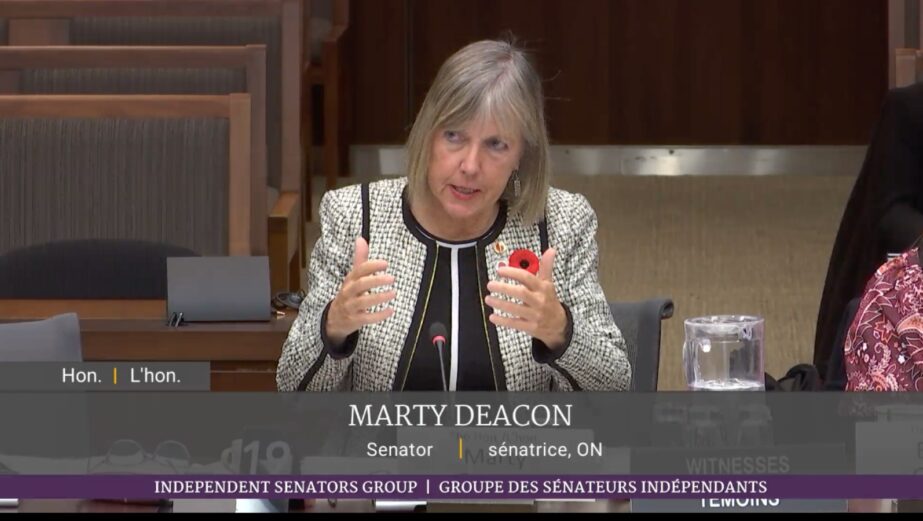

An amended version of S-211, the Canadian bill that would put a federal framework around gambling advertising in place, Tuesday afternoon passed out of the Committee on Canadian Heritage. It is now headed to the full House of Commons for a third reading. The bill advanced “on division,” which means a formal vote was not taken.
The proposal passed out of the Senate in October 2025, after Senator Marty Deacon introduced it in May of that year.
The committee amended the bill, increasing the number of years before a report is due to Parliament from one to two, and the number of days before before the report must be made public after tabling from 10 to 15. There were also some changes to the language:
- Under the definitions section, the definition of “Minister” was changed from the “Minister of Canadian Heritage” to “member or members of the King’s Privy Council for Canada under Section 2.1.”
- Under the content section, the phrase “national standards” was changed to “clinical guidelines” in 2(c).
- Under the consultations section, “must” was changed to “may” in Part 3, so the new line reads “For the purpose of developing the national framework, the Minister may consult with … “
- Also under the consultations section, the list of people the Minister may consult with was changed from a specific list of six other ministers to read “anyone the Minister wishes.”
The change from “must” to “may” in the consultations section is meaningful — rather than mandating that the minister in charge consult with certain others, the minister in charge now has the option to do that, or not.
All of the changes approved were put forth by the Liberal party, and all proposed changes by Conservative party members were shot down.
It’s not clear when the full House of Commons will consider the bill, but the chamber has 23 more sessions scheduled before adjournment for the year Dec. 11.
In-game betting ad ban denied
Among the proposals that did not pass was one from Conservative member Andrew Lawton that would have specified that the framework require the banning of advertisements for in-game betting. Lawton argued that such language would pinpoint what he says is a growing problem, but Liberal Fares El Soud suggested that such specifics “reduce the flexibility of the framework or the establishing or a framework.”
Amy Awad from the Dept. of Heritage told the committee that in any bill where “language specifies a view, it suggests a particular outcome or a type of outcome, so if we are very prescriptive in what that outcome is, it may influence the deliberations that would generate a framework.”
However, she said, that leaving the language out would not mean that it could not be added during the regulatory process. “Broad language allows for anything to be put in,” she said.
Lawton, who proposed two amendments, was clearly frustrated and pointed to decisions being made along party lines.
Before amendments were proposed, the committee heard from representatives from the Canadian Radio-television and Telecommunications Commission (CRCT) and the Health Canada. CRTC Secretary General Scott Hutton said his agency could only control broadcast advertising and does not play a role in monitoring other kinds of advertising, like on billboards or busses. Nonetheless, he said, clear guidance is needed.
Krista Apse of the Health Canada shared advertising experiences learned from other “vices,” including marijuana and tobacco, that might apply to gambling ad guidelines. She also told the committee that guidance from Parliament would help it to develop guidelines.
What’s inside the bill
So far, two Canadian provinces have approved and gone live with online gambling since Parliament voted to decriminalize single-event sports wagering in 2021. Ontario was the first, and operators there launched in April 2022. Alberta launched its online gaming markets in July. Lawmakers in three more provinces — New Brunswick, Nova Scotia, and Quebec — are reportedly all considering whether or not to legalize.
The bill calls for a federal framework for gambling advertising, though it is somewhat non-specific in what that will look like, leaving much of the decision making to those developing the regulations. It does call for the advertising regulations to restrict “the use of such advertising, limiting the number, scope or location” of advertisements or prohibiting or limiting the use of celebrities and athletes in advertising.
Ontario and Alberta, the two provinces with live online gambling, already ban the use of celebrities and athletes, unless they are promoting responsible gaming.
The proposal also calls for developing standards for the “prevention and diagnosis of harmful gambling and addiction and for support measures for persons who are impacted by it,” and for federal research into problem and responsible gaming.