New Commodity Futures Trading Commission (CFTC) Chair Michael Selig will direct the regulator to get involved with court cases about sports event contracts, and to write new prediction market rules, as the agency appears set to take a much more active stance in defending the controversial vertical.
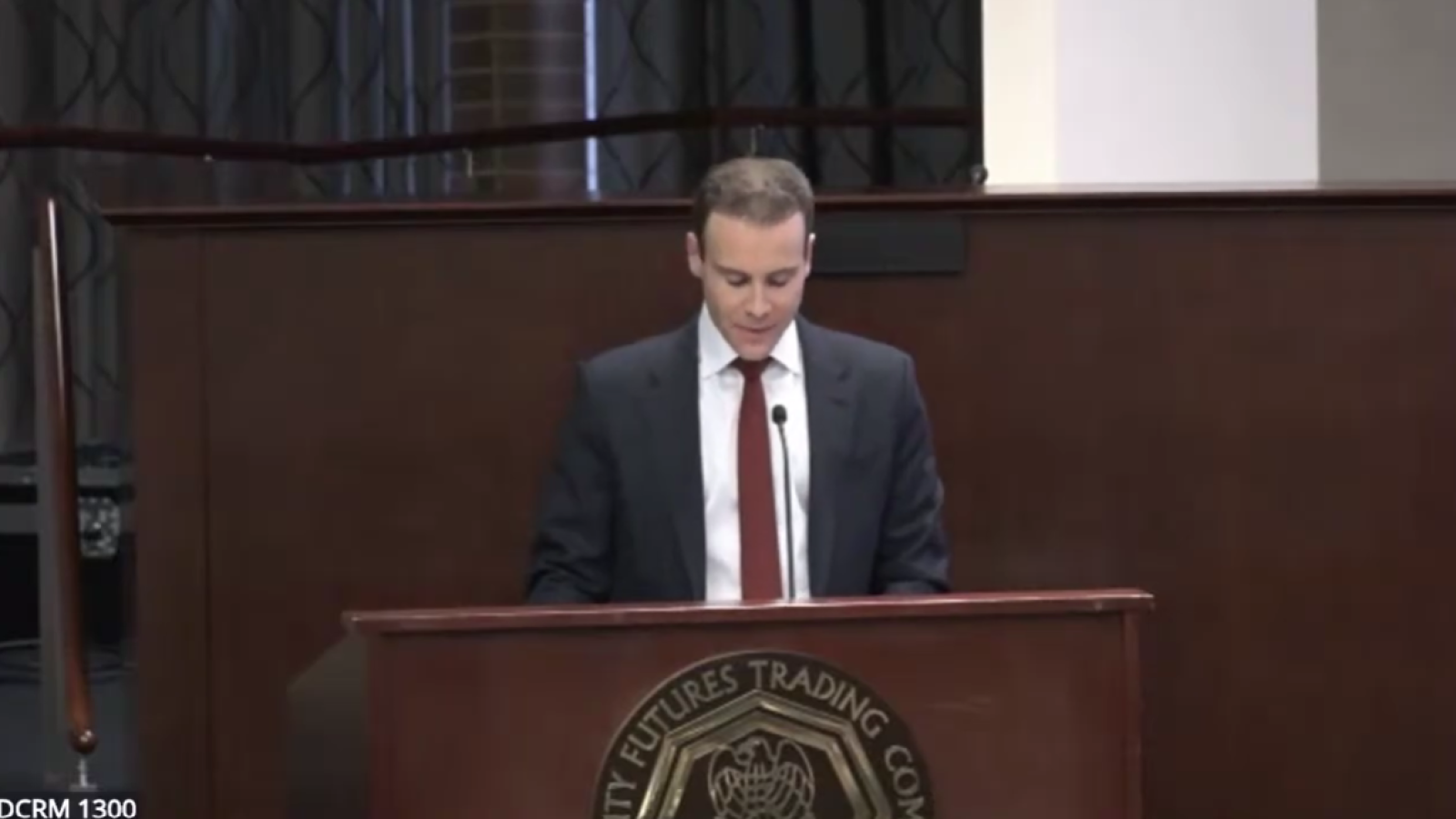
Selig was speaking at a CFTC-SEC “harmonization” event Thursday, that focused mostly on how the commission he now chairs will work alongside the financial securities regulator, where he used to work. He also said the CFTC would withdraw a guidance letter about sports event contracts from September 2025, and a 2024 proposed rule that would have banned event contracts on politics and sports.
Selig addressed prediction markets at the end of his opening remarks. He said that many people view the products as “novel or unsettled,” which he argued does not served the public interest.
Rather than sitting back quietly, as the commission did for most of 2025 under the interim leadership of Caroline Pham, Selig’s CFTC appears to be ready to more actively make the case that sports event contracts are legal.
That, Selig suggested, could include stepping in on court cases about the legality of sports event contracts.
Thus far, the CFTC has not played a part in those court cases, which are taking place across the country. Kalshi, the largest CFTC-regulated prediction market, is suing regulators from a number of states that have tried to shut down its sports offerings — including New Jersey, Nevada, and Maryland — in federal court, while it has also been sued by the Massachusetts attorney general in state court. Crypto.com has also sued Nevada over the same issue, while Nevada gaming authorities have sued Polymarket in state court.
Selig said he would “reassess” the commission’s stance on participating in these court cases, and may take active steps to involve itself, likely by filing an amicus brief arguing that it has jurisdiction over these contracts.
“I have directed CFTC staff to reassess the Commission’s participation in matters currently pending before the federal district and circuit courts,” Selig said. “Where jurisdictional questions are at issue, the Commission has the expertise and responsibility to defend its exclusive jurisdiction over commodity derivatives.”
Change from comments to Congress
In his confirmation hearing before the Senate Committee on Agriculture, Nutrition & Forestry in November, Selig answered almost every question about prediction markets by saying he would defer to the courts, even if the question was not on a matter that was actually being debated in any of the prediction market lawsuits.
But with this “reassessment,” the CFTC now appears ready to make an effort to convince the courts to permit sports event contracts, rather than following their lead.
“It’s a stark departure from what he said before Congress,” a gaming industry source, who has opposed the rise of sports event contracts, told InGame. “I would wonder if he feels that the prediction markets are losing in the courts at the moment.”
Would CFTC action change courts’ view?
Andrew Kim, a partner with Goodwin Law who has followed the various prediction market litigations but is not directly involved, told InGame that the impact of the CFTC getting involved in the cases will depend on what type of arguments it makes. He said that the CFTC simply arguing that it has jurisdiction over the products is unlikely to be convincing, but if it can show how it actually regulates the product then its insight could be more useful.
“I think it depends on what the CFTC says,” Kim said. “If the CFTC says, ‘we think the [Commodity Exchange Act] CEA preempts state gaming laws’ and it repeats the arguments raised by the prediction markets, I’m not sure judges will give that much additional weight/consideration.”
Federal agencies are generally given no deference on questions of preemption—preemption is for a court to decide.
“If, however, the CFTC says, ‘here’s how we regulate prediction markets, and here’s how co-regulation of prediction markets by the states might interfere with our ability to oversee them,’ I could see a few judges giving that analysis serious weight.
“A court might also give some weight to the CFTC’s understanding of what a ‘swap’ is, based on its experience as the federal regulator charged with overseeing swaps. “
All prediction market contracts are classed as swaps by the CFTC. According to the CEA, a swap includes “any agreement, contract, or transaction… that is dependent on the occurrence, nonoccurrence, or the extent of the occurrence of an event or contingency associated with a potential financial, economic, or commercial consequence.” States have argued that this means the financial consequence must be “inherent” to the event, while Kalshi says that any association with a financial consequence qualifies.
New event contract rules coming
Selig might be taking steps to ensure the CFTC can show how it regulates event contracts because he also promised new rules to govern the product, though he did not offer details about what those rules might look like.
“Looking ahead, and in the spirit of markets that trade on expectations, I have directed CFTC staff to move forward with drafting an event contracts rulemaking,” he said.
“For too long, the CFTC’s existing framework has proven difficult to apply and has failed our market participants. That is something I intend to fix by establishing clear standards for event contracts that provide certainty to market participants.”
Selig to withdraw sports contract guidance
Selig also planned to withdraw a guidance that the CFTC had issued to companies involved in prediction markets last year, where it told those businesses to have plans in place in case states succeed in their efforts to ban sports event contracts.
The guidance was issued just before last fall’s government shutdown, during which most CFTC staff were furloughed. In the letter, the CFTC noted that there were a number of lawsuits playing out around the country related to sports event contracts. It told prediction markets to plan for the possibility that sports event contracts could be shut down in certain states.
The letter said little about the CFTC’s actual stance on sports event contracts, apart from a footnote in which it noted that the commission had not decided either way on whether sports event contracts met the definition of “contracts involving gaming.”
However, it was referenced by Superior Court Judge Christopher Barry-Smith in Massachusetts when he granted an injunction to ban Kalshi’s sports event contracts in the commonwealth. The injunction has not yet gone into effect.
Barry-Smith argued that the letter suggested that Kalshi knew there was a legal risk to offering the contracts.
“While the advisory was issued at the staff level with the intent of bringing awareness to the litigation, it has instead contributed to uncertainty in our markets,” Selig said.
2024 proposed rule to be withdrawn, too
Selig added that he would also withdraw a 2024 proposed rule that would clarify that all event contracts on sports and politics would be considered contracts involving gaming contrary to the public interest, and therefore would not be permitted. That rule never came into effect.
In 2024, while working as outside counsel for venture capital fund Paradigm, Selig worked on a letter that argued that the proposed rule would have been “arbitrary and capricious.”
73943AlexanderGrieveThat letter argued that the definition of “contracts involving gaming,” should only include contracts where the underlying event that is being bet on is itself a game played for stakes, emphasizing the importance of the word “involving.” Under this definition, a contract on the winner of a poker tournament would likely be a contract involving gaming, but a contract on the winner of a football game would not be.
The question of whether sports event contracts count as contracts involving gaming has not played a significant part in the lawsuits currently taking place over the legality of the products. However, if sports event contracts are not “contracts involving gaming,” or classed as “similar” to contracts involving gaming via a specific rule or regulation, then the CFTC would not be able to ban them even if it believed them to be contrary to the public interest.