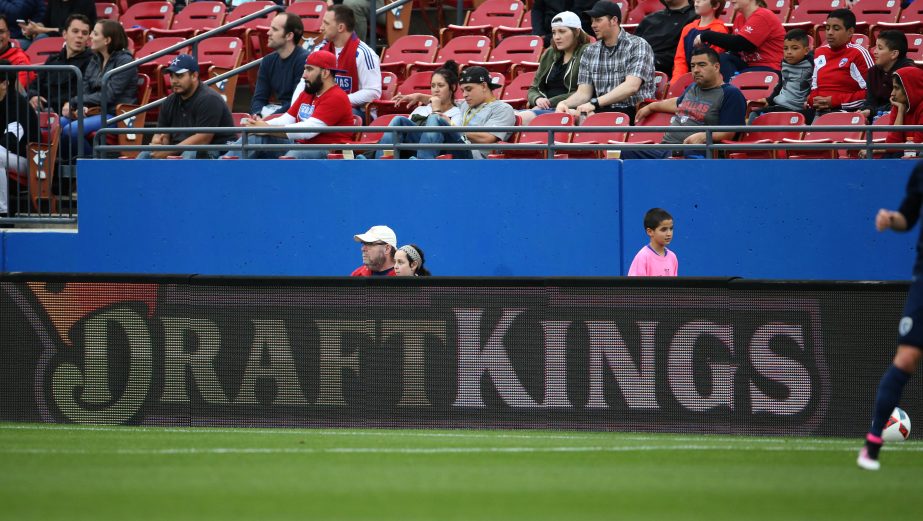

DraftKings CEO Jason Robins said the company has a “huge advantage” in marketing its prediction market, because “most customers don’t really even understand the difference” between the new vertical and a sportsbook, so it can promote both products together.
Robins was speaking on DraftKings’ earnings call Friday, after the company’s 2025 results were released Thursday afternoon. Much of the discussion concerned the company’s prediction market product, which launched in December. In a shareholder letter accompanying the results, Robins wrote that DraftKings is going to spend big on acquiring customers for its prediction market, and that the vertical will generate “hundreds of millions in annual revenue” in the years ahead.
‘Same message’ for sportsbook and predictions
On the call, Robins remained coy about how much DraftKings would spend to compete in the space, but he said that a significant amount of prediction market spending would just be repurposed from elsewhere.
“From a spend perspective, there’s fixed costs, which is double-digits [of millions], which is not that significant. That would include headcount, which is mostly repurposed but some new headcount,” he said.
“Marketing we’re expecting to spend. For competitive purposes I don’t want to give an exact number. But we can repurpose some of our national spend.”
The DraftKings CEO went on to add that the business can market its sportsbook and prediction market offering via the same campaigns, because most customers see the products as effectively the same.
“I think this is actually a huge advantage of ours,” he said. “Most customers don’t really even understand the difference. So I think the national marketing footprint is a big advantage because we can drive people towards our product and we can use it in ways that we can rotate messages and have slightly different things, but in essence it’s the same message to the customer. It can drive value to both products at the same time.”
CFTC chair comments helped DraftKings go all-in
Robins also said the company’s decision to fully embrace prediction markets rather than simply test the waters came because the Commodity Futures Trading Commission (CFTC) became more full-throated in its support for the vertical. Last month, CFTC chair Michael Selig said that the regulator was going to write new rules for event contracts and participate in ongoing court cases to defend the product.
“There’s been a real lean-in from the CFTC,” he said. “What was a hands-off, ‘We’re not going to comment,’ posture, went to real support.
“Anything that creates a stable regulatory environment that allows us to think freely is a real upside for us.”
2026 guidance does not include predictions revenue
DraftKings shares plunged Friday morning — down as much as 15% to $21.28, meaning Kalshi overtook the operator in value — due mostly to the company’s 2026 guidance disappointing Wall Street.
Robins said that there was upside potential to the “conservative” guidance, partly because the figure assumes zero prediction market revenue in 2026.
“Predictions is all upside,” Robins said. “There’s nothing in terms of revenue in the guide. There’ll probably be some revenue but we left that out of the guidance.”
He added that the business had long-term advantages in the space as it rolls out its market-making capabilities and the Railbird exchange, which it bought in October. Railbird is expected to launch in the second quarter of this year.
“We just have so much infrastructure and so much data to be able to build on and leverage,” he said. “In terms of the liquidity question, every market maker is lining up to be set up for Railbird. And then the DraftKings market maker is going to be a real differentiator in creating liquidity.”