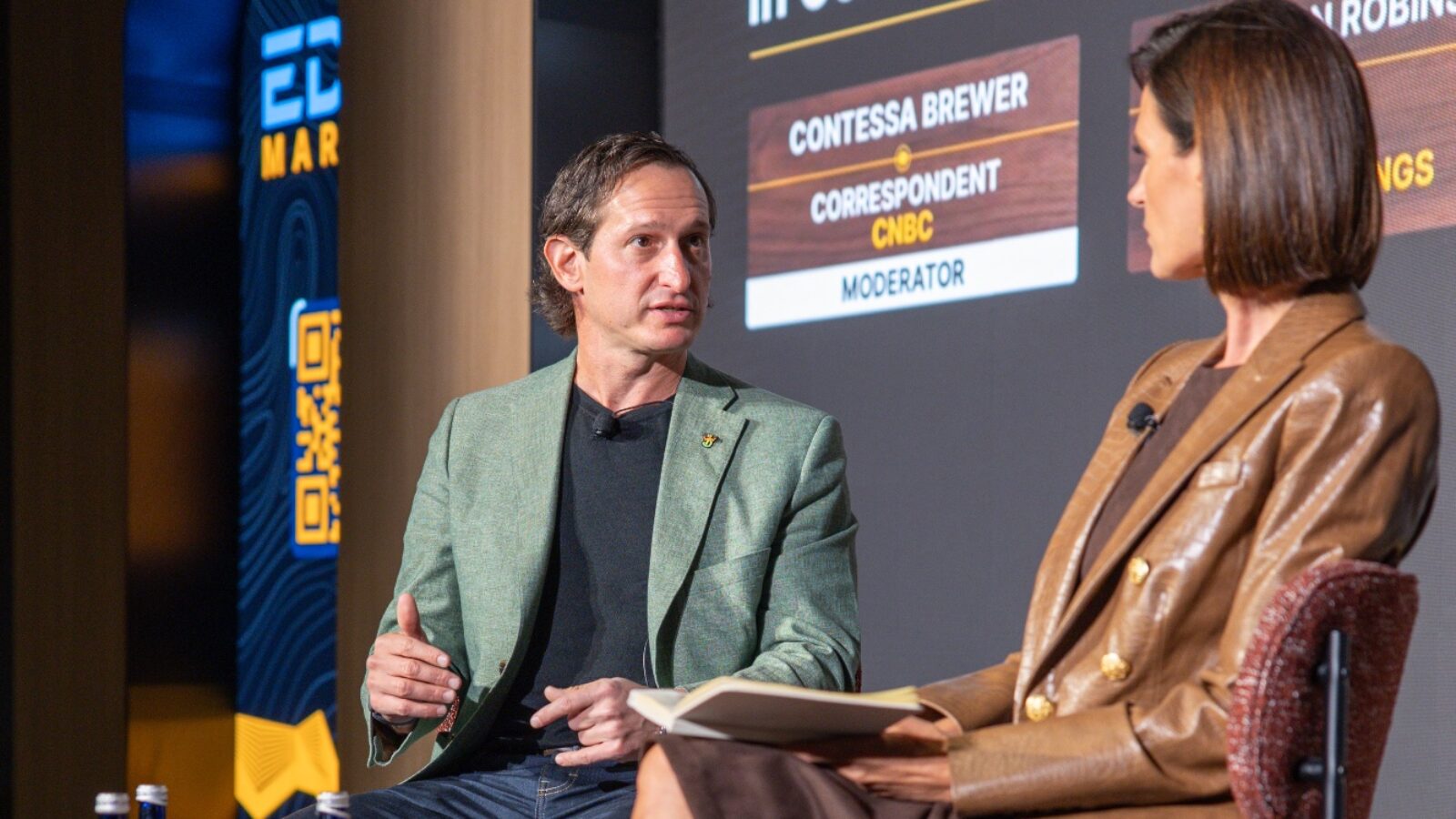
NEW YORK — DraftKings CEO Jason Robins says the company is in a “win-win spot,” unlike most prediction markets or sportsbooks, where it should succeed regardless of how the Supreme Court views sports event contracts.
Robins was speaking Thursday at the NEXTPredict conference in New York, discussing the performance of DKeX, where the company sat with regard to prediction market litigation, and the company’s share performance.
DKeX third In volume
New entrants such as Kalshi and Polymarket have added competition for DraftKings (though Robins has downplayed the extent to which they are truly in competition), leading to a perception on Wall Street that DraftKings benefits most from a shutdown of sports event contracts. Shares in the company have risen after major legal wins for states against prediction markets and fallen after defeats.
But as Robins pointed out, DraftKings’ DKeX has quickly shot into third place among prediction markets in volume, trailing only Kalshi and Polymarket, despite only launching in June and doing minimal volume until September. DKeX is still a long way behind Kalshi, but ahead of exchanges such as Underdog, Novig, Crypto.com, and ProphetX.
This, he said, leaves the company better-equipped to survive a world without sports contracts than prediction-market-first businesses, but better-equipped to survive a world where those contracts continue than other sportsbooks.
“If [sports contracts are] the whole business, which for us it is not, then that's obviously critical. There's nothing to look out to if the entire sports business is gone,” Robins said. “On the other side, if you haven't done what we've done and invested and put ourselves in a position where we're meeting players in predictions now, then if a court decision goes the positive way, then that's a pretty tough spot to be in.
“So we actually feel like we put ourselves in this win-win spot where no matter what the outcome of that process is, we are well positioned going forward.”
Robins added that DKeX’s success came despite DraftKings not offering prediction markets in those states, such as New York, where its sportsbook is available.
“Imagine if we were, right?” Robins said. “We would be even bigger.”
Robins: SCOTUS is 'big deal' for others, not us
This state-by-state approach, Robins said, is part of why DraftKings is not tied to the Supreme Court taking a specific position on sports event contracts.
The Supreme Court is currently considering whether to take up New Jersey’s appeal of a Third Circuit ruling upholding the legality of sports event contracts. It is widely believed among lawyers following the cases that, whether or not it chooses to take up this specific appeal, the Supreme Court will ultimately take on a sports event contract case due to the level of disagreement in lower-court cases about the products.
“I'm hopeful that it ends up being something that is a little bit long-term, but I also feel like if that doesn't happen, we're in a great spot,” Robins said. “And one of the reasons why is that we really work hard to create a really respectful relationship with our regulators and let them know that we aren't going to operate in the markets where we have regulated OSB.
“I think on both sides, there are companies that have really staked a lot on one outcome or the other,” he said. “It's a pretty big deal for them, whether it ends up going away.”
Market making and institutions
Though not mentioned directly Thursday, DraftKings likely also makes money from market making on both DKeX and other exchanges. The business started putting some of its staff to work on market making earlier this year. In August, before DKeX processed significant volume, Robins said DraftKings was market making on three exchanges. It is likely that it also makes markets on DKeX, where parlay takers have lost a higher percentage of their stakes so far than on Kalshi or Polymarket US.
Taker losses on parlays on DKeX as of Oct. 20 total more than $60 million, though there is no way of knowing how much, if any, of that may have been won by DraftKings’ trading team.
Robins did note that DKeX had not gone out of its way to provide tools for other major institutional market makers. While DKeX wouldn’t be able to block major institutional firms like Susquehanna International Group from trading due to the CFTC’s “impartial access” rules, Robins said that DraftKings would like to ensure that its prediction market customers don’t lose so quickly that they stop coming back and therefore has not yet specifically courted institutions.
“My personal belief is that the more of that you introduce into a peer-to-peer ecosystem, the faster that the retail customer will have to spend money in order to keep up,” he said. “And I think that that may create a worse customer experience than maybe having less institutions.
“Now, we can't prevent them from being on the platform of course, but we have at least to date chosen not to invest in product features that are geared specifically to algorithmic traders, to institutional investors, because we do think that creates a healthier long-term ecosystem.”
Contrast with FanDuel
DraftKings appears to have leant into prediction markets more than longtime rival FanDuel. While FanDuel offers a prediction market app including sports event contracts, it does not own its own exchange and has put less of a focus into marketing its sports event contracts.
Last month, during the Global Gaming Expo, Flutter Entertainment Chief Financial Officer Rob Coldrake told JP Morgan analysts that prediction markets being “completely switched off” would likely be the best outcome for FanDuel.
Robins said that DraftKings’ more agnostic position has helped to ease some investor concerns about the business, but that the business is still not getting enough credit for how well-suited it is to manage any possible outcome of sports event contract litigation.
“There's public markets and private markets. Private markets love uncertainty, that's what they thrive on. Public markets are the opposite. They do not like uncertainty. They want predictable, steady earnings, things like that.
“So, I do think that we are suffering from the uncertainty of it all, and I hope that we start to get more credit as we show traction and predictions, but, you know ... we might not really get full credit until there's a Supreme Court ruling.”
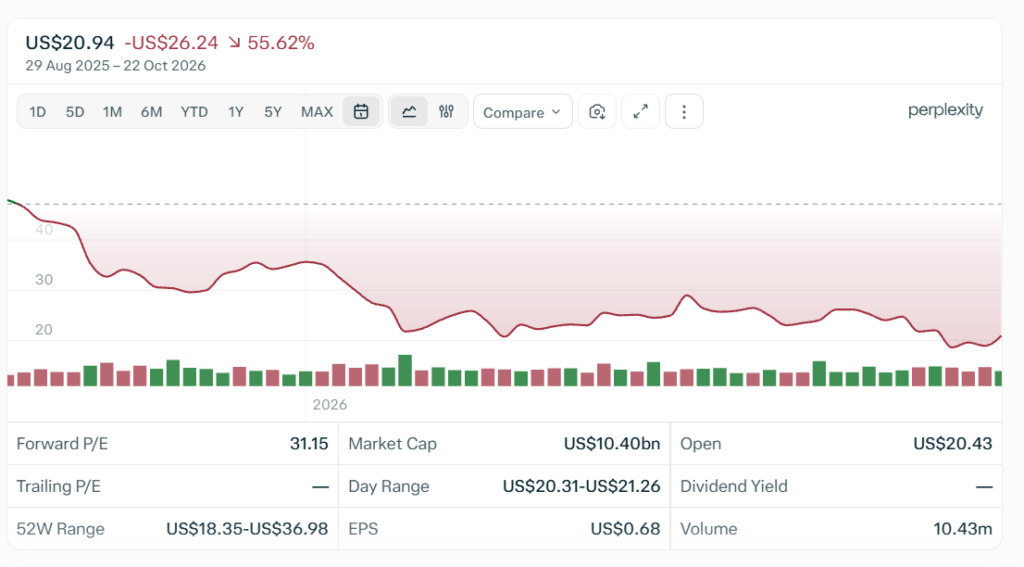
After hitting their lowest level since 2023 at the start of this month, DraftKings shares are now up 12.2% since Oct. 2.
On Thursday, DraftKings shares were up 2% to $20.94, valuing the company at $10.39 billion. That is still down more than 55% since late August 2025.