Kalshi’s lawyer says the company sits outside the reach of Indian Gaming Regulatory Act (IGRA) lawsuits entirely, arguing that “not once” has a party that isn’t a tribe, state, or acting on behalf of a tribe or state, been sued under the law.
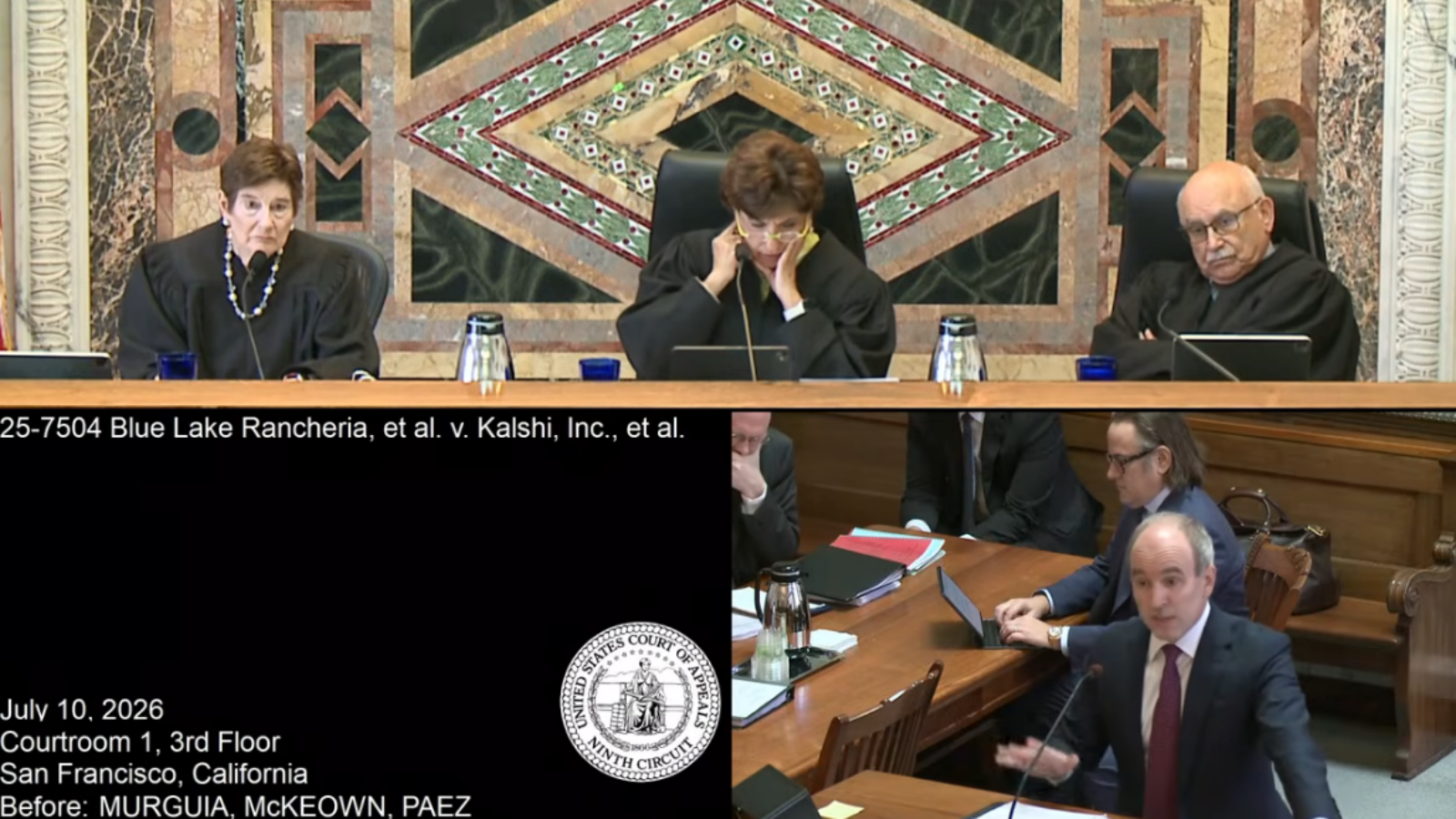
Kalshi and three California tribes — Blue Lake Rancheria, Chicken Ranch Rancheria of Me-Wuk Indians, and Picayune Rancheria of the Chukchansi Indians — engaged in oral arguments before the Ninth Circuit Friday.
The hearing comes after the tribes appealed the November U.S. District Court for the Northern District of California’s opinion not to grant an injunction that would have banned Kalshi’s sports contracts from tribal lands.
In her district court opinion, Judge Jacqueline Scott Corley appeared sympathetic to the tribes’ arguments on moral grounds, but found that the prediction market did not actually violate the text of any tribal compacts. Of the three tribes suing Kalshi, only Picayune Rancheria has a compact with the state, while the other two have secretarial procedures, which function similarly to compacts but are imposed by the Department of the Interior if a state does not negotiate with a tribe in good faith.
While Kalshi is engaged in lawsuits over the legality of its sports event contracts across the nation, most of those are against states. This lawsuit, against three tribes, mostly involves different legal principles, as it is not about whether the federal Commodity Exchange Act (CEA) preempts state law — rather it is about whether or not one federal law preempts another. Kalshi is also involved in lawsuits against the Ho-Chunk Tribe of Wisconsin and the Mescalero Apache Nation in New Mexico. Kalshi lawyers made the same arguments in those cases — the company is not party to tribal-state compacts, so cannot be in violation of them.
Blue Lake lawyer: Kalshi violated ordinances
Before the Ninth Circuit, attorney Lester Marston for Blue Lake Rancheria et al argued that Kalshi violated the tribes’ gaming ordinances, its set of rules regulating the gaming operation authorized under a compact or secretarial procedures.
He then argued that a violation of the ordinances would itself be a violation of the compact, because a compact requires adherence to the ordinances.
In addition, he said that IGRA says Class III gaming – which includes sports betting – can only be offered if authorized by ordinance, and that IGRA allows tribes to sue to enjoin any class III gaming not conducted in accordance with ordinances.
“You can’t just look at the compact and the ordinances because they’re not the sole bodies of law at play,” Marston said. “You also have to look at the provisions of the Indian Gaming Regulatory Act.”
Kalshi lawyer uses recycled argument
Kalshi lawyer Grant Mainland repeated an argument made before multiple districts court and in written briefs, that Kalshi was not a party to any of the compacts or secretarial procedures, and so can’t have violated them.
“Not once has IGRA been used in the manner proposed here,” he said. “We have found only one case, Cayuga Nation, where a private party was sued by a tribe for violating IGRA, and that party was acting as an agent of the state.”
He then argued that even if violating the ordinance was considered to be the same as violating the compact — a stance he also disagreed with — Kalshi did not actually violate the ordinance.
“While compacts may be special, they are nonetheless interpreted as another contract would be,” he said. “They are not regulatory law. And what you do, like with any contract, is you look at the text. What is the actual conduct by Kalshi that is prohibited in the text?”
He also drew a distinction between offering a form of gaming that is not authorized by a compact and actually violating its terms. In every tribal case, Mainland has argued that the sports event contracts offered by his client aren’t, by definition, gambling.
“They have pointed to nothing that Kalshi has done that violates any language in the only compact they have agreed to,” he said. “Instead they say the conduct engaged in is unauthorized.”
Mainland added that sports betting is not defined under the compact, or in IGRA, and so argued that the court should use the definition in the Unlawful Internet Gambling Enforcement Act (UIGEA). That act carves out trading on Commodity Futures Trading Commission-regulated designated contract markets. As a result, he said, Kalshi is not offering unauthorized Class III gaming.