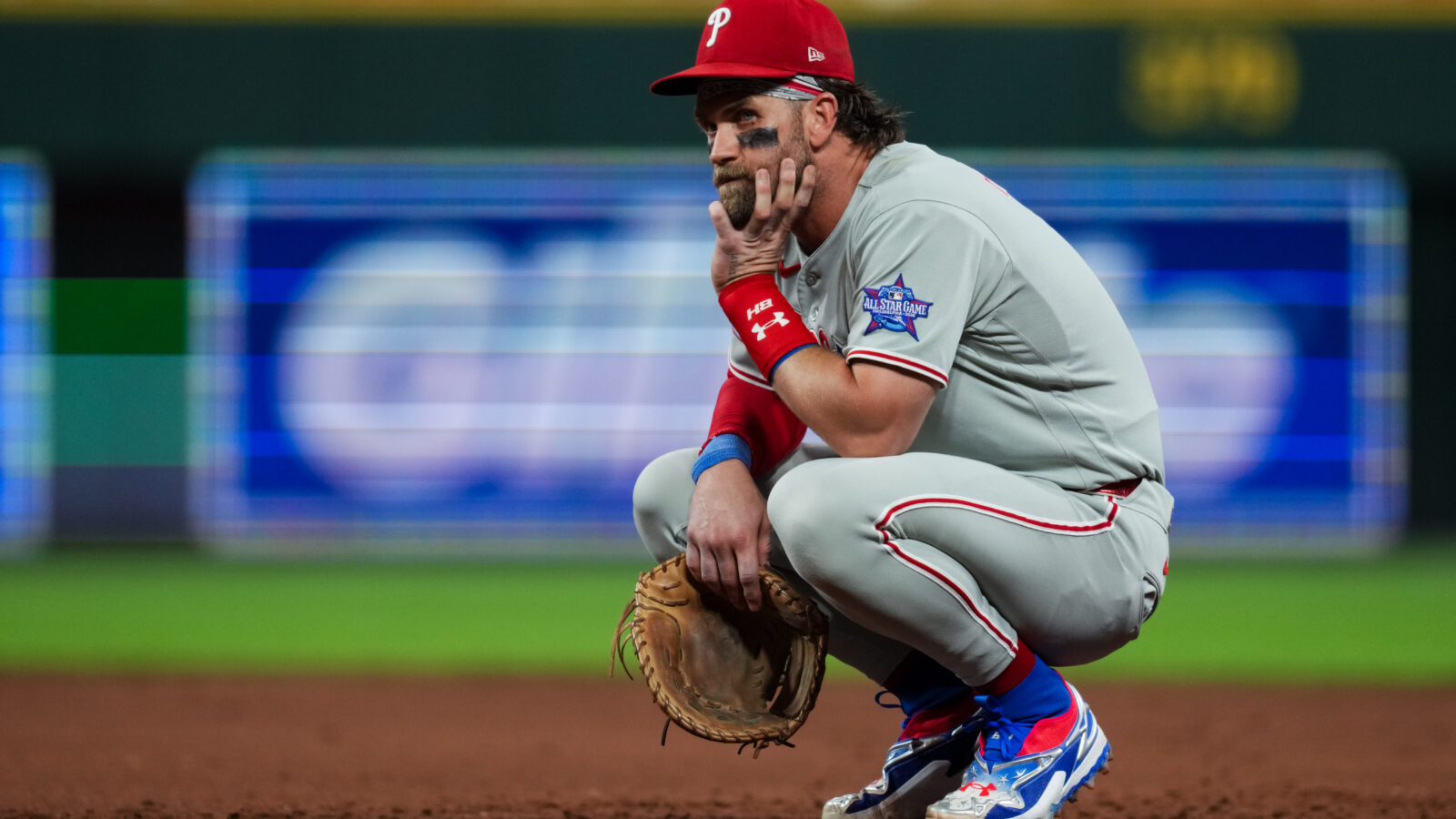
As Major League Baseball’s All-Star festivities get underway in Philadelphia on Monday, one of the league’s most recognizable stars is attempting to distance himself from what can be described, at best, as an unfortunate incident or a really bad look.
Last week, The Philadelphia Inquirer published a story headlined, “FanDuel sent a personal message from Phillies star Bryce Harper to a customer with a gambling addiction.”
The story traces back to November 2024 when a FanDuel VIP account manager, Bryttanni Morgan, procured a video for her then-VIP client Terry Thompson, a Phillies and Harper fan. Morgan submitted a request on the celebrity video platform Cameo (see below), where various people of some note on the A, B, C, or D celebrity lists charge anywhere from $25 to over $1,000 for short, personalized clips tailored toward the recipient.
In this video, Harper addresses Thompson by name and tells him that the VIP host requested the video “to make sure your Thanksgiving was extra special. So I just wanted to hop on here and wish you and your family a wonderful Thanksgiving.” Harper acknowledges Thompson’s son in a 21-second video and thanks Thompson for his support.
On Monday, Harper, who charges $899 per video on Cameo, released a statement on Instagram attempting to clarify some of the facts about how this video came to be, and how much knowledge he had about it. It says (transcription below the image):
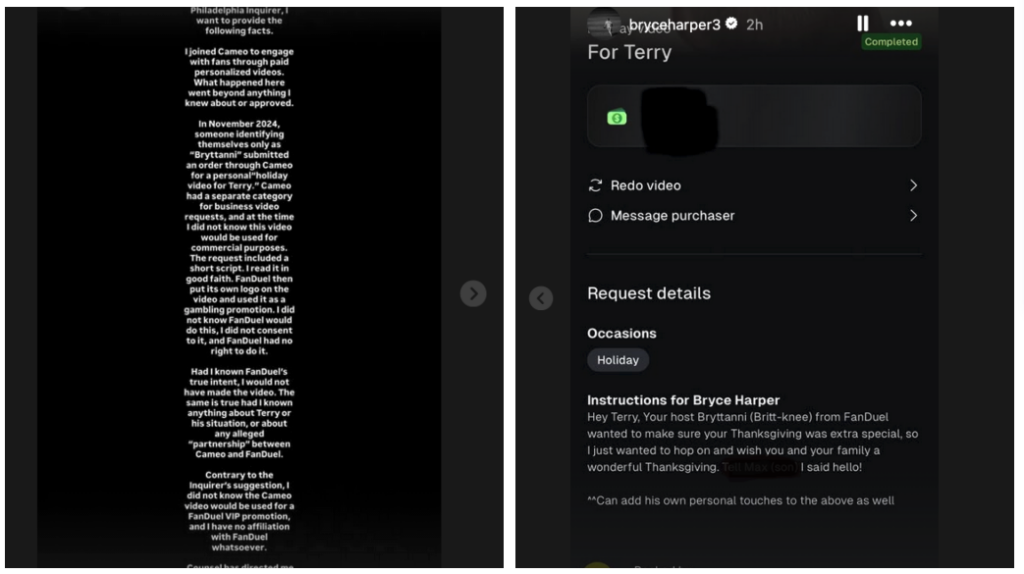
I joined Cameo to engage with fans through paid personalized videos. What happened here went beyond anything I knew about or approved.
In November 2024, someone identifying themselves only as “Bryttanni” submitted an order through Cameo for a personal “holiday video for Terry.” Cameo had a separate category for business video requests, and at the time I did not know this video would be used for commercial purposes. The request included a short script. I read it in good faith. FanDuel then put its own logo on the video and used it as a gambling promotion. I did not know FanDuel would do this, I did not consent to it, and FanDuel had no right to do it.
Had I known FanDuel’s true intent, I would not have made the video. The same is true had I known anything about Terry or his situation, or about any alleged “partnership” between Cameo and FanDuel.
Contrary to the Inquirer’s suggestion, I did not know the Cameo video would be used for a FanDuel VIP promotion, and I have no affiliation with FanDuel whatsoever.
Counsel has directed me to not comment any further at this time.
The reference to Terry’s situation is two-fold. At the time the video was made and provided to him, Thompson apparently was spiraling in addiction, leading to alleged losses of $1.52 million on FanDuel and $336,000 on DraftKings, according to a lawsuit against the companies filed in March.
In a statement given to Front Office Sports, a FanDuel spokesperson said the company “is committed to fostering a culture of responsible gaming and protecting our customers. Unlike illegal offshore sportsbooks, FanDuel employees are trained to recognize and flag signs of problem gambling and offer resources and tools, and we continue to review and strengthen our policies to ensure we have the industry’s strongest consumer protection initiatives.”
Meanwhile, the VIP manager is also a named defendant in the lawsuit against the betting companies.
As far as Harper, it’s difficult if not impossible to divine how much he knew about the nature of the video or about Thompson and his struggle with gambling addiction. Did the video itself induce Thompson to continue gambling beyond his means? Who knows.
As far as what FanDuel or any company has the right to do with a video that the company or its employee lawfully purchased (like stamp it with a watermark), that’s potentially another legal question to untangle.
The only easy question to answer here is whether Harper or any athletes should fulfill video requests for any individual in connection with their gambling activity.