For all its willingness to move fast and break things in the name of hedging risk and signaling truth, Kalshi will not allow its users to trade on whether or not the Supreme Court will hear a case involving prediction markets.
Nor will Kalshi allow users to predict how such a court ruling might impact the future of sports event contracts on the exchange. While adverse court rulings have begun to stack up against Kalshi’s theory of the case, there remain credible reasons to back any outcome at all from submissions to the highest court.
A major, underappreciated reason that the Kalshi-versus-states legal and regulatory quandary is particularly vexing for courts, stakeholders, and anyone trying to evaluate what the heck is happening is that the Commodity Exchange Act (CEA), itself an outgrowth of what was originally the Grain Futures Act of 1922, has been substantively amended five times by five different Congresses, addressing distinct crises with divergent policy goals.
Some statutory surgeries put up guardrails (1974, 1992, 2010), while others focused on deregulation (2000). The resulting law is a tapestry stitched together in a way that left daylight for Kalshi to build an enormous business within it — on the basis that sports event contracts are swaps — but left enough shade for the existence of credible, competing interpretations about what the law actually says, means, and permits.
One of the cases bubbling up through the circuit courts is very likely headed to the U.S. Supreme Court. The first candidate case arrived Sept. 2 when New Jersey requested the court’s review of a Third Circuit Court of Appeals decision favoring Kalshi’s argument that its sports event contracts are subject only to federal regulation.
The lawsuits between Kalshi and states mainly boil down to two questions: (1) Do sports event contracts qualify as “swaps” under the CEA? (2) Does the CEA preempt state gaming laws with regard to transactions involving swaps? Kalshi would need the answer to both questions to be “yes” if it wants to prevent states from banning its sports contracts.
An eventual Supreme Court decision would, and probably will, change the trajectory of prediction markets and sports events contracts in a profound way. But this will come at a time when, as legal scholar Jesse M. Cross of the University of South Carolina has observed, the contemporary Supreme Court has shown a “troubling inability to locate democratic decisions embedded in our amended statutes.”
Cross and other scholars have found that the court has constrained itself in its approach, at times “even adopting a temporal fiction: It pretends that the statutory text it interprets is borne of a single enactment,” which “empowers the Court to seek ‘original’ meaning at a single moment in time, rather than reckoning with the temporal layers of a statute.” Other self-imposed constraints have left the court untethered from congressional goals in its interpretation of amended statutes.
Making the legal picture and range of potential outcomes even murkier, some judges will consider legislative history (“purposivists”) when evaluating the language of the CEA or any other statute. However, other judges, such as Justice Neil Gorsuch, are known as “textualists” who generally do not consider that history.
Describing the role of the late Supreme Court Justice Antonin Scalia in this interpretative realm, scholars Stuart Minor Benjamin and Kristen M. Renberg wrote in 2020 that “his opposition to legislative history was categorical, he was on the Supreme Court, he repeatedly attacked the use of legislative history, and his language was sharp (and quotable). Scalia was most closely associated with the campaign against the use of legislative history in deciding cases, and indeed there is a consensus that Scalia brought the issue to the fore and led the movement.”
Disciples of Scalia’s thinking, of which there are several currently on the Supreme Court bench, will ignore available legislative history for the CEA and attempt to make sense of the on-paper semantic alterations spanning nearly a century of American crisis, Congresses, and compromises. But even for “purposivist” judges who will weigh available legislative history, well, the cupboard is barren in the prediction markets dispute.
Section 745 of the Dodd-Frank Wall Street Reform and Consumer Protection Act of 2010 (“Dodd-Frank”), provided in a 2010 amendment to the CEA in the wake of the global financial crisis, intended mainly to put up guardrails for derivatives like credit default swaps that led to insurance giant AIG’s near collapse. There is no committee report discussing the pertinent part that added the event contracts special rule, (§ 5c(c)(5)(C), which directly addresses “gaming” contracts. The hearings around Dodd-Frank focused overwhelmingly on systemic risk, clearing mandates, swap dealer definitions, position limits, and other major Title VII controversies.
Yet there is one colloquy, a staged exchange between former Democratic Senators Blanche Lincoln of Arkansas and Dianne Feinstein of California, on the last day before passage of the law. This colloquy has been widely cited throughout the litigation by opponents and proponents of sports event contacts — with conflicting interpretations — as revealing Congress’ true intent for sports-related contracts in the derivatives realm.
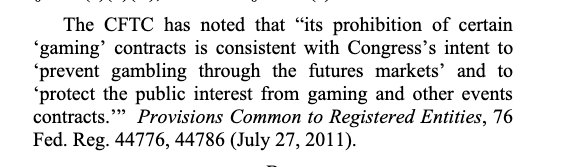
But this is a single colloquy that may have been intended to steer the Commodity Futures Trading Commission (CFTC) and/or influence judges. It did not actually codify anything and simply cannot bear the amount of weight some stakeholders are giving it, if it should or will be given any weight at all by the Supreme Court. This citation below to the colloquy comes from the Ninth Circuit’s ruling in KalshiEx LLC v. Assad:
Judicial decisions, particularly in the context of amended statutes, can be inconsistent. The questions presented around the CEA and sports events contracts in general have been especially incoherent. The inescapable backdrop is that in 2010, Congress as a body did not specifically or sufficiently contemplate the federal regulation of sports event contracts, which are tantamount to sports gambling traditionally regulated by states, as the Supreme Court addressed nearly a decade later in 2018 in Murphy v NCAA.
The prediction markets dispute is essentially asking whether the CEA silently federalized the very activity that in Murphy the court declared the realm of the states to decide — through a statute enacted eight years before Murphy, when legal sports betting did not exist outside of Nevada.
“If Congress really wanted to be clear in prohibiting something or permitting something, they could be clear. Instead, they did a terrible job,” commodities law specialist David Aron observed in a conversation with my colleague Daniel O’Boyle about certain CEA and CFTC language.
When ultimately called upon, the Supreme Court will make some determination based on selected canons of statutory interpretation, but the decision will boil down to judicial preferences — not so much policy choices specifically and deliberately contemplated by Congress. The net result is likely to be a decision with wide-ranging consequences that’s rooted in judicial policymaking.
“I’m not saying [judges are] looking for things to justify their view, but there are so many canons of statutory interpretation that cut against each other,” Aron said.
In this vacuum, there are credible arguments (some more than others) both for and against the statutory validity of sports event contracts. We’ll get a decision, all right, but it will be akin to the court explaining the definitive meaning of a Jackson Pollock painting.
If the future of sports events contracts is to be shaped with any clarity, precision, and enduring guardrails, consistent with the auspices of the American people, that job is one only for Congress, not the courts.
On statutory interpretation and the messiness of amended statutes
Before the U.S. was a nation of amended statutes, it was a nation of just statutes. Today, there are lots of disputes around amended statutes landing on the Supreme Court docket, though not all of them are as heavily amended as the CEA.
Per Cross, the scholar, in the Supreme Court’s 2022 term, cases involving amended statutes comprised 95% of the court’s statutory cases — and more than 70% of its total docket.
When the Ninth Circuit was called upon to assess the earliest initiated prediction markets dispute involving Kalshi and the state of Nevada, its opinion cited a crucial Supreme Court decision in Loper Bright Enters. v. Raimondo:
Courts routinely interpret statutory language to determine whether state law is preempted and the scope of that preemption. “The very point of the traditional tools of statutory construction” — the tools courts use every day — “is to resolve [such] statutory ambiguities.“
That is true. And yet, as legal scholars Lisa Schultz Bressman and Abbe Gluck observed in their 2013 work on “Statutory Interpretation from the Inside”:
[F]ederal courts are notoriously inconsistent in their application of the canons, a fact that undermines the efficacy of any canons ostensibly targeted to provide coherence, notice, or consistency. Regardless, the public justifications that judges do use — those that typically turn on canon awareness or use — have an important expressive purpose. Judges use them to legitimize their interpretive choices and, by extension, the judicial power to make those choices.
Bressman and Gluck undertook a large-scale, in-depth survey of notoriously hard-to-reach congressional staffers involved in the legislative drafting process. The authors probed (among other things) how staffers choose certain language, their awareness of certain interpretative canons, and their expectations for future judicial application, as part of the interbranch interpretive feedback loop. More on this later.
Combining the two current realities around prediction markets and sports event contracts, the CEA is an inherently complex, multi-temporal statute amended five times over nearly a century. Add to that the predictable inconsistency in the way that federal judges and Supreme Court justices apply canons of statutory construction, and you have a recipe for pretty much any judicial result in whichever case bubbles up to the SCOTUS docket.
When judges do examine a statute’s amendatory history, they tend to draw inferences from the statutory textual changes across history — as opposed to legislative history — without asking which Congress made them or why, treating amendments from different decades as though they were coordinated edits into a single piece of legislation.
Anita Krishnakumar, a law professor at Georgetown University Law Center, documented this empirically and specifically to the Chief Justice John Roberts-led Supreme Court in the 2005–18 terms:
Some of the cases [examined] say things like “we doubt that Congress meant” for the amended language to alter the statute’s “longstanding thrust,” or “[i]t would be passing strange” to read the amendment to change the statute’s meaning, or that Congress’s retention of specific language “suggests” that it did not mean to alter the statute’s meaning. Such language reflects the leaps of logic that the Court (or authoring Justice) is making in these cases: it could very well be the case that Congress amended a statute precisely in order to change its longstanding thrust, rather than simply to clarify the meaning the statute had all along, but the Court in these cases is making a negative implication inference in the opposite direction.
The problem is that this decontextualized use of statutory history shifts authority to judges, rather than elected lawmakers, to fill in the gaps between different versions of a statute. And judges engage in substantial speculation when performing such gap filling. This is known as judicial policymaking, or legislating from the bench.
Regarding the stakes and consequences, Cross argues:
Any method of interpreting amended statutes must answer to a democratic imperative in statutory interpretation. That imperative is grounded in a basic premise: In our system, the people choose representatives, and those representatives choose rules. If legislators cannot dictate rules or goals, after all, there is nothing meaningfully democratic about our system of government.
Applying Cross’ thinking to the statute under dispute, some courts are reading the CEA as a “monotemporal” document, treating it as if it all came into existence at one moment in time. But the CEA has a lot of layers along a lengthy lifespan.
The “swap” provision came in 2010. The “exclusive jurisdiction” clause in 1974. “Gaming” arrived in 2010 but wasn’t defined. The savings clause is from 1974. The express gaming preemption in § 16(e)(2) was originally enacted in 1992 by the Futures Trading Practices Act, preempting state gambling and bucket shop laws for specific categories of off-exchange transactions that the CFTC had exempted or excluded from regulation.
The Commodity Futures Modernization Act (CFMA) in 2000 extended it to security-based derivatives and broadened its scope, but it has never covered swaps traded on designated contract markets (DCMs), which is the category Kalshi’s contracts fall into. That distinction matters because if Congress knew how to preempt state gaming law and did so only for a narrow slice of transactions, the omission of swaps looks deliberate.
The sum is that applying a uniform textual analysis to all of these provisions as though they were enacted simultaneously by the same Congress with the same policy objectives is an interpretive failure. Some courts are doing some of the work to untangle the law. Others are not. None of them are examining the issues in exactly the same way.
The crux of the claim by the CFTC and Kalshi that the agency is the sole arbiter of sports event contracts on CFTC-authorized exchanges is rooted in the 1974 “exclusive jurisdiction” clause. But what is the history of the compromise that Congress made to produce that provision? Well, it had nothing at all to do with sports or political event contracts. Rather, there was a soybean crisis in 1973 that exposed cracks in the existing regulatory framework for commodities.
At the time, there were two turf wars underway: one between the Securities and Exchange Commission (SEC) and whoever would regulate futures (at that point still the Commodity Exchange Authority under the U.S. Department of Agriculture (USDA)), and another between states and the federal government. The compromise was resolved with the creation of a new independent agency outside USDA — the CFTC — with exclusive jurisdiction.
The SEC would accept jurisdiction over futures going to the CFTC on the condition that SEC authority over securities was explicitly preserved. And states, which had been regulating commodity dealings, bucket shops, and gambling for decades, accepted federal preemption of exchange-traded futures on the condition that their broader regulatory powers were explicitly preserved.
Cross has proposed a more consistent three-step methodology to approach statutory interpretation in cases involving amended statutes. Step one is to identify which Congress enacted which language; step two, identify the policy goal each amendatory layer was designed to serve; and step three, ask whether reading the provisions together in the way either party proposes is consistent with the decisions embedded in each layer.
The work of another legal scholar, Victoria Nourse of Georgetown Law Center, leads to a similar place where the questions around the legality of sports events contracts under the CEA simply do not have clean or clear answers.
Nourse proposed a framework for statutory interpretation that focuses on crucial decisions made by members of Congress, calling it a “decision theory of statutory interpretation.”
Nourse’s main point is that statutes are the product of legislative decisions, and so interpretation should find and reconstruct those decisions rather than speculate about congressional intent.
Now the problem, again, with analyzing decisions around event contracts described in Sec. 745 of the Dodd-Frank bill is that there was no debate on this provision and no apparent decision. No floor amendment was offered to modify it. No competing version was debated and no committee report analyzed it. The provision was included in the Senate Agriculture Committee’s derivatives title, it survived conference without controversy, and it was enacted without any member of either chamber registering opposition or even sustained engagement.
There’s no decision, but there is that one morsel of legislative history: the famous Lincoln-Feinstein colloquy, cited by everyone, for everything.
Let’s dig into the colloquy
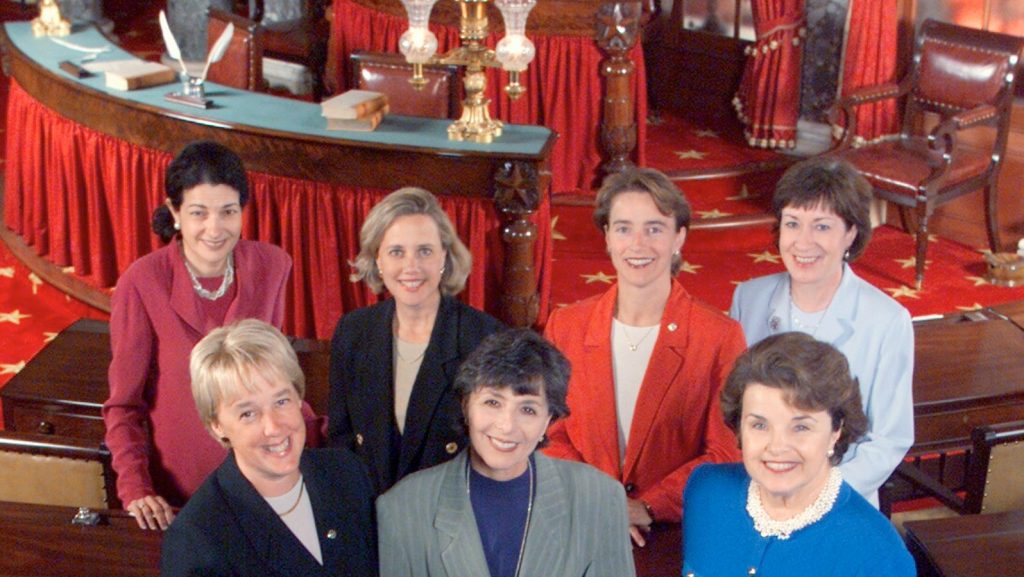
The colloquy was entered into the Congressional Record on July 15, 2010, the same day the Senate voted 60-39 to adopt the Dodd-Frank conference report. The conference committee finished reconciling the bill on June 25 and formally filed its report on June 29. The House had already passed the conference report on June 30, 2010, by a vote of 237-192. So by July 15, the legislative text was locked, and the Senate was voting on the final product.
The colloquy was entered into the record during the window between the start of Senate consideration and the final vote. This period between June 30 and July 15 allowed time for senators to place interpretive statements into the record, not to continue deliberating the bill’s substance.
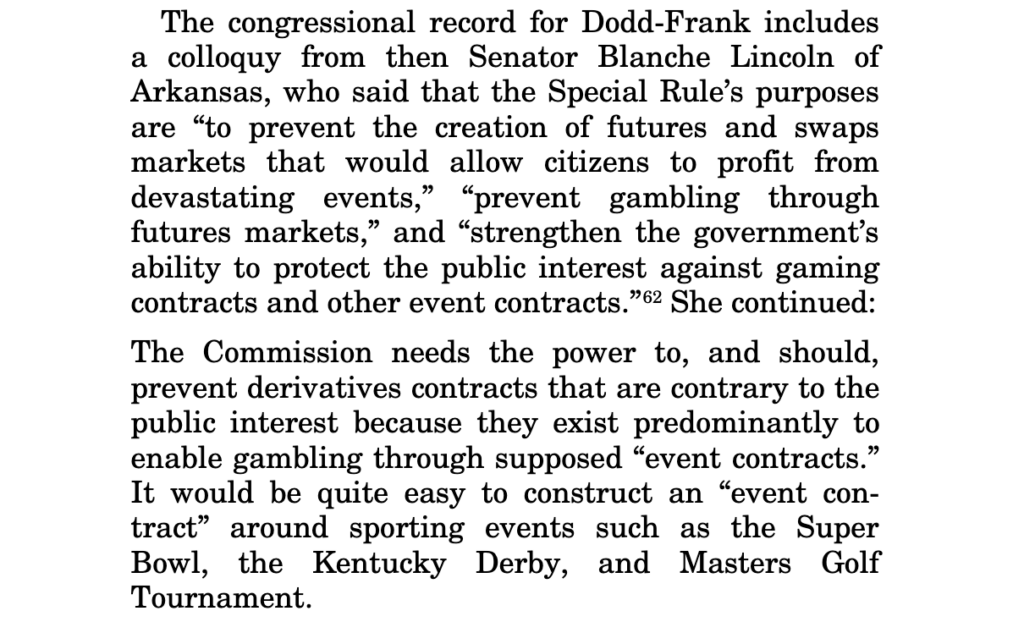
Here is the most oft-referenced portion of the colloquy:
SEN FEINSTEIN: Will CFTC have the power to determine that a contract is a gaming contract if the predominant use of the contract is speculative as opposed to a hedging or economic use?
SEN LINCOLN: That is our intent. The Commission needs the power to, and should, prevent derivatives contracts that are contrary to the public interest because they exist predominantly to enable gambling through supposed ‘‘event contracts.’’ It would be quite easy to construct an ‘‘event contract’’ around sporting events such as the Super Bowl, the Kentucky Derby, and Masters Golf Tournament. These types of contracts would not serve any real commercial purpose. Rather, they would be used solely for gambling.
Textualist judges won’t touch this exchange. But even for judges who do weigh legislative history, this colloquy has problems.
The Schultz Bressman and Gluck study of “Congressional Drafting, Delegation, and the Canons” was an undertaking in which the authors interviewed 137 congressional counsels with responsibilities over drafting legislation. Here is a snapshot of what the respondents — persons involved in drafting laws, not interpreting them on the bench — observed about colloquies:
Colloquies have not been highly regarded by courts, and are usually treated like floor statements — as legislative history of little value. But our respondents distinguished between different types of colloquies, treating them differently from floor statements and noting that some were especially useful and reliable. In particular, they singled out “staged” colloquies between the chair and ranking member of the committee as reliably indicating the common understanding on both sides. We note that commentators sometimes assume the opposite: namely, that they infer unreliability from the scripted nature of a colloquy.
But our respondents were not bothered by the staged aspect. They told us, for example: “Members will orchestrate this bizarre kabuki they call a colloquy. This has been the most important avenue to get instruction to courts and agencies. It’s very reliable if it’s someone involved with the bill”; or “colloquies are very revealing because they are things people have been struggling to work out. They have a lot of truth.” Others described the colloquy as “a way of solving a problem: we will write it this way and do a colloquy on the floor to get to a compromise.”
Less reliable colloquies, in our respondents’ opinions, were those colloquies inserted into the record without notice, or not including committee leadership or members on both sides of an issue or from both parties. This distinction furthers our intuition that legislative history that is evidence of a shared consensus seems most reliable to our drafters.
Also consider this hierarchy ranking legislative history sources from legal scholar William Eskridge Jr. They are ranked from most to least authoritative, crafted with an eye toward determining which source is most likely to reflect the political deal that Congress actually struck.
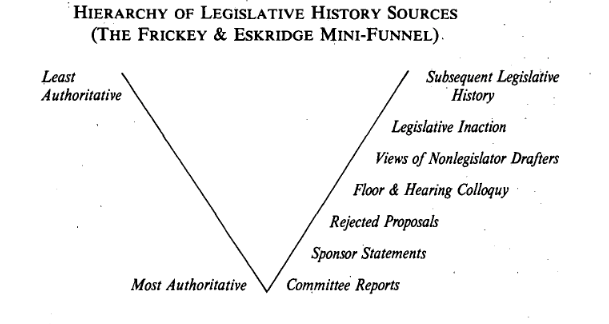
Why are colloquies further down the list? According to Eskridge, it’s because they involve a small number of participants, they’re often staged or scripted (this does not bother the staffers, apparently), and they don’t necessarily reflect the broader chamber’s understanding. Floor colloquies, in particular, are choreographed exchanges designed to create an interpretive record rather than to inform fellow legislators.
Lincoln was not just any senator at the time of the the Dodd-Frank Wall Street Reform and Consumer Protection Act, she was chairwoman of the Senate Agriculture Committee and a primary author of the act. She was a key figure in shaping the bill. Lincoln’s colloquy does carry a bit more weight, but nevertheless, it still falls into the “less authoritative” bucket.
The colloquy was still only a two-person interpretive exchange, alongside a fellow Democratic senator, Feinstein, who was not on the Senate Committee on Agriculture, Nutrition, and Forestry (which Lincoln chaired and which produced Title VII, including the event contracts provision). Nor was Feinstein on the Senate Committee on Banking, Housing, and Urban Affairs (which Sen. Chris Dodd chaired and which produced the broader financial reform framework). In effect, she was a rank-and-file senator on the bill.
In another scholarly assessment of judicial use of legislative history, authors Stuart Minor Benjamin and Kristen M. Renberg in 2020 discuss Justice Scalia’s critiques on the usage and origins of certain components, colloquies included:
Members of the majority coalition would be unlikely to be moved by, or even know about, a colloquy on the floor or in a committee hearing between two members. Legislative history, Scalia suggested, was likely written by staffers or lobbyists who were attempting not to inform members of Congress but instead to influence judges’ interpretation of the statute.
On that point, there’s not any available evidence (that I have discovered yet) that the colloquy was actually spoken. When I reached out to Lincoln’s consulting group to ask about this point, I was told that no comment was available.
Rather, it appears that exchange was entered into the record as written but not ever uttered. Bear in mind, an overreliance on this colloquy was controversial even prior to the explosion of sports event contracts and Kalshi’s ascendance.
In 2024 when the CFTC under the Biden administration proposed new rules around event contracts, Aristotle International offered this assessment of the proposed rules:
The Commission’s heavy reliance on the colloquy for these and other key determinations is, to put it mildly, misplaced. That colloquy never occurred. That is to say that the words printed in the Congressional Record were never spoken on the floor of the Senate. Nor can the colloquy have played any role in informing the understanding of the Congress as to the meaning of CEA 5c(c)(5)(C) because it was submitted to the Congressional Record and printed only after passage of the legislation.
One of the CFTC commissioners at the time, Summer Mersinger, objected to a slate of proposed rules — including a definition of “gaming,” for which a definition may soon come through newer proposed rules — on the basis of its overreliance on the colloquy. Mersinger wrote:
I cannot accept the Proposal’s assertion that this isolated colloquy between two Senators establishes an intent by the whole of Congress that the Commission conduct its public interest reviews of event contracts based on an “economic purpose test” that the Commission had withdrawn as a result of the repeal (by the whole of Congress) of the statutory provision it implemented a decade earlier.
All of the above points to the colloquy’s very shaky foundation.
Nevertheless, it continues to hold a lot of water in various judicial opinions, in scores of briefs and comments across the country from state attorneys general, tribal groups, gaming regulators, former CFTC Chairman Gary Gensler, and is right there in New Jersey’s petition to the Supreme Court for a writ of certiorari.
Now here’s where things get especially bonkers.
Former Sen. Lincoln is now a consultant and lobbyist for, among others, Kalshi. In that paid role, Lincoln has been buttressing Kalshi’s arguments in favor of sports event contracts. Part of that has involved reframing a piece of the colloquy.
In a letter to the CFTC ahead of a roundtable discussion on prediction markets in 2025, Lincoln wrote:
Under Dodd-Frank, lawmakers gave the CFTC authority to prohibit contracts, but only if it determines that the contracts have no commercial utility. Elections have significant policy consequences that affect businesses of all sizes, so the commercial implications are clear.
Sporting events like the Super Bowl also have strong commercial value because they have major impacts on advertising, apparel sales and the hospitality industry to name a few. Stepping back, these examples further speak to the CFTC’s need to let the markets decide what’s beneficial.
So, back at the time of Dodd-Frank’s passage, Lincoln said an event contract around the Super Bowl “would not serve any real commercial purpose. Rather, they would be used solely for gambling.” And now she’s making the case for why such a contract would have strong commercial value. Lincoln’s remarks today would qualify as “subsequent legislative history,” which is effectively meaningless.
Lincoln is not the only one backtracking. Kalshi itself, in 2024 litigation with the CFTC, cited the colloquy as legislative history for distinguishing political contracts from sports event contracts:
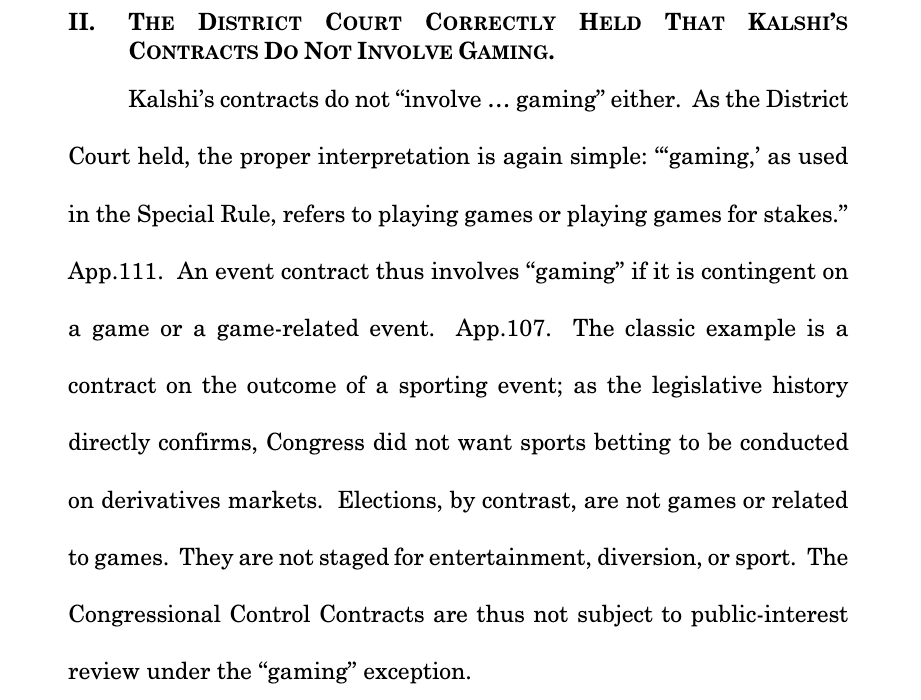
These briefs were not lost on the Ninth Circuit, which directly cited them in its latest opinion. There’s more dissent still.
Dodd-Frank co-author Dodd, in a July 2026 comment letter to the CFTC regarding the newest proposed rules, writes:
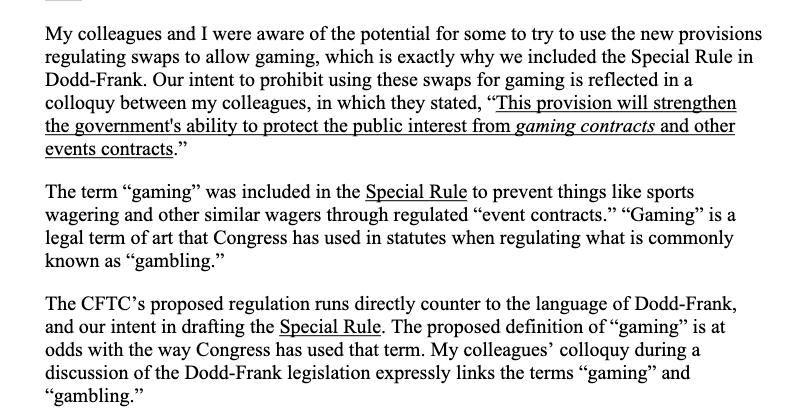
This statement, by a key figure obviously, likewise constitutes subsequent legislative history, which inherently does not mean much of anything. Are we to trust his version of events and intentions or Lincoln’s?
It’s all just too much.
The same two-senator exchange, post voting on the bill, was cited by the CFTC in the 2024 rulemaking as the definitive expression of congressional intent to restrict gaming contracts; by state attorneys general as proof that Congress never intended to preempt state gaming authority; by Gensler as proof the CFTC was meant to block sports contracts; by Kalshi’s allies as proof the CFTC has exclusive jurisdiction to allow/evaluate sports event contracts as the agency sees fit; by Lincoln herself for a position that appears to contradict what she said in 2010; and, of course, by Dodd in expressing just the opposite.
So, if we strike the colloquy, as far as legislative history on section 745, we’re left with … nothing at all.
And by the way, I do not think that discounting or dismissing this piece of history is meaningfully injurious to either party’s arguments for or against federal preemption. Based on all of the above, I just don’t think it should be a factor. It can be spun both ways and all ways, after all.
Where is this road going?
None of the Congresses that modified the CEA, including the 2010 version that added the events contract provision to Dodd-Frank, actually contemplated the CFTC or another federal agency becoming a national regulator of sports event contracts, which are tantamount to sports gambling traditionally regulated by the states. Congress in 2010 was addressing the aftermath of a financial crisis. As Alito articulated for the majority in Murphy: “Congress can regulate sports gambling directly, but if it elects not to do so, each State is free to act on its own.”
Nevertheless, there remains ample material for the Supreme Court to find — like the Third Circuit did with a strict textualist reading in the Kalshi vs. New Jersey dispute — that Congress did confer exclusive jurisdiction to the CFTC to regulate swaps, and that sports event contracts do qualify as swaps under the CEA. The textualist pathway to Kalshi’s position is real, but it requires reading a financial crisis statute to encompass consumer sports wagering, which is exactly the kind of transformative expansion the major questions doctrine was designed to flag. The judges will interpret what they have, and they will read into the gaps what they will.
“The major questions doctrine can be a get-out-of-jail-free card,” Aron said. “A lot of these judges lean on the plain meaning of the text, unless what results from the plain meaning would be too consequential.”
Ultimately, only Congress can make the necessary tradeoffs undergirding a deliberate, considered, enduring framework for prediction markets, potentially inclusive of sports event contacts — not only elections and various other categories where retail traders and institutions can actually hedge economic risk.
Should the CFTC or state gaming regulators oversee sports event contracts? Both have legitimate claims. Should consumer protection standards from state gaming frameworks apply in some dual-federalism model? The CFTC framework was not designed for retail sports bettors, yet imposing state-by-state requirements and restrictions may fully kneecap the market.
Should tribal sovereignty under the Indian Gaming Regulatory Act be preserved with respect to sports event contracts? The answer implicates treaty obligations and government-to-government relationships in numerous states that courts are poorly positioned to navigate. These are legislative questions: allocation of regulatory authority, consumer protection design, intergovernmental relations. They are not questions of statutory interpretation.
Maybe what the colloquy does do, if anything, is underscore that two members of Congress intended for the CFTC to have exclusive jurisdiction over activity on designated markets. But Lincoln and Feinstein probably did not count on an ideologue acting as the lone commissioner of a five-person commission, dialing up emergency powers to force registered designated contract markets to defy state law. Or, in other words, proactively furthering activity they imagined the agency would proscribe or police.
This article is not an endorsement of states controlling legal sports betting in the U.S. The flaws in that system are widespread. States like Rhode Island, Oregon, and New Hampshire have authorized actual monopolies, and many other states have created anti-competitive market structures, favoring larger outfits to the detriment of consumers. State-led measures to combat problem gambling have generally improved since 2018, but they continue to leave trails of citizens vulnerable to certain predatory sportsbook practices and many others mired in financial ruin.
Kalshi et al have engaged in some of the same predatory conduct and continue to perpetuate the false notion that sports trading on their platforms is merely a peer-to-peer endeavor. Setting that aside for now, there is a lot of merit and value in the exchange model. There is certainly exploding demand.
But harnessing the power and utility of it from beyond the cracks of a five-time-amended statute will not be a simple compromise for Congress to broker.
Here’s U.S. Rep. Dusty Johnson, chairman of a House Subcommittee on Commodity Markets, Digital Assets and Rural Development, when asked about events contracts looking like swaps:
“To what extent do we feel like this is risk management and hedging, which is a derivatives purpose — regulated at the federal level? And to what extent is this gambling — which has traditionally been regulated at the state level?” Johnson asked.
“As chairman of the subcommittee that oversees commodity markets, I mean it’s my job to try to find out whether or not there is a path for legislation that would answer some of these open questions. I think it’s a really difficult path. I’m in the process of drafting legislation, it may be that I’ll be in a position to release that,” Johnson said. “But if I’m being honest, I think it is going to be really hard to find a product that could get 60 votes in the United States Senate. This is a highly controversial issue.”
Highly controversial, and a job for Kalshi’s growing lobbying force in Washington.
“Kalshi is leading the push for bipartisan legislation that protects consumers, keeps minors off our platform, and makes insider trading bans standard across the industry,” John Bivona, Kalshi’s head of federal government relations, told The Washington Sun in a statement. “We’ve worked with dozens of lawmakers from both parties on these priorities, and we welcome partnering with anyone serious about responsible regulation.”
Their work is cut out for them, but it’s work worth doing. Because even if the Supreme Court does rule favorably for Kalshi and allows the current structure to hold, what happens if in 2028 a new administration — whether Democratic or Republican — doesn’t like what it sees? Consider this take from Katie Haun, an investor and attorney who previously clerked for U.S. Supreme Court Justice Anthony Kennedy:
“The bigger lesson: never underestimate Article III. Congress changes. Administrations change. Court decisions stick. My take: a loss on federal preemption isn’t necessarily bad for prediction markets in the long run. Wanting a single federal regulator sounds great … until that regulator is hostile to your existence. Watch this one as it likely heads for SCOTUS.”
The Supreme Court shouldn’t be the end boss here, and it may not be. When it ruled in Murphy, that decision did not legalize sports betting across the U.S. States still had to deliberate and affirmatively legalize the activity before any bets were taken.
If the American people and Congress wish the CFTC to become the de facto national sports betting regulator, Congress should say so and under what terms, clearly, and unequivocally.