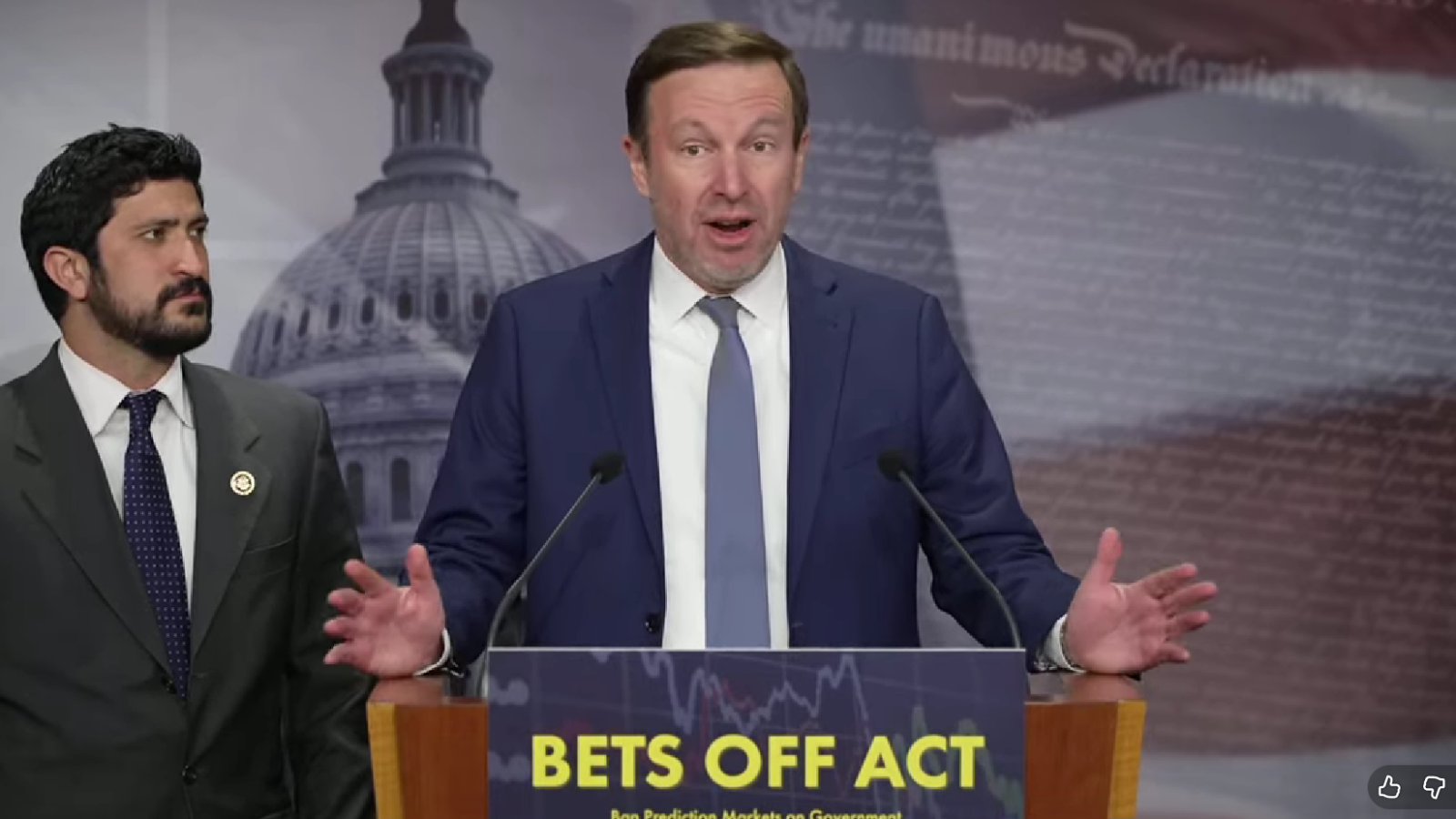
Two members of Congress have introduced a bill that would ban all prediction market contracts on government actions or outcomes known to one person.
Rep. Greg Casar and Sen. Chris Murphy introduced the Banning Event Trading on Sensitive Operations and Federal Functions (BETS OFF) Act Tuesday.
The bill would ban all markets on government actions or events where the outcome is controlled by one person. The bill text has not yet been published, meaning an exact definition of an outcome controlled by one person is not currently clear. However, Murphy referenced “mention markets,” on the words that a politician or other notable figure will say during a public appearance, as an example.
In a press conference announcing the introduction of the bill, Murphy described those markets as “almost certainly rigged” due to the possibility of insider trading.
Murphy also said that prediction markets on government activity created a risk of policy being manipulated in order for insiders to win money.
“They offer incredibly perverse incentives, especially within government, for people to push government actors towards making specific decisions,” he added.
He pointed to trades involving military actions in Iran and Venezuela, in which some users won six-figure sums by placing bets just before military operations began, and argued that these bets were proof that “the Trump Administration is clearly making money off these markets.” The identities of the users who made large trades on Iran and Venezuela markets, and whether they were government employees, are not known.
“Think about what’s happening inside the situation room,” he said. “There are likely people who have placed bets on whether the U.S. is likely to take particular military action and they are likely giving advice not based on what’s best for the country, but based on what will make them money.”
Murphy added that the prevalence of insider trading on prediction markets only benefited the rich and powerful, rather than ordinary Americans, as powerful people possess the most valuable inside information.
“The people who decide who performs at the Super Bowl, the people who know what words the president will say, these are very powerful people,” he said.
Joins growing list of federal bills
It’s the latest in a growing list of proposed federal legislation to address prediction markets.
Two other bills also sought to address insider trading. In January, Rep. Ritchie Torres introduced a bill that would limit federal government officials’ ability to trade on prediction markets. On March 5, Sens. Jeff Merkley and Amy Klobuchar introduced a bill that would ban federal elected officials from trading on prediction markets.
The BETS OFF Act would go a step further by entirely banning a swathe of markets where its sponsors believe insider trades may be prevalent.
Murphy said that punishments for government officials who trade on prediction markets make sense, but that the BETS OFF Act instead prioritizes a straightforward solution.
“There’s a variety of ways you can approach this question. Obviously you could put, and we should put, penalties on members of the government who bet on inside information, but this bill is simpler,” he said. “It simply says that these markets should not exist.”
Elsewhere, a bill introduced by Rep. Blake Moore and Rep. Salud Carbajal would make event contracts on assassination, war, terrorism, gambling, and politics illegal, ending any possible gray area over the legal status of those markets.
Casar said that while there may be some debate over exactly what prediction markets can offer bets on, there should be consensus about preventing these types of markets.
“We can debate various aspects of prediction markets, but at a minimum, shouldn’t we agree that somebody shouldn’t be able to place 17 bets on the halftime show and win all of them,” he said.
Murphy expressed a similar sentiment.
“From my point of view, this bill doesn’t cover the waterfront, but it addresses the most urgent problem,” he said.