Let me give you a hypothetical scenario. Let’s say there’s a network — we’ll call it the Private Broadcasting Service — and it’s airing an hour-long roundtable-style show about sports betting. And the discussion and debate are lively, until, with a few minutes left in the hour, all of the panelists pull off what we thought were their faces, Mission: Impossible-style, to reveal they are not actually notable gaming, sports, or media figures, but rather are all either aliens, robots, or amorphous gelatinous organisms. In this scenario, would you find it worthwhile to dissect the viewpoints they offered on sports gambling back when you believed they were actual humans?
I’m exaggerating to make a point. But if you watched the hour-long special Breaking the Deadlock: Gambling With Your Life that aired on PBS (as in, the Public Broadcasting Service) Tuesday night, you know the exaggeration isn’t too terribly disconnected from reality.
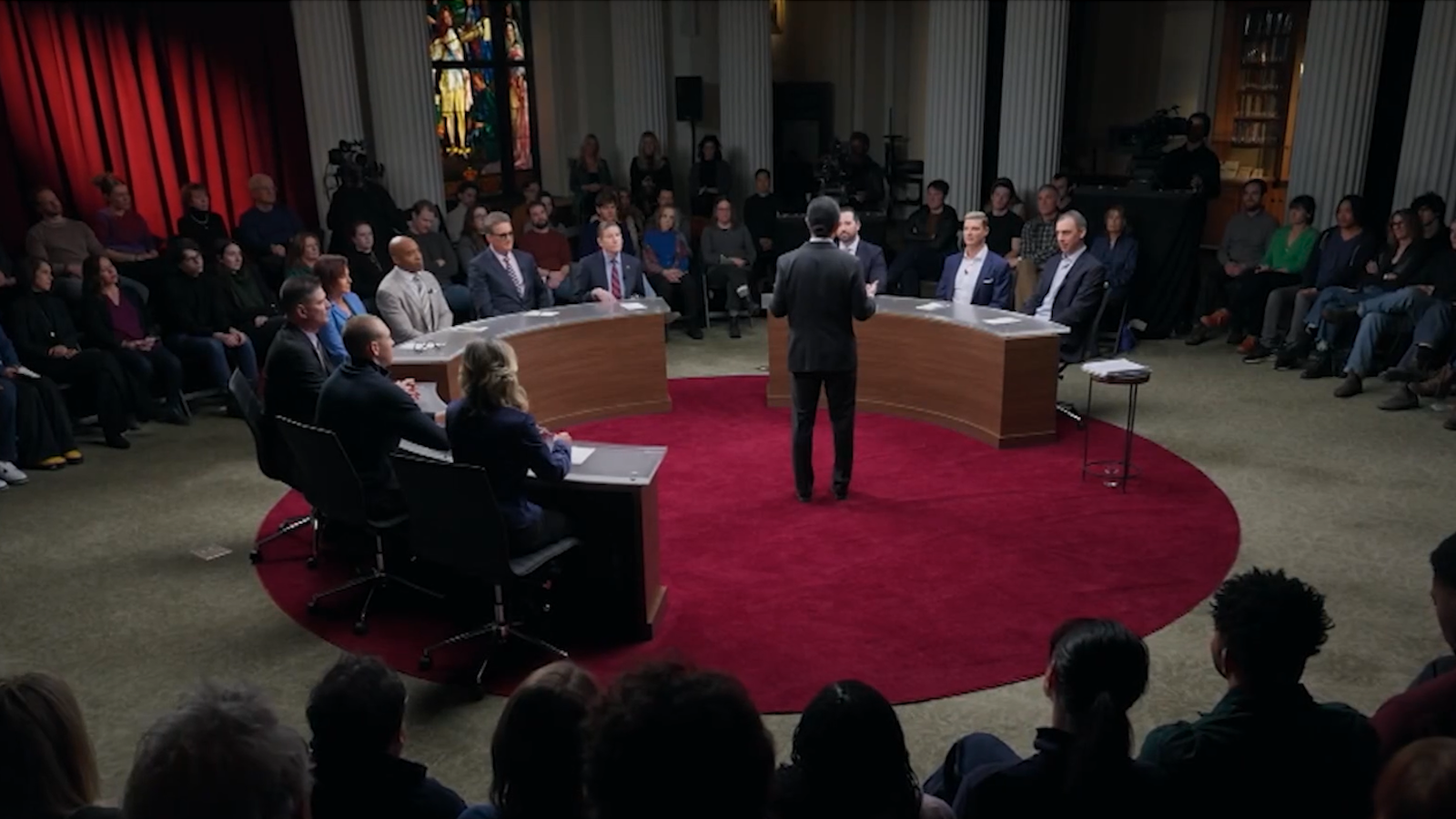
Moderator Aaron Tang, an author and constitutional law professor at the University of California, Davis, gathered an esteemed and fairly evenly divided group of 10 panelists and led a spirited, often entertaining, and provocative discussion. But he did so within the framework of a hypothetical scenario that was consistently slanted in an anti-gambling direction and eventually devolved into side scenarios that had no clear connection to gambling.
The premise involved a young man named Jeremy, who lived in the state of “Middlevania” and bet on a site called “FanFuel.” There were further creative flourishes, but that was the foundation. It was a perfectly reasonable set-up. But as Tang continued to advance the story, every new development was based around Jeremy being a problem gambler and spiraling deeper into his addiction.
That is one entirely realistic and all-too-common scenario we see in the sports betting world — one of many realistic, common scenarios. Yet it wasn’t balanced at all by any scenarios depicting hypothetical gamblers with healthy habits or problem gamblers who receive help and curb their behavior.
Thankfully, this significant shortcoming was addressed to a point by Breaking the Deadlock assembling about as balanced a panel of experts and observers as has ever been seen in mainstream media examinations of sports betting.
Starting lineups
Just last Friday, CNN aired a brief piece on sports betting that was more of the typical one-sided, gambling-is-the-devil approach (as almost any piece that includes problem gambler turned addiction therapist Harry Levant as a talking head proves to be).
So, full credit to PBS for offering an alternative to that sort of partial journalism.
The panel of 10 on Breaking the Deadlock included four who were clearly advocating for regulated sports betting, four who fell somewhere on the opposite side of the spectrum, and two former professional athletes who are now in the media and came across as more or less neutral on legal wagering.
In legal sports betting’s corner:
- Shawn Fluharty, West Virginia state delegate
- Daniel Wallach, gaming lawyer
- Alan Levy, artificial intelligence entrepreneur
- Anita Marks, ESPN gambling analyst
On the anti-gambling side (or at least anti the way regulated sports gambling has evolved):
- Stephanie Ruhle, MS NOW host
- Richard Blumenthal, U.S. senator from Connecticut
- Jonathan D. Cohen, author and gambling policy lead at the American Institute for Boys and Men
- Ed Elson, analyst, writer, and podcaster
And the two seemingly neutral ex-athletes:
- Tiki Barber, NFL player
- Ben McDonald, MLB player
Embrace debate
The standout moment of the show, one that exemplified the positives of the two-sided open forum and the drawbacks of the framing device, came in an exchange between Marks and Elson.
ESPN’s Marks asked and attempted to answer the question, “Why do people wager?” She noted that by putting a single dollar on a game she otherwise wouldn’t care about, she’s given herself a reason to watch and root. “What are you paying for?” she asked. “You’re paying for the price of entertainment. It is more entertaining to watch a game … when you have money on the game than when you do not.”
It was a utopian perspective, certainly, one where everyone treats sports betting as fun. And Elson objected.
“That’s what gambling is supposed to be,” Elson said. “But what we’re seeing here is that’s not what gambling is.”
Unfortunately, the “what we’re seeing here” that Elson referenced was a fictional young sports bettor’s entirely imagined scenario that represents the worst-case outcome. Jeremy, the character moderator Tang constructed, whose choose-your-own-adventure gambling story featured financial ruin, oddly inserted failure in his dating life, and ultimately ransacking his parents’ home to pay for his habit, was being held up as Exhibit A, when in fact Jeremy was a construct of Tang’s imagination, no more real than an alien or an amorphous gelatinous organism.
One hopes, though, that PBS viewers could largely distinguish between the real and the hypothetical. And as far as the real issues go, they did hear from both sides.
Fluharty, the president of the National Council of Legislators from Gaming States, was the first to mention the black market and point out that legalizing sports betting was not akin to inventing sports betting. In an amusing exchange between Democratic politicians with opposing views, he told Blumenthal, “You keep your federal hands off my state legislation,” to which the senator sharply responded, “Your legislation was totally ineffective in trying to keep up with the technology.”
In lock step with Blumenthal, Cohen noted, “Gambling has of course been a part of human history forever, but gambling as much money as you want on Malaysian women’s doubles badminton on your phone in the middle of the night has never been a part of our never-ending dance with the forces of chance.”
Other observations and notable moments
Ruhle seemed the most staunchly opposed to legal sports betting, suggesting that there should be less talk about how to perfect gambling systems and more talk about getting rid of gambling. (Which Fluharty noted would just mean pushing gambling offshore, into markets without “guardrails.”)
Blumenthal made the astute point that today’s youth are facing challenges older generations didn’t have to: “No longer do they have to go to the casino. Now, they have one in their pocket. That’s the casino.”
Wallach spoke on behalf of the industry when he said, “We don’t want to target vulnerable gamblers” — which is in theory correct, but we know that in practice the operators don’t always work that way. Wallach later added of problem gambling, “I share Sen. Blumenthal’s concerns. More can be done. More can definitely be done.”
When the topic of betting-related sports scandals came up, Marks explained, “It’s not that anything has changed. It’s that now players are getting caught — because it’s being regulated.”
The hypothetical scenario went off the rails late in the hour, when Tang’s protagonist Jeremy started getting catfished by an AI chatbot — and panelists explored this even though it had no apparent connection to gambling. Levy, perhaps the staunchest AI advocate on the planet, went so far as to say virtual girlfriends may, in the future, be a good thing.
Toward the end of the hour, the focus shifted to prediction markets, and there, common ground was found. Everyone seemed to agree sports prediction markets are sports gambling, and there was strong consensus that prediction markets should be regulated and taxed in the same fashion as online sportsbooks.
Ultimately, Breaking the Deadlock provided a lively conversation in which all of the panelists seemed to be having fun and, despite philosophical disagreements, tempers never fully flared. The gambling industry could use more exposure like this — with both sides given room to state their case — and the general public could certainly use more exposure to shows like this.
Next time, though, I’d like to see the whole thing built around a boring hypothetical scenario in which a recreational bettor turns his $200 deposit at the start of football season into $172 at the end of football season and concludes that he had at least $28 worth of fun.