
CME has launched its sports team index futures, which allow bettors to trade on NHL team performances like a stock, and to trade on margin, with the business touting the contracts’ utility to vendors, sponsors, and retail traders.
Futures on NHL team performance went live Sunday night, and the exchange hopes that more leagues will follow.
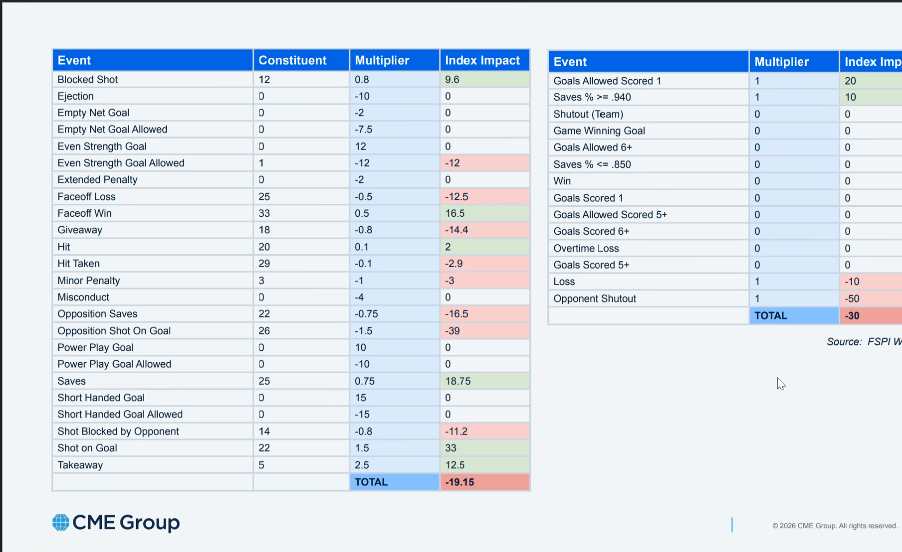
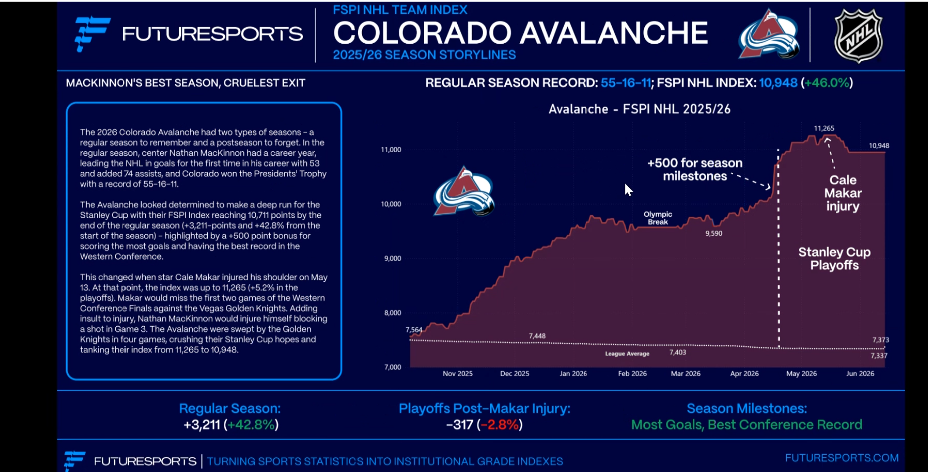
The futures are based on sports team indices, which are created by FutureSports. The indices start trading at 7,500 at the start of a season and move up or down based on in-game, weekly, and monthly statistical performance. For example in hockey, shots and goals add points to the index, while shots and goals conceded have the opposite effect.
CME then facilitates trading in futures contracts that resolve to the price of the index at the end of a week, month, or season.
Futures and indices
If a team is expected to perform well in their upcoming games, their futures price may be higher than the price of the index. If they are expected to perform poorly, it may be lower.
“Because the underlying index is not a tradable product here, the future is really just the market expectation of what the index is going to be,” CME Senior Director and Global Head of Retail Education Craig Bewick said.
For example, for the NHL futures, every team’s index is currently at 7,500, because no team has played any games yet. However, the defending Stanley Cup champion Carolina Hurricanes’ futures contract that expires Oct. 4 is priced at 7,530, because the team is expected to perform better than average during their opening games of the season. That price suggests that the Hurricanes’ performance during those games would be worse than their average performance last season, though.
“The market is pricing in that the pricing of the Carolina Hurricanes over the next three games is worse than how they performed over the last year,” Bewick said. “So if you’re a trader thinking that the Hurricanes are going to perform as well as they did last year over these next three games, you should buy the future at 7530.”
Futures can be bought with margin
The Commodity Futures Trading Commission (CFTC) Friday approved CME’s futures contracts on FutureSports NHL indices.
The vast majority of CFTC contracts are self-certified, meaning that the CFTC does not explicitly approve them, but instead an exchange says it will list the products and if the CFTC does not order a review into them, they can be listed. However, the sports futures were instead explicitly approved.
As futures contracts, the products can be purchased on margin, allowing users to buy contracts worth more than the amount they have deposited with their broker, and possibly lose more money than they have deposited. Prediction market contracts, on the other hand, currently cannot be purchased on margin, though Kalshi has asked the CFTC for some of its longer-resolving non-sports contracts to be eligible for margin.
CME Senior Director of Equity and Alternative Investment Products Murphy Brennan said that CME hoped to see the product expanded to more sports soon.
“Would we consider other sports such as cricket or soccer? Absolutely,” he said. “Our index partner is out working with the various leagues to develop a relationship. So we do expect our leagues to expand.”
Retail and institutional use cases
Bewick said the products would have use cases for both retail traders and institutions hedging real risk.
“There are use cases from the retail customer to the market maker to the institution, and then all of the use cases that result from that,” he said. “From the vendor at the stadium who might not sell as many hot dogs if the stadium is half full, to a season ticket holder who might want to get his full value out of his ticket.
“The vendors and sponsors, the use-cases are so interesting. It’s a need that hasn’t been met yet. CME is the place where people come to manage risk. This is a whole-new risk and the variety of use-cases that this is applicable to is fascinating.”
The contracts will be tradable 24/7. They are available from brokers, as CME does not offer most users the ability to trade on its exchange directly without a broker. DraftKings and FanDuel are both brokers that offer access to CME’s prediction market contracts for certain non-sports markets. Spokespeople for DraftKings and FanDuel did not immediately respond to a question on whether they would offer the contracts.
CME had little success with sports event contracts
The launch comes after CME stopped offering sports event contracts from Sept. 12. CME’s remaining contracts have done very little volume, barely over $10,000 per day.
Although CME’s sports contracts saw more volume than its non-sports contract, the products never gained serious traction when compared to other prediction markets. At its peak, volume on CME sports event contracts averaged around $6 million per day.
CME CEO Terry Duffy appeared to be opposed to certain kinds of sports event contracts. In July he said that parlay contracts were “gambling” (CME self-certified parlays in January but never offered them). In August he said that individual-based sports contracts like player props were “being manipulated.” Duffy has also opposed mention markets.