
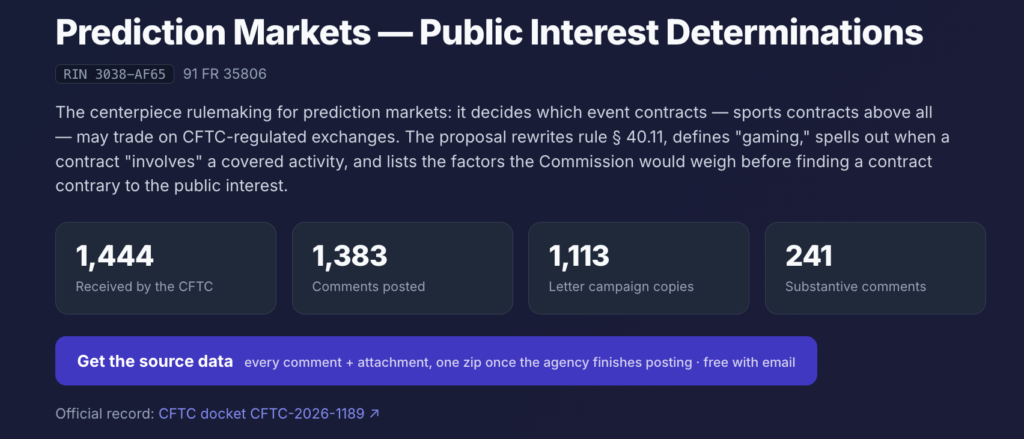
The comment window on the Commodity Futures Trading Commission’s (CFTC) comprehensive proposed rulemaking effort for prediction markets closed at midnight on July 27. By the time the agency began uploading its backlog the next day, the record had filled with potent critiques from all sides.
By way of review, among the most significant changes that the “Prediction Markets; Public Interest Determinations” (NPRM) would effectuate, and which drew substantial attention from the commenters, concerned:
- A definition of “gaming” within the context of the CFTC’s Special Rule.
- A definition of “involve” in this same context.
- Replacing a categorical prohibition on certain types of markets with a factor-based review.
- Whether or not the CFTC can act prospectively on entire classes of contracts (e.g. prohibit them) before any specific contract is filed, or only after.
(Shoutout to PredictionMarketPulse, which assisted in categorizing, labeling, and compiling comments.)
The comments poured in from all corners of the prediction market ecosystem and its periphery. They included one of the architects of the Dodd-Frank Act that gave rise to event contracts, former U.S. Sen. Chris Dodd himself, and a former CFTC chairman, Timothy Massad.
Also, tribal groups showed up in force (and at length) with broad opposition to the rules, while also planting seeds for later legal challenges on “arbitrary and capricious” and procedural grounds. In addition, American Gaming Association CEO Bill Miller urged the CFTC to withdraw the proposed revisions to Rule 40.11 altogether, arguing the gaming definition is engineered to let virtually any sports event contract through in changing from a prohibitory to permissive structure. Forty-four state attorneys general, led by Ohio’s Andy Wilson, filed a 34-page joint comment arguing the CFTC lacks statutory authority, the rule violates the major questions doctrine and the federalism canon, and the proposed rules would impliedly repeal the Wire Act.
CME Group delivered a pretty blistering and lengthy critique of the rules and the CFTC’s existing approach. In CME’s view, numerous contracts have been allowed that violate the 23 Core Principles for designated contracts markets (DCMs), and it pointed to likely failures from certain DCMs to adhere to these principles. Meanwhile, DraftKings and FanDuel carefully offered support for the new rules, while DraftKings did push back on the broad definition of gaming that would have it include sporting events or athletic competitions.
Kalshi itself submitted four separate comments, while overall filing in support and urging adoption. Its package contains a main comment from co-founder Luana Lopes Lara, plus three supplemental filings building the record for combinatorial contracts (parlays), sports hedging utility, and player-performance markets. Polymarket US (the regulated DCM/DCO entity, filing separately from Polymarket.com) filed an 11-page letter supporting the NPRM with targeted pushback.
Robinhood Derivatives filed in support and disclosed its exchange-building ambitions alongside Susquehanna in a joint venture that acquired 90% of MIAXdx, now operating as Rothera Exchange & Clearing. Coinbase, which operates both a CFTC-registered DCM and an FCM, filed in support of the NPRM’s two-step statutory framework while pressing the agency for additional clarity on the “multiple causal pathways” concept and on DCM de-listing obligations.
The players’ associations in the five major sports filed jointly on athlete protection. The NFL took a staff meeting with the CFTC on July 22, and while the letter does not appear on the docket, it has surfaced elsewhere.
And then there’s Dodd, the former Connecticut senator, filing on Arnold & Porter letterhead to say the CFTC’s proposal contradicts the law he wrote.
Massad filed in personal opposition, his first comment on any rulemaking since leaving the leadership of the CFTC. Sen. David McCormick, a Pennsylvania Republican, urged caution. A 16-organization coalition led by Better Markets and Public Citizen pressed the commission to prohibit election contracts. And the commission’s own questions on antitrust implications and alternative regulatory approaches drew almost no engagement from anyone, a silence worth noting when it comes time for the final rule.
This is not a fully exhaustive list (you’re on your own, pal) but an effort to surface some of the more salient issues that the various stakeholders emphasized for the CFTC to consider.
CME Group: You’re solving the wrong problem(s)
CME Group’s 14-page letter, signed by General Counsel Jonathan Marcus, who formerly had the same role at the CFTC (2011-2017), comes from the only commenter that is simultaneously a legacy exchange operator and a prediction market participant. It includes some interesting critiques, hence the extended treatment here.
CFTC-2026-1189-0177_attachment_1-1CME generally supports the NPRM’s goal of giving the marketplace guidance on the Special Rule. But the group’s core argument is that the CFTC, through its proposed rules, is building an elaborate post-listing review framework while ignoring a more fundamental problem: thousands of existing contracts have already been listed without adequate legal analysis, and they may not even qualify as swaps under the Commodity Exchange Act (CEA).
‘Not everything is a swap’
CME starts at the statutory definition. For an event contract to be listed as a swap on a DCM, the underlying event must have “a financial, economic, or commercial consequence” and must be “beyond the control of the parties to the contract.” Those tenets are embedded in the CEA’s (broad) definition of a swap and its definition of an excluded commodity. CME argues the CFTC has effectively deferred the economic-consequence analysis to the post-listing public-interest review under 40.11, when it should be a threshold requirement at the listing stage.
One example given is “mention market” contracts, where users trade on whether a public figure will say a specific word/phrase during a live event. (It’s the same kind of market that a White House teleprompter operator used for a bet at Kalshi, which Kalshi flagged to the CFTC.)
These contracts have proliferated on prediction market DCMs. But as CME points out, the outcomes are entirely within the control of the individual who could be a party to the contract. Public figures including Coinbase’s own CEO have caught on and deliberately uttered triggering words to impact the result. How can a contract where the outcome is controlled by a single person who might trade it possibly satisfy the swap definition’s “beyond the control of the parties” requirement? And what is the “financial, economic, or commercial consequence” of someone saying a word on a podcast?
‘The Core Principles are being ignored‘
CME then pivots to the CFTC’s 23 Core Principles for DCMs. Core Principle 3 requires that contracts not be readily susceptible to manipulation. Core Principle 4 requires a DCM to have the capacity to prevent manipulation through surveillance. Core Principle 12 requires rules protecting participants from abusive practices.
CME notes the CFTC itself acknowledged in the NPRM that exchanges are filing template certifications covering hundreds of contracts with only general descriptions, a violation of Regulation 40.2 requirements. Many contracts, CME argues, present “inescapable Core Principle compliance problems that should have prevented their initial listing.” In sum, CME believes the newer prediction market DCMs have been certifying contracts they know can’t withstand legal scrutiny, and it submits the agency has let it happen unchecked. But note: The CFTC recently addressed this particular practice in a July 24 memo.
CME’s proposed solution is this: Instead of allowing contracts to trade while a 40.11 review proceeds, the agency should establish a 10-day pre-listing certification period for event contracts that may implicate the Special Rule. If the CFTC determines within that window that no extended review is necessary, the contract lists immediately. If the CFTC decides the contract involves an enumerated activity, the listing period extends an additional 80 days, and the contract does not trade until it has been cleared.
This puts CME in the unique position of agreeing with the Pennsylvania Gaming Control Board’s concern about toxic contracts trading during review… but proposing a market-structure solution rather than demanding withdrawal.
Two more points …
First, CME argues the CFTC can make categorical prohibitions, contrary to the CFTC’s/NPRM’s preliminary stance that it lacks authority to do so. That puts CME directly opposite Kalshi, which agrees with the agency that categorical determinations are impermissible.
Second, CME flags Section 12(e)(2) of the CEA, which preempts state and local laws that “prohibit or regulate gaming.” That provision shields derivatives trading from state anti-gambling statutes. CME warns that by defining “gaming” as the sport itself rather than the wagering on the sport, the agency could inadvertently undermine that safe harbor, causing a self-inflicted wound that could ripple beyond prediction markets.
By defining “gaming” as the sport itself rather than the financial wagering on the sport, the CFTC’s definition suggests the CEA is preempting state sports regulations, which is a striking overreach. Equally important, it could undermine the safe harbor against state gambling laws that was intended to be created by this section. While CME Group appreciates that the CFTC attempts to limit the definition by using the phrase “for purposes of this section[,]” it must still consider how the proposed definition will be applied by courts in light of Section 12(e)(2).
Kalshi and Polymarket weigh in
The two leading prediction market DCMs both filed on July 27. While they agree on the big structural questions, they look to be building different pieces of the record.
Kalshi
Kalshi’s main letter is shorter and more surgical than in the earlier ANPRM filing. The posture is broad support: Kalshi calls the proposal “meaningful progress” and urges adoption. The letter endorses the settlement-based “involve” definition, the three-step procedural framework, the rejection of categorical determinations, plus the factor-based public interest analysis.
The weightiest position is on gaming. Kalshi proposes a very narrow definition: Gaming should mean “any activity conducted as a game of chance, or of mixed chance and skill, that is played for stakes and in which the staking of money or other value is intrinsic to the activity itself, including house-banked and other casino-style games such as casino table games, games conducted through gaming devices, roulette, craps, lotteries, keno, and bingo.”
That’s a definition designed to keep the entire universe of sports event contracts outside the Special Rule’s reach — not just outside a “contrary to the public interest” finding, but outside the trigger for review entirely.
Kalshi supports the sports-specific public interest factors “as a Fallback,” meaning: they don’t think sports should be within the gaming definition at all, but if they are, the factor-based approach is a sufficient framework.
Kalshi’s supplementals: building the record for sports
Kalshi’s three supplemental letters each build another piece of the record. Together, they construct the foundation Kalshi would need either for a favorable final rule or for litigation if the rule goes the other way.
Xavier Sottile (head of markets): combination contracts
Sottile builds the case for prediction market parlays, reframed as “combination event contracts,” before the agency asked the specific question.
A combination event contract is the binary-outcome analog of multi-asset derivatives that have traded under CFTC and SEC supervision for decades (basket options, correlation swaps, credit tranches). Sottile reasons that combination markets produce joint and conditional probability information that single-leg contracts mathematically cannot: the implied correlation between events, recoverable only from a market priced on the joint event.
Sottile is preemptively reframing parlays as correlation trades and challenging the agency to explain why a fully collateralized binary on a joint event is contrary to the public interest when continuous-payoff structured products with identical economics trade freely.
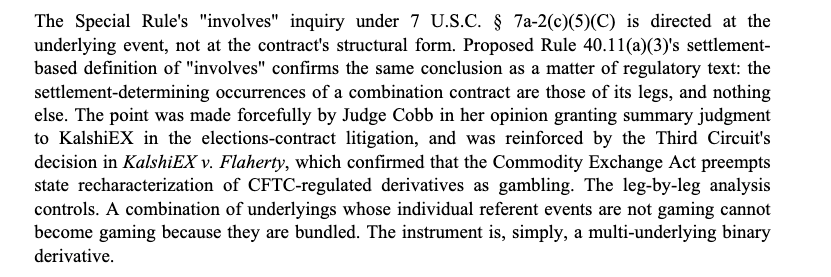
Sottile also argues that the individual legs of a combination are what matters to the “involves” analysis, not the sum of the combination’s parts.
Sara Slane (head of corporate development): sports hedging utility
Slane outlines five categories of commercial actors with real exposure to sporting outcomes: sportsbooks with un-hedgeable concentration risk, merchandisers who pre-produce championship gear for both finalists, broadcasters with series-length and market-size exposure, hospitality operators in contending cities, and sponsors from naming rights to player endorsements. These are excluded-commodity exposures with financial consequences arising from occurrences beyond the parties’ control, which are largely uninsurable.
To what extent do those use cases satisfy the category for the vast ocean of average, everyday retail traders, including your cousin Tommy and his seven-leg parlay? Topic for another day, we suppose.
Adam Barrick (head of sports partnerships): player-performance contracts
Barrick defends player-performance contracts by flipping the integrity argument: Manipulation is detected precisely because it occurs on monitored venues, and a CFTC-regulated DCM would exceed sportsbook surveillance. DFS operators face structural “chalk concentration” risk with no hedge. Sportsbooks “hedge” player-prop exposure by banning winning customers, an outcome the CFTC’s price-discovery mandate should treat as a market-design failure.
Barrick’s key technical ask: conforming the discrete-action provision to the preamble’s specific-participant formulation, “and let the regulated derivatives industry build the surveillance and risk-management infrastructure that will define the next decade of event-contract markets.”
Polymarket US
Polymarket US (QCX LLC and QC Clearing LLC) filed an 11-page letter signed by General Counsel Matthew Lischin. The letter supports the NPRM, affirms exclusive CFTC jurisdiction and preemption, and frames the Special Rule as a narrow, last-resort tool that should not displace the Core Principles framework.
On gaming, Polymarket agrees the primary definition is overbroad, arguing that it would “capture almost every sporting, cultural, or competitive event” and “convert what is intended to be a narrow Enumerated Activity into a general-purpose review trigger.” But rather than proposing its own definition, Polymarket urges the CFTC to adopt the NPRM’s alternative definition, which it says is more “grounded in the structural features that distinguish games from other activities.”
The market-integrity section is Polymarket’s answer to the insider-trading narrative. The letter discloses league partnership agreements with major professional sports leagues, real-time surveillance, and an NFA regulatory services arrangement. It also points to two federal enforcement actions (the soldier/Maduro case and the Google employee search results insider trading case) that arose directly from Polymarket’s referrals. That’s Polymarket claiming credit for the very enforcement actions its critics cited against the industry.
Polymarket also pushes back on the NPRM’s “multiple causal pathways” framework as unworkable.
Author of the Dodd-Frank Act weighs in
Dodd, the co-author of the Dodd-Frank Act and the man who managed the bill on the Senate floor, filed a three-page letter on his current law firm’s letterhead.
CFTC-2026-1189-0100_attachment_1Dodd states that the CFTC’s proposed regulation “contradicts the language and intent of the Dodd-Frank Act.” He says “gaming” was included in the Special Rule specifically “to prevent things like sports wagering and other similar wagers through regulated event contracts,” and that it is “a legal term of art that Congress has used in statutes when regulating what is commonly known as ‘gambling.'”
He states that Congress was “well aware of existing federal laws regulating gaming” including the Indian Gaming Regulatory Act (IGRA) and PASPA, and “had no intention of amending those laws.” He calls for the CFTC to rescind the proposed rule entirely.
Dodd’s letter is a direct rebuttal to the prediction market industry’s argument that the Feinstein-Lincoln floor colloquy doesn’t compel a broad reading of “gaming.” DraftKings’ letter calls the colloquy “a concern about contract design and public-interest effects, not a statutory definition of sports as gaming.” Kalshi argues “gaming” should be limited to casino-style games. Dodd says: We meant gaming to mean gambling, including sports wagering.
Courts give weight to post-enactment legislative history and interpretations very unevenly, some not at all. But a letter from the bill’s primary author, filed in the rulemaking record, is the kind of evidence that lands in an arbitrary-and-capricious challenge. The tribal nations and states now have Dodd’s take on the record. Prediction market proponents will argue the statute speaks for itself. Textualist judges will agree with that. The CFTC will have to decide whose reading of “gaming” it can defend in court.
The tribal wave
Tribal filings dominate the substantive record by page count and legal intensity. At least 20 filings arrived from tribal nations, tribal gaming regulators, and inter-tribal associations, nearly all urging outright withdrawal of the rule.
The letters converge on a consistent framework: The CFTC failed to conduct government-to-government consultation required by Executive Order 13175; the proposed definition of “gaming” is contrary to congressional intent; the “involve” standard is read too narrowly; the rule would authorize online wagering on sovereign lands in violation of the IGRA; and the agency should make categorical, pre-listing public-interest determinations rather than reviewing contracts one at a time after self-certification.
“Arbitrary and capricious” appears as a refrain across the cohort, and several letters share drafting, signaling coordinated, litigation-ready positioning as an Administrative Procedures Act arbitrary-and-capricious challenge under Section 706(2)(A). The framework comes from Motor Vehicle Manufacturers v. State Farm (1983) where a rule is arbitrary and capricious if the agency “entirely failed to consider an important aspect of the problem.”
The Oklahoma Indian Gaming Association filed the single largest letter on the docket, roughly 65 pages with nearly 300 footnotes. It argues gaming should be defined “consistent with its plain meaning” to include wagering on games, rejects the CFTC’s narrow “involve” interpretation, and calls the public-interest factors arbitrary and capricious. The letter cites figures from Eilers & Krejcik Gaming that roughly 90% of U.S. prediction market activity is sports-related, with approximately 69% originating in states where online sports betting is illegal. If accurate, the majority of prediction market sports volume is coming from jurisdictions that have not (yet) chosen to legalize sports betting.
Additional filings include the Mashantucket Pequot, Morongo Band, Minnesota Indian Gaming Association, Seneca-Cayuga, Stockbridge-Munsee Community, Leech Lake Band of Ojibwe, Nisqually, Rincon Band, Ute Mountain Ute, Mille Lacs Band, Tonto Apache, Prairie Band Potawatomi, Guidiville Indian Rancheria, Thlopthlocco Tribal Town, and Estom Yumeka Maidu, with more still posting.
This is not a handful of tribes registering objections, but rather a coordinated, well-funded, legally sophisticated campaign to put the CFTC on notice that any final rule will face immediate litigation, and the legal theories are aligned across the cohort.
Gaming industry establishment
Another feature of the NPRM record is the arrival of organizations that didn’t weigh in during the ANPRM round, or didn’t weigh in this forcefully. Obviously, the American Gaming Association was heard both times around, but this time also:
Association of Gaming Equipment Manufacturers (AGEM)
AGEM calls for outright withdrawal. The association, whose members generate nearly $60 billion in annual economic output, argues the rule would “open the floodgates to unregulated online sports wagering and casino gaming” by replacing the categorical prohibition with a 10-day review window “the CFTC cannot realistically meet.” AGEM notes the proposal does not rule out slot-style random-chance games and cites Ho-Chunk Nation v. Kalshi (W.D. Wis., May 2026) against CEA preemption of tribal gaming law.
World Lottery Association (WLA)
The WLA filed a position paper titled “Prediction Markets: Unlicensed Betting by Another Name,” documenting sector growth from under $100 million per month in early 2024 to $26 billion in January 2026 alone, with an estimated 90-plus percent of volume from sports and event contracts. The WLA warns of “deliberate regulatory arbitrage” and asks for substantive information-sharing mandates, suspicious-activity reporting, and prohibited-trader screening.
North American Association of State & Provincial Lotteries (NASPL)
NASPL argues the applicable test “must be functional and economic”: A financial return contingent on an event outcome is gambling regardless of nomenclature.
Pennsylvania Gaming Control Board (PGCB)
One of the few state gaming regulators on the docket, the PGCB urges the CFTC to discard both proposed gaming definitions as artificial bifurcations that “validate retail derivatives” escaping state oversight. The board warns that because exchanges are not required to suspend trading during the 90-day review period, “a toxic or manipulative sports contract could actively trade” throughout it.
That procedural point on the absence of a mandatory trading suspension during review may be one of the more practically significant objections on the docket (CME Group echoed this).
Stop Predatory Gambling
While very much an opponent to the gaming establishment, this advocacy group calls the proposal “the most permissive posture toward prediction markets in the agency’s history,” argues the definition of gaming has “no gambling in it,” that the framework “never prices what people lose,” and asks that trading suspension during review be mandatory rather than discretionary.
DraftKings and FanDuel: The duopoly weighs in
Two of the more consequential filings came from big public companies figuring out how to straddle the sports betting and prediction market worlds. DraftKings had much more to say than FanDuel, but overall, they appear to be preparing for a world where they are competing here, rather than angling to squash sports event contracts.
FanDuel
The largest U.S. online sports wagering and real-money gaming operator filed a short follow-up to its detailed ANPRM comments. Notably, FanDuel does not ask for withdrawal. It urges the agency to center market integrity, surveillance, and consumer protection, and it states that clarifying when and how Section 40.11 applies to sports-related event contracts “will enable a wider variety of market participants to trade more freely.”
DraftKings
DraftKings’ 12-page filing was a much fuller regulatory blueprint. DraftKings purchased the Railbird Exchange DCM, relaunched as DKeX, and supports the NPRM’s three-step analytical structure and urges targeted revisions.
The most consequential argument is, as seen elsewhere, on the definition of gaming. DraftKings explains: Congress wrote “gaming” in the CEA. It did not write “sports,” “sporting events,” or “athletic competitions.” A football game exists independently of whether anyone wagers on it. Treating the athletic event itself as gaming would collapse the distinction between the regulated contract, the wagering activity, and the event itself.
CFTC-2026-1189-0374_attachment_1DraftKings then extends this to the Feinstein-Lincoln colloquy, arguing that it reflected concern about contract design and public-interest effects, not a statutory definition of sports as gaming. That’s a rejoinder to Better Markets’ filing invoking the same colloquy to urge withdrawal.
On discrete-action contracts, DraftKings concedes that injury contracts, officiating-dependent contracts, single-actor-control contracts, and altercation contracts warrant heightened review or prohibition. But the label “discrete-action” is too blunt: Many granular contracts settle on objective, publicly observed, multi-participant outcomes and can be monitored with the same integrity infrastructure DraftKings already runs on its sportsbook side.
Two other positions worth flagging: DraftKings opposes mandatory official league data for settlement (the standard should be data quality, not data source) and opposes league coordination becoming a de facto veto, warning of anti-competitive barriers to entry (Kalshi, Underdog and others echoed this sentiment).
The gaming definition: a spectrum
The docket now presents a continuum from broadest to narrowest on the most consequential definitional question in the rulemaking. So let’s lay it out:
Broadest: The tribal nations and gaming establishment argue that gaming includes any wagering activity. Define it broadly, enforce the prohibition. OIGA says it should be defined “consistent with its plain meaning” to include wagering on games, not only the playing of them.
Discard and start over: The Pennsylvania Gaming Control Board urges the CFTC to throw out both proposed definitions as artificial bifurcations that validate retail derivatives escaping state oversight.
Concerned about overbreadth: CME Group doesn’t propose its own definition but warns that the proposed one is too broad, could create an unintended safe harbor for non-swap contracts, and could undermine the CEA’s Section 12(e)(2) preemption of state anti-gambling laws.
Adopt the alternative: Polymarket US says the primary definition is overbroad and urges adoption of the NPRM’s alternative definition, an activity created by its rules, in which all outcome-determining participants operate within the activity itself, for purposes internal to the activity. Polymarket argues this tracks ordinary usage better and cleanly excludes elections and contests.
Don’t define sports as gaming: DraftKings argues Congress wrote “gaming,” not “sports” or “athletic competitions.” If the CFTC nevertheless treats sports as gaming, the classification should trigger review with no adverse presumption.
Narrowest: Kalshi proposes gaming should mean house-banked, casino-style games only, activities where the staking of money is intrinsic to the activity itself. Roulette, craps, lotteries, keno, bingo. Not sports. Not even wagering on sports. This would keep the entire universe of sports event contracts outside the Special Rule’s reach entirely.
Where will the CFTC ultimately land?
Other notable filings
The NCAA asks that student-athlete event contracts be barred as a class and that the NCAA be given a role in reviews. MLS takes no position on definitions but “implores” the CFTC to import integrity safeguards from state sports wagering regulation. The players’ associations (NFLPA, MLBPA, NBPA, NHLPA, MLSPA) filed jointly, urging athlete-protection regulation “akin to those in place under state regulatory regimes.” Sportradar recommends minimum data-quality standards; Stats Perform aligns with DraftKings on allowing diverse settlement data sources.
Optiver and PTG support the NPRM’s architecture. Dragonfly (Polymarket investor) supports adoption. Smaller outfits such as BetEx, PredictBoard, MotorMarkets, FanLabel, SkyStop, Convexly seek clarity on their product categories.
Former CFTC Chairman Massad opens: “The Commodity Futures Trading Commission has lost its way,” his first comment on any rulemaking since leaving the agency. He argues the proposal would make the CFTC “the nation’s regulator of sports betting” and describes the review process as “likely to be illusory in practice.”
Sen. McCormick of Pennsylvania urges “caution in a public interest approach that is so permissive as to allow a CFTC-regulated exchange to be indistinguishable from a sportsbook.” Better Markets and 14 co-signers urge prohibition of election contracts; in a separate filing, Better Markets invokes the Lincoln colloquy to urge withdrawal. Big law firm Proskauer Rose flags internal tensions in Appendix F.
Two ex-parte meeting memoranda were posted: CFTC staff met with the NFL on July 22 to discuss the special rule and sports contracts. The NFL did not file a comment letter, or else it had not been uploaded as of this writing.
What comes next?
The posting wave that began Tuesday is running faster than the ANPRM’s. The backlog that took the earlier docket weeks to clear appears to be filling out within days on the new platform. The posted count will continue climbing toward the received figure, with the letter-writing campaign’s share of the record becoming measurable as it does.
The comment period is closed. The CFTC’s next formal step is a final rule, on no fixed timeline. Any final rule now faces de novo judicial review of the CFTC’s statutory interpretations after the Supreme Court’s decision in Loper Bright Enterprises v. Raimondo (2024), which eliminated Chevron deference, alongside the traditional State Farm arbitrary-and-capricious standard that multiple commenters have explicitly invoked. Also the 44-state AG letter has previewed the major questions doctrine, nondelegation, and arbitrary-and-capricious arguments, while some of these arguments are already underway in different venues.
The litigation backdrop the commenters repeatedly cite, including Ho-Chunk Nation v. Kalshi and the state court orders referenced in the Massad letter, continues to run in parallel. And the NCLGS resolution opposing “unregulated” prediction markets, unanimously adopted at its July meeting, adds another institutional voice to the chorus calling for state authority.
The ANPRM round was a debate about whether prediction markets belonged on regulated exchanges at all. The NPRM round reveals an industry that has moved past that question and is fighting over the terms, and opponents that now have the co-author of the underlying statute on the record saying the CFTC is contradicting his law. The battle lines no longer run cleanly.
DraftKings and FanDuel are positioning to enter the very markets they challenged months ago. Kalshi is filing litigation-ready records on combination contracts, sports hedging, and player props. The tribal nations remain firmly opposed. And the gaming definition, from “all wagering” to “roulette only,” is a major fault line to watch.
Meanwhile, many new bills on prediction markets have been introduced in Congress. And Congress has shrugged.