A Canadian Parliamentary committee hearing Thursday intended to address a proposal to create a federal advertising framework for sports betting was derailed by legislators wanting to discuss other issues, including the European Union, the ability to speak in French at the hearing, and a faith-related amendment. The committee set aside two hours to discuss S-211, but left with little new information, dismissed witnesses, and took no action.
The House of Commons Standing Committee on Canadian Heritage devolved into a mostly polite but animated day of drama as America’s northern neighbor continues to negotiate with the EU to become an associate member, while a discussion about violence against faith communities took center stage.
Besides the additional issues, Fares Al Soud of the Liberal Party of Canada was heated in trying to get the conversation back on track.
“Perhaps the Conservatives care very little for young Canadians’ safety within the online spaces as it pertains to gambling online, we certainly do” care, he said.
Vice Chair Rachel Thomas, a Conservative, responded with, “There is a point of order there because personal attacks are not fair game at a committee like this.”
And from Conservative committee member Andrew Lawton, “We’ve seen where this is going before, every time this comes up, the Liberals have a motion to adjourn. I would invite the members to vote on the motion and not try to get away from it like they do every single time.” Lawton went on to press Liberal Committee Chair Lisa Hepfner to the point where he challenged a ruling she made, forcing a vote.
The committee will reconvene Tuesday for further discussion about a federal framework for gambling advertising that Sen. Marty Deacon first introduced in May 2025 and has already passed out of the senate. Should the bill pass, operators would be subject to federal guidelines for advertising, including limiting the amount, kind, and location of sports betting advertisements. It would also make using celebrities or athletes in gambling advertising illegal. Regulators in Ontario and Alberta, the only two provinces with live online gambling, already have such a prohibition in place.
In the House of Commons, the bill has passed through first and second readings, and the Standing Committee on Canadian Heritage should be its last stop before a full vote in the chamber. Thursday, the bill stalled amid the other issues and no vote was taken to advance it.
Bill sponsor: Advertising ‘unrelenting’
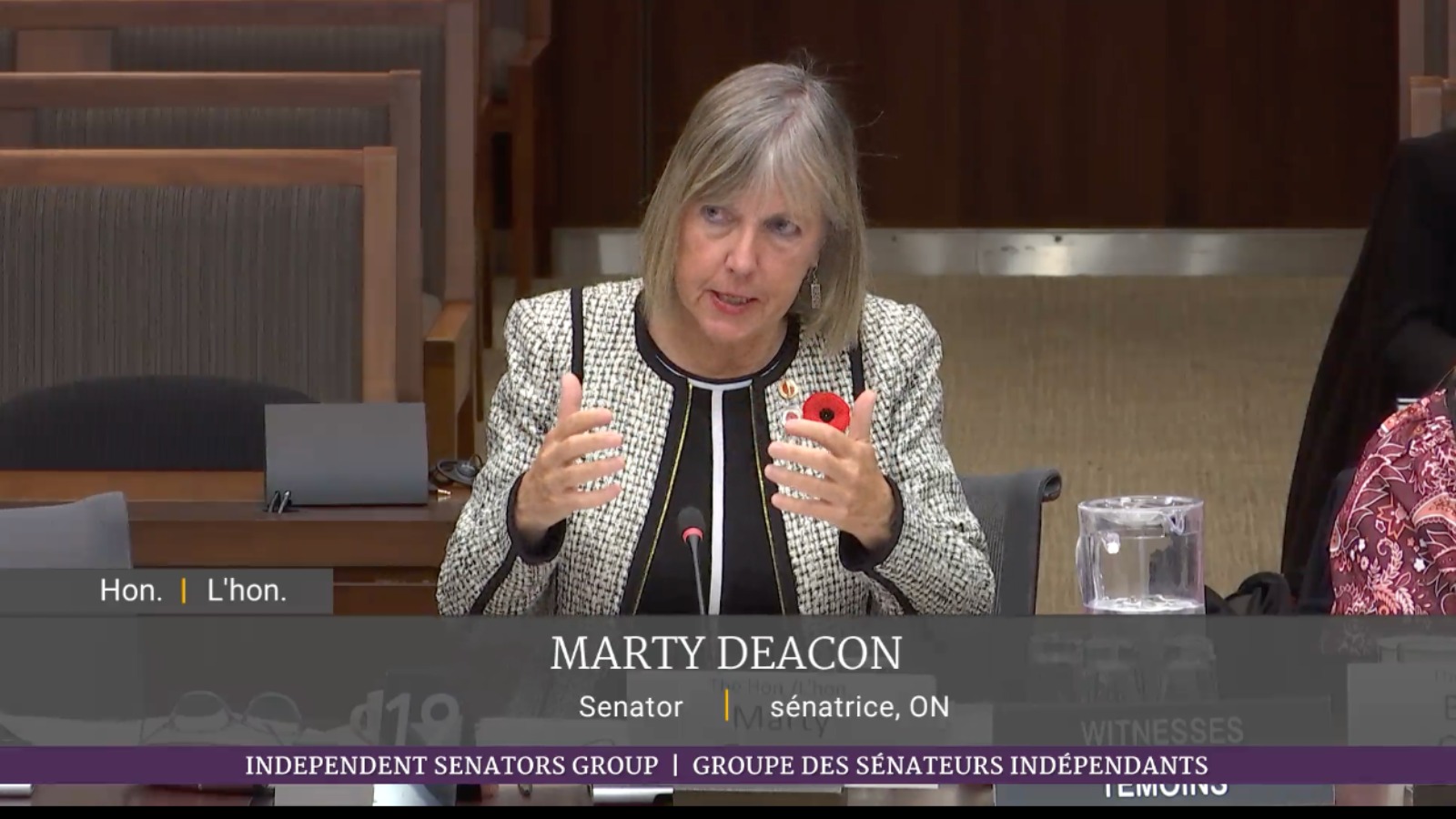
Before the first detour — a discussion about Canada’s relationship with the EU — Deacon and House of Commons sponsor Bardish Chagger introduced the bill. Deacon is a member of the Independent Senators Group and Chagger is a Liberal.
Deacon called sports betting advertisements “unrelenting” and said that when Ontario became the first province to launch in 2022, she understood that the tide would recede as operators got their footing. Citing CBC-University of Bristol research, she said that during a stretch of seven Stanley Cup games this year, viewers were subjected to 3,000 gambling exposures. The study, released earlier this month, included views of logos on equipment or on the boards, in addition to advertisements.
Since introducing the proposal, Deacon, who voted to decriminalize single-event sports betting in 2021, has been clear that she has reservations.
“We’ve not only allowed for single-sport betting, but as a society we are outright encouraging the activity of gambling,” she said. “Perhaps it was the relative simplicity of C-218 — removing one line in the criminal code — that blinded the majority of us to the harms that promotions could cause. That was a mistake, one I seek to rectify with this legislation and needed sober second thought.”
She went on to say that she is not looking to “vilify” gambling companies, whom she said are working “within the parameters they’ve been told they can,” but whose main goal is making money, not “preventing societal harm.” Deacon also said a federal framework was needed to avoid a “patchwork” of provincial regulation, and prevent the “seep” of gambling advertisements and availability from a legal province to one where it is not legal.
Chagger told the committee that it is imperative for the federal government to get involved, as there is already federal regulation for other “vices,” including alcohol, cannabis, and tobacco. The goal, she said, is to offer the products and allow free choice, but to ensure that “Canadians are not bombarded to participate.”
“Legalization should not mean normalization,” she said. “Gambling should not be an expected part of being a sports fan. For many young people, especially men, this line is becoming blurred.”
Pros, cons of total ad ban
MP Gabriel Hardy asked one question before addressing Thursday’s Canada-EU Summit in Montreal and proposing the committee consider a study that would protect the French language in Quebec.
From there, committee members spent about 30 minutes discussing the issue before returning to S-211. Two witnesses, Kevin Desjardins from the Canadian Association of Broadcasters (CAB), and Renze Nauta of Cardus, a public policy think tank, each offered input.
Desjardins said “the bill appears to assume that there is a significant regulatory gap that needs to be addressed without first establishing whether such a gap exists.” He said the CAB cautions that banning advertising from legal operators completely could backfire by “inadvertently shifting the advertising to less regulated offshore and digital platforms,” and it is difficult to enforce laws on unregulated entities.
Nauta said his group has done some research into the effects of legal wagering on Canadian citizens, and called the statistics from Ontario “deeply disturbing.” The research revealed that $10 billion per month is bet on sports and online casino by 1.3 million accounts, and that the average Ontarian loses $300 per month to online gambling. Cardus is calling for a complete advertising ban, and barring that a prohibition on gambling ads during live sporting events plus a ban on advertising for in-game betting products.
Cardus also recommends amending S-211 to include operators funding problem gambling research, prevention, and treatment in a dollar amount “at least equal to what they spend on advertising” and require stronger gambling prevention language in ads.
After Nauta completed his testimony, Lawton during a question-and-answer period aggressively turned the conversation back to violence against faith-based groups, which took the remaining time the committee had for discussion.