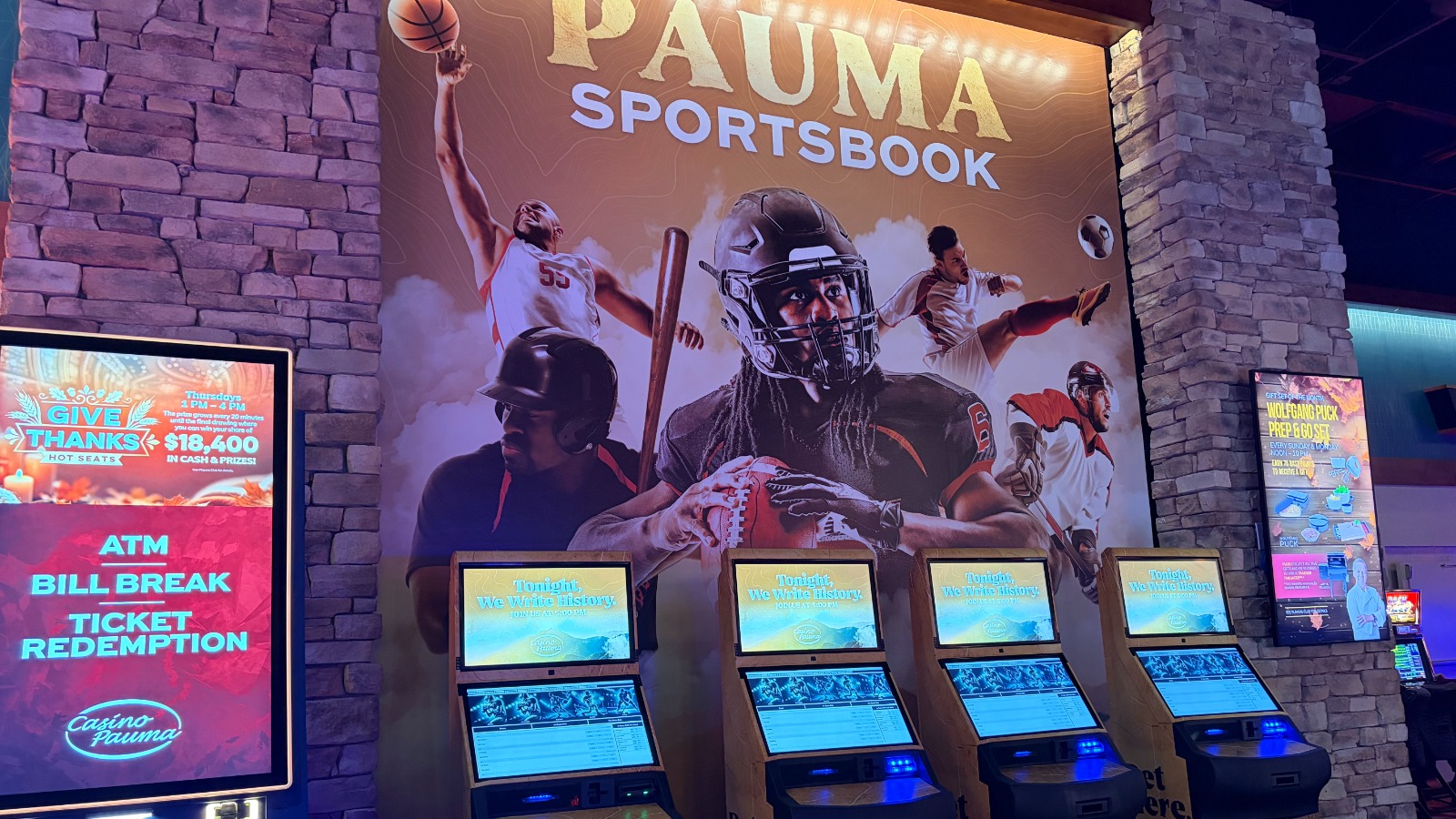
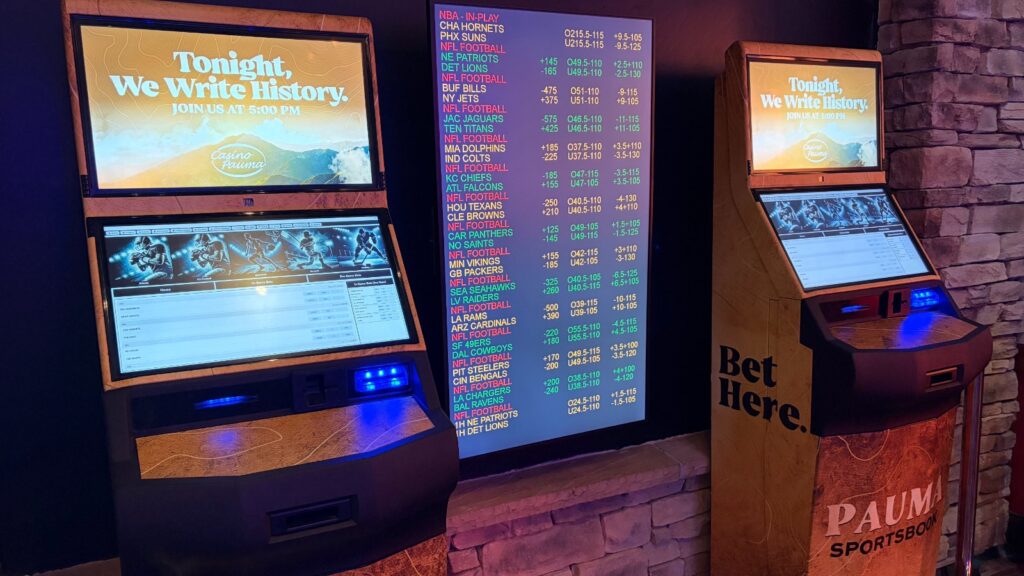
When a California Indian tribe last Thursday opened the state’s first retail sportsbook, the move created a buzz within the industry with some stakeholders questioning the legality of the move and others asking how they could get in on the action.
The Pauma Band of Luiseno Indians sits in an unusual spot. It operates under “secretarial procedures” rather than a tribal-state compact. That means the tribe has an agreement with the federal government, not the state of California. And Pauma’s secretarial procedures include language that could be interpreted to mean that it has every right to open a sportsbook on its reservation … or not. How the language is interpreted has much to do with who is doing the interpreting and what his or her own agenda might be.
But the tribe believes it is well within the bounds of what its secretarial procedures allow, and it will take its sportsbook a step further next month when it begins offering on-reservation mobile betting.
The state of legal sports betting in California is fraught, contentious, and divisive. Since 2021, when a group of commercial operators got approval for an online wagering ballot initiative, the issue has been a minefield of rhetoric revolving around tribal sovereignty and gaming exclusivity.
Is the Pauma tribe’s new addition to the U.S. sports betting landscape legal? That depends on who you ask.
But first, a little background.
California law on sports betting
California does not have a law on the books that explicitly prohibits sports betting as illegal. The state and tribes have worked under the interpretation that it is not legal, and that a voter initiative or a legislative solution would be needed to allow it.
California uses the National Indian Gaming Commission’s (NIGC) via the Indian Gaming Regulatory Act (IGRA) definition of Class III gaming, which does call out sports betting as Class III gaming. From the NIGC definition:
Class III gaming means all forms of gaming that are not class I gaming or class II gaming, including but not limited to: (a) Any house banking game, including but not limited to—
(1) Card games such as baccarat, chemin de fer, blackjack (21), and pai gow (if played as house banking games);
(2) Casino games such as roulette, craps, and keno;
(b) Any slot machines as defined in 15 U.S.C. 1171(a)(1) and electronic or electromechanical facsimiles of any game of chance;
(c) Any sports betting and parimutuel wagering including but not limited to wagering on horse racing, dog racing or jai alai; or
(d) Lotteries
There are indicators that the spirit of the law is that such wagering is not permitted. California Penal Code 337a reads that “any person who engages in …. pool selling or bookmaking, with or without writing, at any time or place” will be “punished.” First-time offenders are subject to up to one year in prison and/or a $5,000 fine.
In July 2025, California Attorney General Rob Bonta, in an opinion that daily fantasy sports (DFS) are not legal, wrote “traditional forms of sports wagering — which California law generally prohibits” as he put daily fantasy sports into context. Also in 2025, the state legislature banned sweepstakes models, and that law went into effect Jan. 1. DFS remains a legal gray area. California’s tribes supported and lobbied for both actions.
The state moved quickly in January to shut down a type of gambling it deems illegal. Historical horse racing machines installed at Santa Anita Park were removed by the state Department of Justice within days of their operation. The machines had been installed quietly, with no announcement or notice to the horse racing board.
While it’s not clear what level of involvement Indian Country had in having the machines removed from Santa Anita, it supported their removal.
Since the federal Professional and Amateur Sports Protection Act was overturned in 2018, most states and tribes seem to have proceeded under the idea that sports betting must be explicitly allowed in order for sportsbooks to be legal. There is at least one departure. In New Mexico, tribes interpreted the NIGC definition of Class III gaming to include sports betting, and some began offering in-person wagering on their reservations as early as 2019. The state attorney general has taken no action against the tribes, which continue to offer it.
Secretarial procedures vs. compacts
In 1988, Congress through IGRA gave federally recognized tribes the right to offer Class III gaming on their land. The law allows the tribes exclusivity, with the gambling allowed as long as “the gaming activity is not specifically prohibited by Federal law and is conducted within a State which does not, as a matter of criminal law and public policy, prohibit such gaming activity.”
Tribes usually compact with the states in which they are located to set out details of an agreement. But some operate under “secretarial procedures.”
There are 19 tribes in California that operate under secretarial procedures instead of compacts with the state. Secretarial procedures come about because the state did not enter into compact negotiations in “good faith.” Being under secretarial procedures means that the tribe has an agreement with the NIGC as a representative of the federal government, rather than the state.
“I think its worth mentioning that Puama has had to fight every step of the way to assert their right to have gaming on their lands,” Indian Gaming Association Executive Director Jason Giles told InGame. “Part of doing secretarial procedures is how the IGRA is designed to work. Pauma deserves credit for doing what they think is best to defend their sovereignty and economic development.”
The Pauma tribe’s secretarial procedures include two key entries, both under Section 4.0, Scope of Class III Gaming. These entries are on a list of “authorized and permitted Class III gaming”:
(d) Any other Class III gaming that the State permits “for any purpose by any person, organization or entity,” including any Class III gaming arising from the State’s authorization of Controlled Games for play at nonprofit organization fundraisers under California Business and Professions Code § 19985 et seq.
(e) For any Class III gaming that the Tribe wants to introduce for play after the effective date of these Procedures, the Tribe shall notify the NIGC of its intent to offer such games for play at least 60 days in advance. This notification will include the Tribal Internal Controls, which shall remain in compliance with the applicable NIGC regulations. If the NIGC has not promulgated the needed game
specific regulations, the Tribal Internal Controls shall be no less strict than those of the State of Nevada.
While 4(d) seems to indicate that the tribe can offer any Class III gaming permitted by the state, 4(e) suggests that the state does not play a role, and that the tribe need only give 60-day notice to the NIGC. Among the questions about the language is whether or not Parts D and E must be taken together or if they are separate provisions.
Items A, B, and C on the list of “authorized and permitted” gaming are “gaming devices,” “banking or percentage card game,” and lottery. Put into context, it seems clear that each entry under “authorized and permitted” gaming stands on its own as, for example, a slot machine has no relationship to the lottery.
The argument for only having to give a notification resembles the situation that prediction markets have nationally with their regulator, the federal Commodity Futures Trading Commission (CFTC). The platforms need only alert the agency when opening a new market, they do not require approval, though the CFTC has the option to push back.
In the Pauma scenario, the NIGC has the option to push back, as well.
Stephen Crystal, founder of SCCG Management, a gaming consulting firm that is partnered with Pauma for sports betting, said the tribe submitted the notice to the NIGC, which did not offer comment on it. The NIGC declined to provide the notice to InGame, or to comment on the situation, writing in an email to InGame, “This matter is under review. We have nothing to provide at this time.”
Under the Trump administration, the NIGC is operating without a chairman. There are two commissioners — Associate Commissioner Sharon Avery and Associate Commissioner and Vice Chair William Kirkland is doing double duty, as he is also assistant secretary for Indian Affairs for the U.S. Department of the Interior.
Pauma didn’t do this lightly
The idea for the Casino Pauma Sportsbook originated more than a year ago with the tribe, said Crystal. After tribal lawyers brought back their interpretation that an in-person sportsbook and on-reservation mobile betting were legal, the tribe reached out to SCCG.
“They followed the rules to a T,” Crystal told InGame. The secretarial procedures do “not require them to get authorization. Looking at the procedures and the fact that they are doing it exclusively on tribal land means they are doing it within the rules.”
The 5,877-square-mile Pauma reservation is located in far northeastern San Diego County, 59 miles north of downtown San Diego. There are 236 enrolled tribal members, many of whom live on the reservation, which is adjacent to the larger Pala Band of Mission Indians reservation (1,573 enrolled members; 20,000 square miles).
Crystal said that Pauma’s reading of the procedures is that the tribe is required “only to give 60-day notice,” that Parts 4(d) and 4(e) are independent, and that it views sports betting as a Class III activity. If Parts D and E of the secretarial procedures are taken separately, Part E clearly only addresses the notification process. One tribal lawyer not associated with the tribe agreed, writing that the “NIGC doesn’t have to approve” the gambling expansion.
“Pauma did not open a sportsbook only by declaring a right,” Crystal wrote Monday in a post on the SCCG website. “It acted on the notice provision in the procedures it operates under. That provision is the legal basis, and the reasoning follows from it.”
However, Crystal and others closely involved with Indian gaming say there could be repercussions, either from the NIGC or the state.
“Is it possible the NIGC will speak up with a different view?” Crystal asked. “Or that the state will write a letter and say they can’t do it? Or is it possible the tribe will defend itself in court? [All of those scenarios] are possible.”
A lawyer who has experience practicing in front of the NIGC offered this take. “The big question now is whether the NIGC would enforce,” the lawyer told InGame. “It’s not a Class III-approved game in California. I don’t see legally how they can do it, I’d like to see their rationale.” The lawyer went on to say that it’s possible the tribe views its new sportsbook as a “test case” that will allow others to see what the federal or state response might be.
“There’s a very generous reading of the secretarial procedures, especially as they relate to NIGC enforcement authority, that would make this legal,” IGA’s Giles said. “I’m sure that they’re willing to roll the dice and see what a federal judge might say if the state takes action.”
Sources in Indian Country expect a response from the state, though it’s not clear when or what it will be. The attorney general’s office did not respond to inquiries for this story.
“I think they also know that there will be immediate pushback from the state, which is why they have secretarial procedures,” Giles said.
The California Gaming Control Board (CGCB) is on the periphery of tribal gaming, managing two tribal gaming funds, but it is not involved in the day-to-day operation or regulation of Indian Country gambling.
“The Commission does not have any roles or responsibilities in regulating Casino Pauma’s offering of sports betting,” a CGCB spokesperson told InGame. “Casino Pauma operates via a secretarial procedure, which is an agreement between the tribe and the US Department of the Interior and the National Indian Gaming Commission. The secretarial procedure provides that the state gaming agencies have no gaming regulatory responsibilities or obligations to the tribe, and vice versa.”
Could another tribe launch sports betting?
There are 84 federally recognized tribes in California that have either compacts with the state or secretarial procedures in place allowing them offer some form of gaming. The vast majority — 65 — are compacted with the state, including all of California’s biggest and most successful gaming tribes. Nineteen tribes are operating under secretarial procedures.
Of those under secretarial procedures, Pauma and Berry Creek Rancheria of Maidu Indians of California have the same language in Sections 4(d) and 4(e) of their secretarial procedures, making them the only two tribes that could consider launching sportsbooks under Pauma’s interpretation of the procedures.
Berry Creek, located in the Sierra Nevada foothills north of Sacramento, has 304 enrolled members. The tribe owns the Gold Country Casino Resort, which offers table games and slots, and has an 87-room hotel tower.
Other tribes have language that would clearly prohibit them from offering sports betting or any other Class III gaming that is not approved by the state. From the secretarial procedures of many tribes:
Nothing herein shall be construed to authorize or permit the operation of any Class III Gaming that the State lacks the power to authorize or permit under article IV, section 19, subdivision ( f), of the California Constitution.
Some also include language that would allow a tribe to add any type of Class III gaming approved after their secretarial procedures went into effect, meaning they’d have a clear path to sports betting should the state legalize it. Others allow for pari-mutuel betting on reservation. In reviewing the 19 secretarial procedures, it’s clear that every tribe forges its own future.
“Sports betting has been around for many years now, but who knows when it will get legalized in California,” former Cahuilla Band of Indians Chair and Sports Betting Alliance advisory council member Daniel Salgado wrote on Facebook. “Tribal governments are evaluating their own circumstances, weighing the opportunities and risks, and making sovereign decisions about what they believe best serves their people. … Each tribe has its own responsibility to determine its path forward.”
None of the compacted tribes have the language of the Pauma and Berry Creek secretarial procedures. And as tribes compacted by the state, they submit to only allowing Class III gaming authorized by the state. Crystal says this is a “hammer” that the state could wield to keep a compacted tribe from offering sports betting. In that scenario, a compact renegotiation would be required, and most tribes shy away from reopening compacts because it opens the door for the state to seek to get involved in other issues from water rights to gas taxes.
Attempts at legalization in California
In 2019, Indian Country got approval for a 2020 ballot measure that would allow for in-person wagering. But the state shut down signature gathering in early 2020 when the COVID-19 pandemic broke out. The initiative was delayed to the 2022 ballot.
In 2021, commercial operators filed their own initiative, this one for retail and online sports betting. But commercial operators and the tribes — which have the exclusive right to gambling in the state — couldn’t come to a consensus, and Indian Country spent $250 million to kill both initiatives, which were rejected by voters statewide in 2022.
Since then, there was another commercial initiative attempt that didn’t get past the signature-gathering stage. All the while, Indian Country has been working within its own community to reach a consensus on what online sports betting in the Golden State might look like. Despite the publicly contentious situation around the 2022 ballot initiatives, there has been a continuing dialogue between the commercial industry and Indian Country. Over the summer, the California Nations Indian Gaming Association formally and quietly reached out to the commercial industry to gauge interest.
With every legalization attempt, however, there has been an effort to divide the tribes. Three smaller tribes joined the initiative effort led by DraftKings, FanDuel, and others in 2022, and a year later Kasey Thompson, who launched Pala Interactive, the online platform for the Pala tribe, said he had tribes that supported his initiative attempt.
Since then, a group of smaller California tribes pledged their support to sweepstakes operators, and three this year signed deals to offer prediction platforms run by Kalshi. At every step, the state tribal association has stood firm, saying such efforts galvanize and unite the tribes.
Will Pauma’s decision to launch wagering be divisive? It certainly doesn’t open the door to a floodgate of on-reservation sportsbooks. But it does reveal a key truth in Indian Country — every tribe is its own entity with its own culture and own way of defending or exerting its sovereignty.