
Welcome back to “Midterm Market Monitor,” a recurring InGame feature between now and Nov. 3 in which we explore the latest and most noteworthy prediction market odds and trends related to the upcoming elections.
No matter how Americentric you may be, you are presumably aware that elections are not just a U.S. thing. As I write this column on Tuesday morning, prediction markets are bouncing all over the place as Israel determines its next prime minister. And over the weekend, Brazil held a presidential election of great importance to the gambling industry, since incumbent Luiz Inácio Lula da Silva (pictured above) has been working to ban all online gambling in the country (which means a ban on regulated online gambling, not a ban on all online gambling, but that’s another topic for another day).
The big gambling story coming out of Brazil’s election, though, was how “wrong” the prediction markets got it. And I put “wrong” in quotation marks because you can never truly be “wrong” if you declare something likely or unlikely. When the Cardinals win outright against the Rams as 12.5-point underdogs, it doesn’t mean the Rams shouldn’t have been favored; it just means the less likely scenario became reality.
And according to prediction markets, Lula defeating Flavio Bolsonaro was the much less likely scenario. But it became reality. Lula finished second in the opening round of balloting but went on to win the election.
At Polymarket, Lula’s odds were as low as 13.5% at one point. Polls mostly saw a close race, but prediction markets painted Bolsonaro as a heavy favorite. And after the election, that led to a wave of “don’t trust the prediction markets” sentiment.
OK, let’s get Americentric: What does this mean for the U.S. midterm elections, which are exactly one week away? Well, it should serve as a reminder that polls are one indicator, and prediction markets are another indicator, and a 67% chance of one candidate winning means that one-third of the time the other candidate will win, and nothing is certain until the ballots are counted.
So prepare your grains of salt as you read this final edition of Midterm Market Monitor, offering a snapshot of likely and unlikely scenarios — but not certain or impossible scenarios — as Election Day looms.
Senate control
You might think in a market this liquid, we’re not likely to see huge swings at this point. You figure we’ll see them next week as election returns come in and certain key races are clinched and the possibility of one side or the other locking up that 100% comes into view. But for now, a move of one percentage point here or there feels like plenty.
And from last Tuesday to this Tuesday, one percentage point is pretty much what we got. All the major prediction markets ticked slightly in favor of Democrat control over the past week.
Kalshi went from 64% to 65%. Polymarket and PredictIt both went from 65% to 66%. And the Robinhood market went from 64% to 66%.
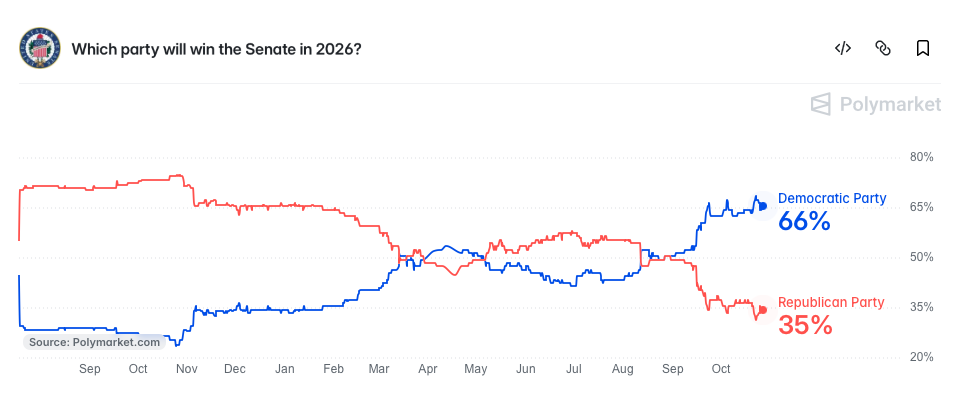
But what’s interesting is that there were bigger swings within that modest movement. At PredictIt, for example, sure, it was 65% a week ago and it’s 66% now. But in between, last Thursday, Dems got as high as 71%.
If you compare where we are right now to where we were one Tuesday ago, and two Tuesdays ago, and three Tuesdays ago, and so forth, people holding shares of Democratic control of the Senate should be feeling good. But if you just look back five days, Republican backers might talk themselves into liking the way things are trending.
House control
As has been the case for months now, the battle for House control isn’t as intriguing as the one for the Senate. Now, if all the blue wave talk turns out to be fiction and Republicans hold the House after Nov. 3, we’ll be singing a different tune about which chamber proved more fascinating. But if there’s any truth at all to the sense that the elections will serve as a referendum on the supposed unpopularity of President Donald Trump, the House is basically a done deal already.*
(*With all the usual “nothing is 100% certain until it’s over” caveats, of course.)
Anyway, in the fight for 218 or more House seats, the Democrats are 91% at Kalshi, 92% at Polymarket and Robinhood, and 89% at PredictIt.
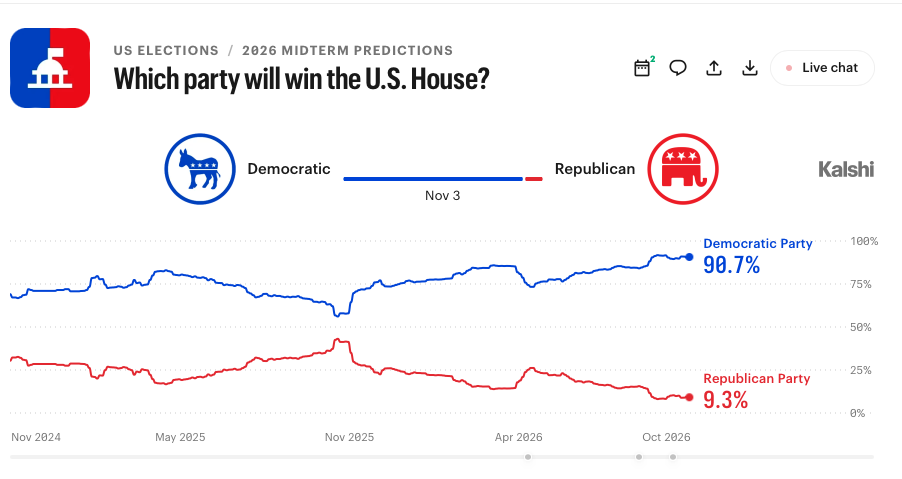
If the Republicans end up with 218 or more seats, we’ll hear a lot of talk about how meaningless the prediction markets are. But unless and until that happens, there doesn’t seem to be much drama here.
Race to watch: Kansas Senate
This will arguably be the most telling outcome on election night, in terms of whether a full-on blue tsunami is possible.
Kansas is a red state. Plain and simple. At the start of 2025, when this market opened, prediction markets had the state’s Senate race above 90% to go Republican. But it started to get a little closer after the U.S. military aggression in Iran began. In May, it got to around 75-25. As September gave way to October, it got tighter. Democrat Adam Hamilton’s chances were in the 30s. Republican Roger Marshall’s were in the 60s.
At last glance, Marshall was around 60% at all the major markets.
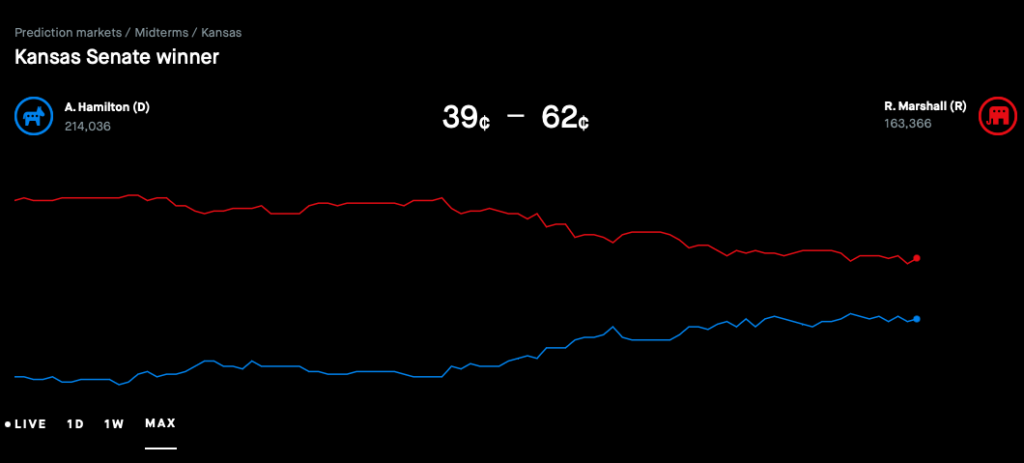
It’s still not what we’d call a toss-up. There’s a distinct favorite and underdog. But this has the air of a tipping-point state. If Hamilton actually wins — which once seemed absurd but is now, according to polls and prediction markets, realistic — it points to a truly disastrous midterm election for the Republican Party.
Presidential election odds
If you think projecting who will win the presidency in November 2028 is a case of getting ahead of ourselves … well, that’s nothing compared to a market on Kalshi capturing the full balance of power after the ’28 elections.
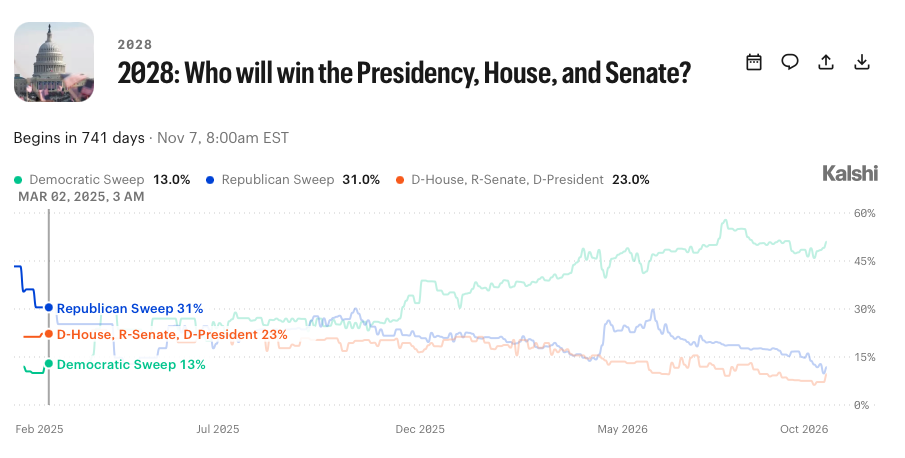
As of press time, there was less than a half-million bucks of liquidity in the market, but still, it’s fascinating. Democrats sweeping the presidency and both chambers of Congress is 51%. A Republican sweep is 12%. Then there are all sorts of split scenarios, the most popular being a Democratic president and Dem control of the House, but with Republicans emerging with the majority in the Senate, at 9.9%.
What a time to be alive.
And we haven’t even gotten to the “wacky market of the week” yet …
Wacky market of the week
This market shows you just how granular the political betting markets have become. It’s titled, “Who will be the top ActBlue fundraiser on Friday?” So it’s asking which Democratic candidate will have raised the most money, as displayed on ActBlue’s official directory page, by the end of the week.
You might say it’s a window into which candidates are inspiring the most passion right now (provided they’re locked in competitive races).
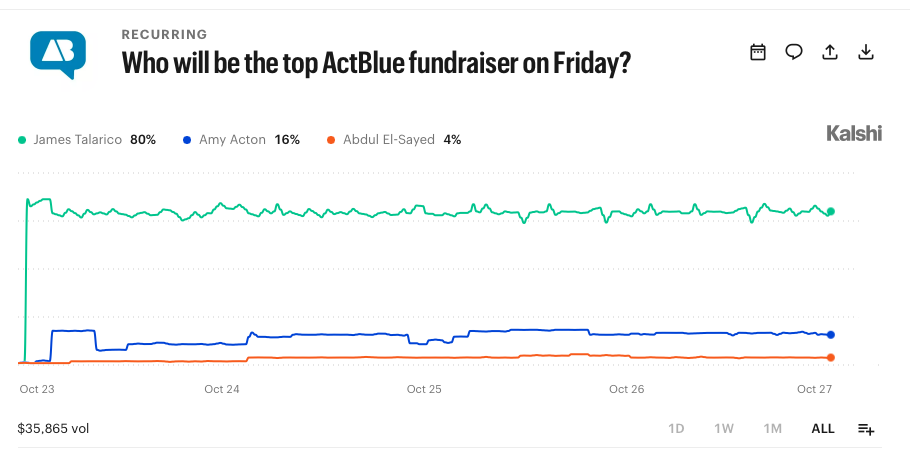
Texas Senate candidate James Talarico is the heavy favorite, but Ohio gubernatorial candidate Amy Acton is surging in the wake of her opponent’s controversial attack ads. Michigan Senate candidate Abdul El-Sayed is running third, and then it’s back to Texas in fourth place, where the underdog to win the governor’s race, Gina Hinojosa, is a 1% longshot to rise to the top of the ActBlue rankings.