National tribal leaders urged a congressional committee Tuesday to take decisive action to halt the proliferation of prediction markets, which they say encroach on their sovereign rights and gaming exclusivity.
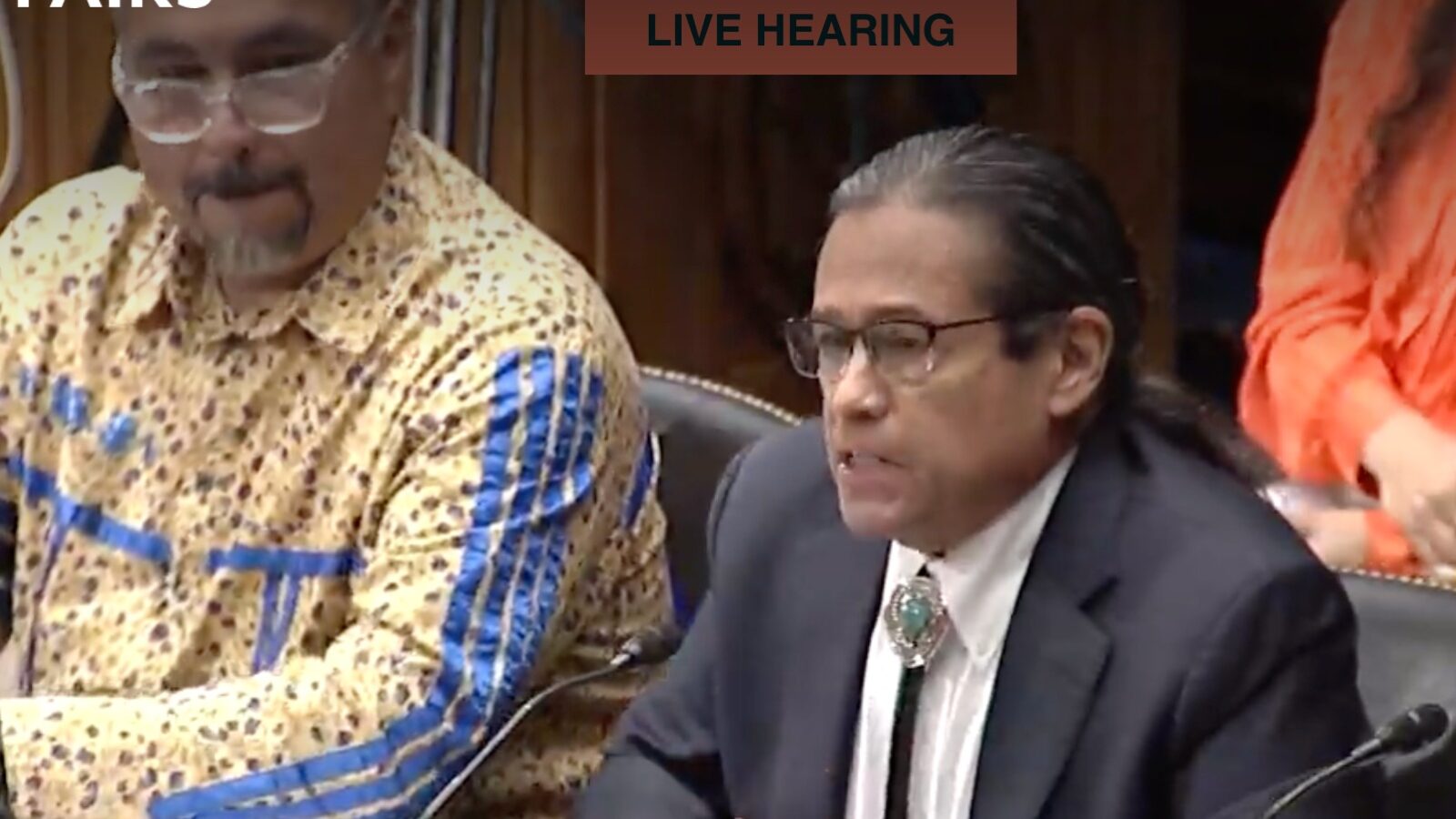
During a Senate Indian Affairs Committee roundtable with three well-known tribal spokesmen plus the Ohio solicitor general and a public health advocate, Indian Gaming Association Vice Chair Tehassi Hill said companies like Kalshi and Polymarket have “manipulated a weak regulatory agency” and “claim to be innovators, but have innovated nothing.”
Hill, the chairman of Wisconsin’s Oneida Nation, along with National Congress of American Indians President Mark Macarro (California Pechanga Band of Mission Indians chair) and National Tribal Gaming Commissioners and Regulators Chair Jamie Hummingbird, outlined several strategies they are proposing for Congress to protect Indian gaming. Indian Country has been opposed to the rise of the prediction market platforms’ sports event contracts for more than a year.
The offerings, they say, are forcing tribes to consider cutting key services and are violating federal law. Three tribal groups are currently in court with Kalshi, and dozens of tribal entities have filed or signed on to amicus briefs supporting states’ rights against the platforms and the Commodity Futures Trading Commission (CFTC).
Macarro told the committee that sports event contracts — as well as other current and potential prediction contracts — “usurp all of the infrastructure … and undercut tribal sovereignty.”
Sen. Brian Schatz of Hawaii, the committee’s vice chair, said that prediction offerings are eviscerating the budgets of Indian Country, “and what is about to happen to Indian Country’s revenue pales in comparison to what we would be able to replace it with.”
Tribal leaders shared that prediction markets have already cut into revenue, forcing hard decisions around cutting funding for education, elder care, and other vital services. Macarro said that, anecdotally, it appears that up to 5% of California Indian gaming revenue has shifted to prediction markets in the last year. No form of online gaming is legal in California.
Committee members, while empathetic, were trying to understand what resolution Indian Country seeks and gain a better understanding of what regulated gaming brings to the table that prediction markets do not.
Indian Country offers Congress a punchlist
The tribal leaders outlined what they believe Congress can do to protect Indian Country:
- Pass S 4160, a bill titled “Prediction Markets Are Gambling,” which would amend the Commodities Exchange Act (CEA) to ban contracts on sports betting and casino-style games. The bill is currently in the Senate Agriculture Committee and does not have a hearing date.
- Amend HR 3633, the Clarity Act, the crypto bill that passed out of the House late last year and has been under heavy discussion in the Senate. Indian Country wants any language that would allow for prediction sports contracts or casino-style gaming removed from the bill.
- Prevent the CFTC from moving forward with its proposed rules changes, which would effectively put a framework around and codify their legality. The proposed changes have been a hot-button issue that gaming stakeholders say would allow a de facto sports betting product to be available nationwide with no consumer protections or taxes paid to states. The proposal would all but take gaming regulation — which has long been under state purview — away from states and give it to the federal government.
- Enforce any and all current laws pertaining to gaming and support states’ rights to regulate gaming.
- Fill out the full CFTC, which has been operating with a single commissioner for more than six months. Macarro called the situation untenable.
“No one voted for this,” Hill said of prediction markets. “This is happening because one person has declared that sports betting is legal in every state.” Hill appeared to be referring to CFTC Chair Michael Selig, who was confirmed last December.
“Make no mistake, nothing in the legislative history of the CEA suggests that Congress ever intended the CFTC to become a backdoor regulator of gaming,” Macarro said. “The CFTC was created to oversee commodities and derivatives, not to create, tolerate, or bless a shadow framework for sports and event betting that Congress never authorized it to regulate.”
Macarro is no stranger to the Indian Affairs Committee — in February, he was among a group of tribal and commercial gaming leaders that briefed the committee on the rise of prediction markets.
Macarro went on to cite the Lincoln-Feinstein 2010 colloquy during Dodd-Frank Act discussion in which the two senators described the CFTC as tasked with eliminating trading that “runs contrary to the public interest.” According to the text of CEA, the CFTC can restrict or ban contracts on gaming, as well as on assassination, terrorism, and war.
In addition to the tribal leaders, Ohio Solicitor General Mathura Sridharan made clear that her state — which is in court with Kalshi — opposes sports event contracts. Harry Levant, a recovering gambling addict who is the director of policy for the Public Health Advocacy Institute, said Congress should “support a federal minimum standard.”
Dozens of tribes to back NM tribes
Per a July 29 filing in the Mescalero Apache Nation’s case against Kalshi in New Mexico, more than three dozen tribal entities — including the IGA, Arizona Indian Gaming Association, California Nations Indian Gaming Association, Minnesota Indian Gaming Association, and Washington Indian Gaming Association — are preparing to file an amicus brief. The tribes filed a motion with the U.S. District Court for the District of New Mexico and are awaiting approval. The Mescalero Apache, along with three others in New Mexico, sued Kalshi in May seeking to keep it from operating on tribal lands. It is the third tribal lawsuit against the prediction market.
The New Mexico tribes on July 22 also filed a brief opposing Kalshi’s motion to dismiss the case and requested a preliminary injunction to keep the platform off their lands. In the response brief, the tribes say they’ve made “legally sound and factually sufficient” arguments and have every right to enforce the Indian Gaming Regulatory Act (IGRA), and that IGRA extends to tribal-state compacts. Kalshi previously argued that the tribes could not sue it because it is not party to compacts between the tribes and the state of New Mexico.
The tribes also argue that Kalshi is in violation of IGRA by offering its product in Indian Country without approval of tribes, which under IGRA are the sole arbiters of gambling on their land.
Tenth Circuit extends Ute tribes’ timeline
The U.S. Court of Appeals for the Tenth Circuit early last week extended the time for Colorado’s Southern and Mountain Ute Tribes to file their opening brief in a case against the state of Colorado from July 30 to Aug. 31. The tribes first appealed a district court ruling in December, and the deadline for the opening brief has been continued at least six times since then.
At the heart of the case is the tribes’ right to offer online sports betting across the state. Online sports betting has been live in Colorado since May 2020, and the Southern Ute Tribe launched its own platform in partnership with US Bookmaking, but it was shuttered in 2023 following a dispute with the state. Last October, a U.S. district court judge ruled in favor of the state, saying that he believes that a bet is placed where the bettor is physically located.
In two other states — Florida and Wisconsin — state law allows for bets to be considered placed where received. In those states, servers are or will be located in Indian Country, and any bet placed anywhere in the state is or will be considered to have been placed on tribal land.
More than a dozen commercial platforms are live in Colorado. Unlike in Florida and Wisconsin, the Colorado tribes would not have exclusivity for online sports betting, but they did ask at the district court not to be taxed or regulated by the state. In other states where commercial and tribal platforms co-exist, all are regulated and taxed by the state.