Last updated: September 4, 2026 | Last verified: September 4, 2026
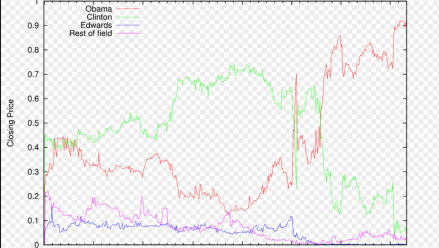
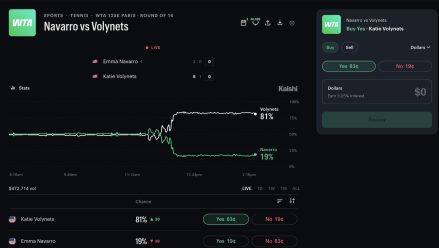
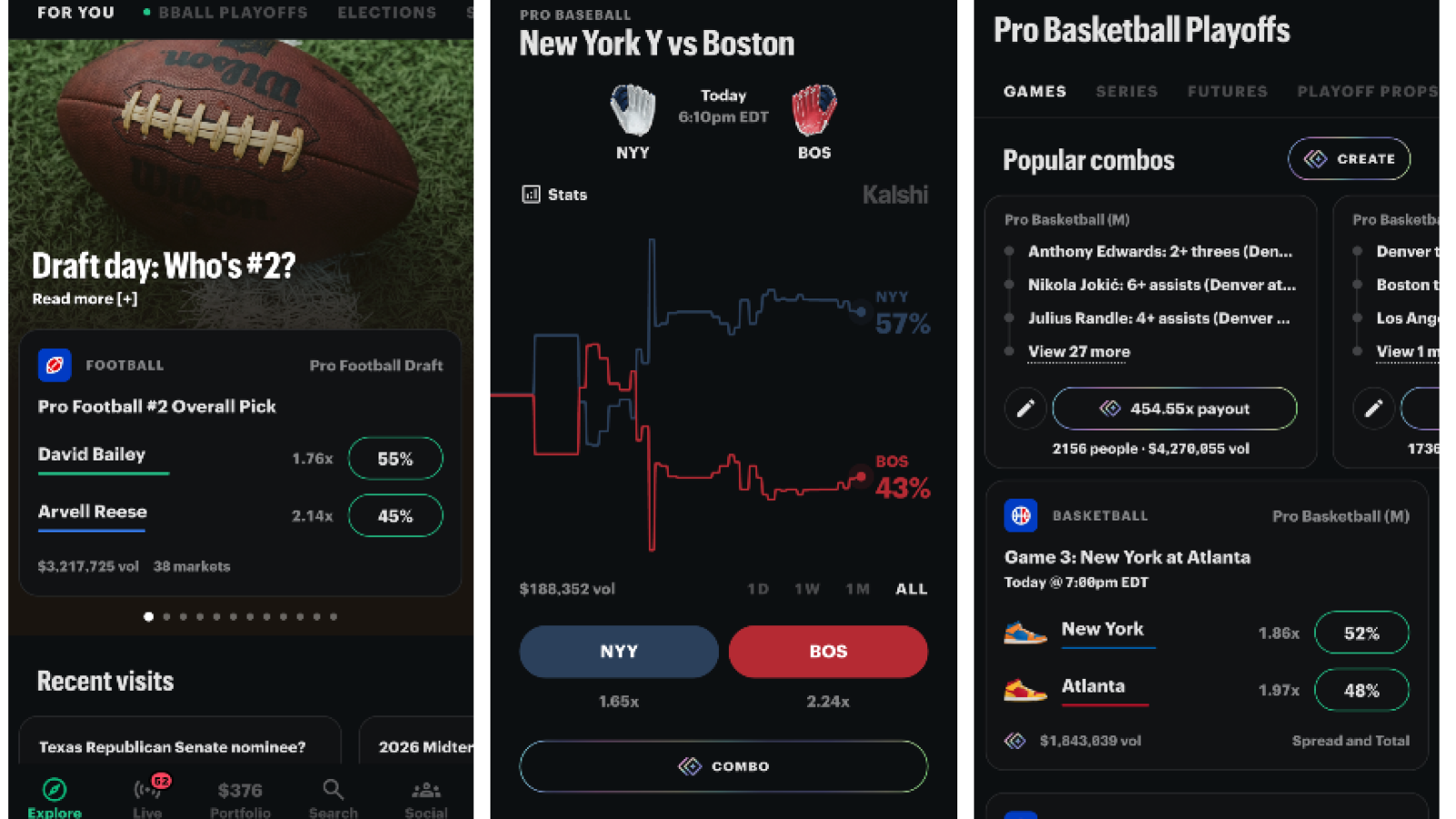
A prediction market is a regulated exchange where you buy and sell contracts tied to the outcome of real-world events. Each contract is priced between $0.01 and $0.99, and it pays out $1.00 if your prediction is correct. If a contract on the Yankees winning tonight’s game trades at $0.65, the market is collectively pricing that outcome at a 65% probability. Buy at $0.65, and you profit $0.35 per contract if they win. If they lose, the contract expires worthless and you’re out $0.65.
I started trading on Kalshi in late 2024, and I’ve since opened accounts on Polymarket US, Novig Prediction, Crypto.com and a handful of other platforms. Prediction markets aren’t brand new, but in the current iteration, with the scale, investment, competition, and legal entanglements, make the whole landscape a bit unclear and worth examining before you dive in.
Our Top Prediction Market Apps



How prediction markets work
Every prediction market contract is structured as a yes-or-no question. “Will the Bengals win the Super Bowl?” “Will the Fed cut rates in June?” “Will Bitcoin close above $100,000 on May 1st?” You buy the side you believe in and/or where you perceive value in in relation to the actual probability of the event occurring.
Contracts trade on a price scale from $0.01 to $0.99. That price doubles as an implied probability. A contract at $0.40 means the market collectively thinks there’s a 40% chance the event happens. If you think the real probability is higher, you buy “Yes.” If you think it is lower, you buy “No” (which trades at $0.60 in this example, because Yes and No always sum to $1.00).
💡 The math in 10 seconds:
You buy 100 “Yes” contracts at $0.40 each = $40 total cost.
If the event happens: 100 contracts × $1.00 = $100 payout. Your profit: $60 (minus fees).
If the event doesn’t happen: contracts expire at $0.00. You lose your $40.
This is the big difference from a sportsbook. In a sportsbook, the house sets the odds, takes a cut (the vig), and your bet is locked in until the game ends (barring a “cash out” offer, which varies by sportsbook). In a prediction market, the market sets the price through supply and demand, and you can sell your contracts at any point before the event resolves. Bought a contract at $0.40 and the price moved to $0.70? You can sell for a $0.30 profit per contract without waiting for the outcome. That flexibility is closer to trading stock options than placing a bet.
Prediction market contracts are classified as event contracts or futures by the Commodity Futures Trading Commission (CFTC), the same federal agency that oversees derivatives and commodity markets. This regulatory classification is important: it’s why prediction markets can legally operate in states where sports betting is not legal or requires state licensure, and why the legal battles currently playing out are about federal vs. state jurisdiction.
A real trade, step by step
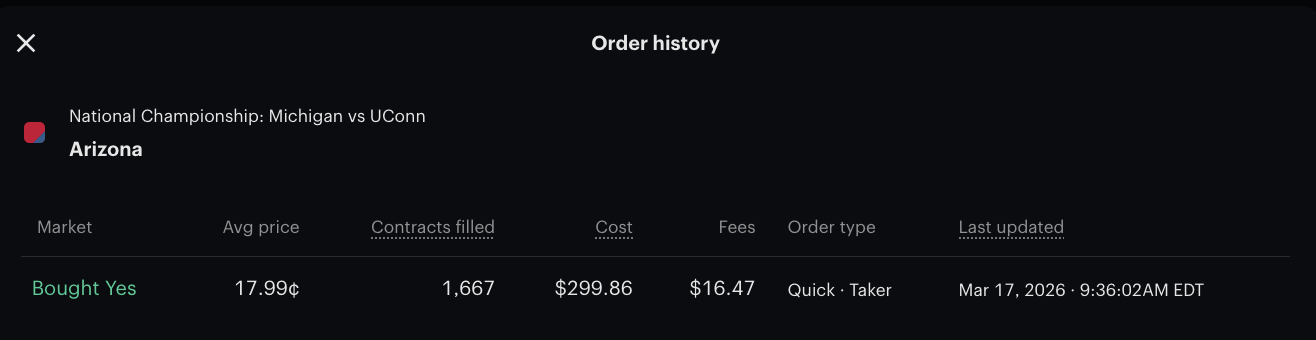
I placed this trade on Kalshi in March 2026 and will use it show how the mechanics work in practice.
The market: “Will Arizona win the NCAA men’s national championship” I purchased at $0.18 before the tournament tipped off. I bought 1667 contracts, and Kalshi applied about a 5.5% taker fee on my order. That’s consistent with their standard fee structure for taker orders, I could have (maybe should have) entered a limit order, but I paid a small premium for the convenience of getting filled immediately at the market price rather than placing a limit order and waiting.
Essentially, I paid about ~$300 that #1 seeded Arizona would win the championship, buying each “share” for about 18 cents. If Arizona had won, each share would pay out $1.00, so your 1,667 contracts would have returned $1,667. If they lose, which they did in the Final Four to eventual champion Michigan, I’m out the $300 plus fees. The 18-cent price roughly reflected the market’s view that Arizona had about an 18% chance of winning at the time.
During the tournament after Arizona blew out #4 Arkansas and then #2 Purdue in their region, the price/probability rose to as high as about 35%, and the market value at the time for my position was about $600, which would have roughly doubled up for me. I decided to let it ride, and not sell at that time. But I certainly thought about it!
🔑 Key takeaway: The ability to sell mid-event is what makes prediction markets unique. The prediction market will let you take partial profit at market probability during the game. You could also sell some of the shares, and keep some until final resolution, for better or worse.
📊 What you can trade on prediction markets
The range of tradeable events has expanded dramatically since 2024. When I first signed up, Kalshi was mostly politics and economics. Now the major platforms cover nearly everything with a verifiable outcome.
| Category | Example Markets | Primary Platforms |
|---|---|---|
| 🏈 Sports | Game outcomes, point spreads, totals, player props, futures, in-game trading, combos (parlays) | Kalshi, Polymarket US, DraftKings, FanDuel, Novig Prediction, Crypto.com, Underdog, Robinhood, Fanatics |
| 🗳️ Politics | Election outcomes (presidential, congressional, international), policy decisions, Supreme Court rulings | Kalshi, Polymarket, PredictIt |
| 💹 Economics & Finance | Fed rate decisions, GDP reports, inflation data, jobs numbers, S&P 500 levels | Kalshi, Polymarket |
| ₿ Crypto | Bitcoin/Ethereum price milestones, ETF approvals, regulatory actions | Kalshi, Polymarket, Crypto.com |
| 🌡️ Weather | Monthly temperature records, hurricane landfalls, seasonal forecasts | Kalshi |
| 🎬 Culture & Entertainment | Awards ceremonies (Oscars, Grammys), box office performance, TV ratings | Kalshi |
Sports is where the volume is at, as of spring 2026. Kalshi commands roughly 89% of U.S. prediction market sports volume as of early 2026. Newer entrants like DraftKings Predictions and Fanatics Markets are adding markets gradually but remain thinner than Kalshi, while Polymarket US operates as a separate product from the international site. Its U.S. iOS app is live for eligible users, while Android is still coming soon and is not broadly available.
Kalshi’s politics markets are buzzing ahead of the 2026 midterms. The “Will Democrats win the House?” market alone has seen over 855,000 transactions, and traders can weigh in on competitive Senate races in states like Georgia, Maine, Louisiana, and Texas, where James Talarico is currently trading at $0.47. Congressional control, election outcomes, and government shutdown markets are all available, with prices reflecting real-time implied probabilities.
Prediction markets vs. sportsbooks
This is the question I get asked most. The short answer: prediction markets and sportsbooks let you wager on the same events, but the mechanics are fundamentally different. You’re trading against other users on an exchange, not betting against a house that profits when you lose.
| Prediction Market | Traditional Sportsbook | |
|---|---|---|
| Pricing model | Market-driven (peer-to-peer exchange) | House-set odds (bookmaker) |
| How operator profits | Per-trade fee (coefficient model) | Built-in vig/juice on every line |
| Can you sell before the event ends? | ✅ Yes (trade out at market price) | ❌ Limited (cash-out at operator’s discretion) |
| Event types | Sports, politics, economics, weather, culture | Sports only (in most cases) |
| Regulator | CFTC (federal) | State gaming commissions |
| Minimum age | Varies by platform; many are 18+, while Novig Prediction is 21+ | 21+ in legal states |
| Availability | Kalshi: 49 states + DC | ~38 states with legal sports betting |
The practical difference that matters most to everyday users: prediction markets work in states where sports betting is not (yet) legal. If you live in Texas, California, or Georgia, you can’t use DraftKings or FanDuel for sports bets, but you can trade sports contracts on at least a handful of prediction markets. That geographic advantage is a massive part of why prediction markets have grown so quickly, and why the duopoly of DraftKings or FanDuel have pushed out and are investing in their predictions paltforms.
Where sportsbooks still win: depth of props and derivative markets (alt spreads, totals) per game, promotional offers (daily boosts, insurance, profit boosts add real value), and guaranteed liquidity on popular markets. If you’re a high-volume sports bettor in a state with legal sportsbooks, prediction markets are a complement, not a replacement. For a deeper breakdown, see our prediction market vs. sportsbook comparison.
💰 Prediction market fees
Fees are the part most beginners underestimate, and the part that matters more than any welcome bonus over time. Prediction market fees work differently from the vig in a sportsbook, and they vary significantly across platforms.
Most regulated prediction markets use a coefficient-based fee model. The fee is calculated as a percentage of the risk on each trade, not the total amount wagered. The math gets complicated fast, but the bottom line is this: fees are proportionally highest on contracts near 50/50 pricing and decrease as the contract moves toward extreme prices (near $0.01 or $0.99).
| Platform | Taker Fee | Maker Fee | Approx. Cost per 100 Contracts at $0.50 |
|---|---|---|---|
| Kalshi | 7% coefficient | 1.75% coefficient | ~$1.75 |
| Polymarket (U.S.) | 5% coefficient | 1.25% rebate (makers get paid) | ~$1.25 |
| Robinhood | $0.01 per contract (flat) | $0.01 per contract (flat) | $1.00 |
Two things to know about fees that aren’t obvious:
Fees trigger on both sides of the trade. You pay when you buy and again when you sell (or when the contract settles). So the true all-in cost of a round trip is roughly double what the table above shows. On a $50 position at $0.50 pricing on Kalshi, expect to pay somewhere around $3.50 in total fees between entry and exit.
Taker vs. maker matters a lot. A “taker” fills an existing order in the book. A “maker” posts a new order and waits for someone else to fill it. On Polymarket, makers actually earn a small rebate, which means patient traders who set limit orders and wait can functionally trade for free (or even get paid). On Kalshi, makers pay a reduced fee but still pay something. If you’re making lots of trades, learning to use limit orders saves real money.
Novig Prediction also rewards maker orders. Pre-game straight trades are currently fee-free for both makers and takers, while maker fills remain fee-free on live straight markets. Taker fees apply to live straight trades and parlays.
⚠️ Watch Out: Kalshi’s parabolic fee formula keeps per-contract fees tiny on extreme-priced contracts, but the spread can quietly wreck your edge. A longshot contract listed at $0.02 might have a best ask of $0.03 and a best bid of $0.01. You buy at $0.03, but if you need to exit before resolution, you’re selling at $0.01, which is a 67% loss just from the spread. On low-volume markets, the gap between buyers and sellers is the real hidden cost.
🏆 Major prediction market platforms in 2026
The field has gotten crowded. When I first wrote about prediction markets in early 2025, Kalshi was essentially the only game in town for regulated U.S. trading. Now there are at least seven platforms worth knowing about, with more on the way. Here’s a quick snapshot of who matters and why.
| Platform | 🌎 U.S. Availability | 📊 Fee Model | 🏈 Key Strength | 🎁 Welcome Bonus | 🔞 Min. Age |
|---|---|---|---|---|---|
| Kalshi | 49 states + DC | 7% taker / 1.75% maker | Widest market selection, live in-game trading | Trade $25, and get up to $500 bonus (code INGAME) | 18+ |
| Polymarket | Eligible U.S. jurisdictions; iOS live, Android coming soon/not broadly available | 5% taker / 1.25% maker rebate | Lowest fees, fastest app | Deposit $10, get a $20 trading bonus (code INGAME) | 18+ |
| DraftKings | Varies by market category | Exchange + platform fees | Familiar brand for sports bettors | Varies | 18+ |
| Robinhood | All 50 states | $0.01/contract flat | Cheapest fee for small trades, zero-friction for existing users | None currently | 18+ |
| Crypto.com | 49 states (not NY) | Exchange fees | Crypto-native audience, Underdog partnership | Deposit match up to $50 | 18+ |
| Novig Prediction | Available in eligible U.S. states; restricted in AZ, MI, NV | Pre-game straight trades and maker fills free; live taker/parlay fees apply | Sports-focused CFTC-regulated event-contract exchange | Deposit $10, get $25 in Trade Credits | 21+ |
| Fanatics Markets | 24 states + 4 territories | Exchange + platform fees | Mobile-first, consumer-friendly | None confirmed | 18+ |
If you’re starting from scratch, take a look at Kalshi first. It has the broadest availability, the deepest market selection, and the fewest barriers to entry. Polymarket is also worth comparing, particularly if you use iOS. Its U.S. app is live for eligible users, while Android is still coming soon and is not broadly available. Having both gives you more markets and the ability to compare pricing, which is the closest thing to an edge a retail trader has. For the full comparison, read our Kalshi vs. Polymarket breakdown, and for a comprehensive ranking of every platform, see our best prediction market sites page.
✅ Getting started: your first trade
Signing up for a prediction market takes about five minutes. Here’s what to expect on Kalshi (the process is similar across platforms):
- Create an account on Kalshi (use promo code INGAME for the Trade $25, and get up to $500 in bonus trades offer). You’ll need an email address and to set a password.
- Verify your identity. Kalshi requires a government-issued ID and typically verifies within minutes. This is a federal regulatory requirement, not optional.
- Deposit funds. Kalshi accepts debit cards, bank transfers (ACH), wire transfers, crypto, and Apple/Google Pay. The minimum deposit is $1. I’d suggest starting with $25-50 while you learn how the platform works.
- Browse markets. Pick a category (sports, politics, economics) and look for a market where you have a genuine opinion about the outcome. Don’t trade just to trade.
- Place your first trade. Select “Yes” or “No,” enter the number of contracts, review the price and fee breakdown, and confirm. You now own a position that you can hold until resolution or sell whenever you want.
💡 Pro Tip: Start with markets you actually understand. If you follow the NBA closely, trade NBA games. If you have strong views on the Fed’s interest rate path, trade economics contracts. The worst first trade is one where you’re just guessing because the payout looks attractive.
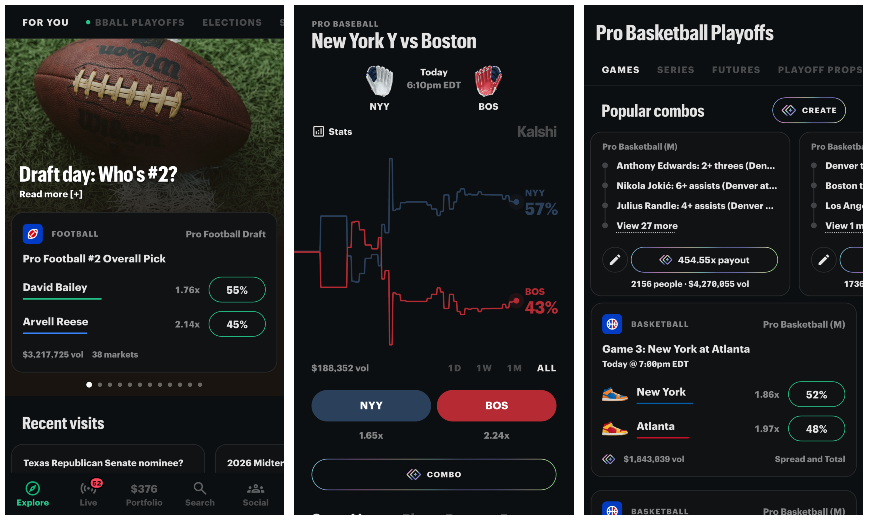
💧 Liquidity: the thing nobody talks about enough
Liquidity is the single most important concept in prediction markets that gets not enough attention. A market’s price only means something if there’s enough volume behind it to fill your order at that price.
On a liquid market (say, “Will the Seahawks win the Super Bowl?” the week before the game), you can buy and sell hundreds of contracts instantly at the displayed price. On a thin market (“Will it snow more than 3 inches in Denver on April 14?”), you might see a price of $0.45 but find that only 12 contracts are available at that price. If you want to buy 100, you’ll end up pushing the price up significantly to fill your order.
Kalshi has the deepest liquidity in U.S. prediction markets overall, especially on sports. But even on Kalshi, niche markets can be thin. Polymarket has strong liquidity on many of its larger political and sports markets. Its U.S. iOS app is live for eligible users, although Android is still coming soon and is not broadly available. The newer platforms (DraftKings Predictions, Fanatics, FanDuel Predicts) are all still building liquidity, and it shows. Prices can be wider, fills can be slower, and you may not get the price you expected on larger orders.
My rule of thumb: if the order book on a market shows fewer than 200 contracts at the price I want, I either reduce my position size or skip it entirely.
⚖️ Legal status of prediction markets
Prediction markets operate under federal CFTC regulation as Designated Contract Markets (DCMs). That federal authorization is why platforms like Kalshi can offer sports event contracts in states like Texas and Georgia, where sports betting is not legal. The CFTC classifies event contracts as financial instruments, not gambling products, and has publicly declared it will defend its “exclusive jurisdiction” over them.
The problem: a growing number of states disagree. As of April 2026, multiple states have filed lawsuits or issued enforcement actions arguing that sports prediction market contracts are functionally identical to sports bets and should be regulated under state gambling laws. Nevada secured a temporary restraining order against Kalshi in March 2026, making it one of the states where Kalshi currently can’t operate. Other states with active litigation (including New Jersey, Massachusetts, Illinois, and New York) haven’t yet succeeded in blocking operations, but the cases are ongoing.
A federal appeals court sided with Kalshi over New Jersey in early April 2026, which was a significant win for the industry. But other courts could rule differently. The whole thing may eventually require Supreme Court resolution or Congressional action.
For users, the practical takeaway: prediction markets are legal and operational right now in nearly all states. But the legal foundations are being actively contested, and state-by-state availability could shift. We cover the legal developments in detail in our prediction market legality guide and our reporting on the states vs. CFTC regulatory battle.
⚠️ Watch Out: “Available in all 50 states” does not mean unrestricted in all 50 states. Specific market types, particularly sports contracts, may be limited in states with active litigation. Always check the platform directly for your state’s specific access. And don’t assume today’s availability is permanent. This is genuinely uncertain.
Risks you should understand before trading
Prediction markets are not a savings account. They carry real risk, and the industry’s marketing doesn’t always make that clear. A few specific things:
You’re often trading against professionals. The “peer-to-peer” framing suggests a level playing field, but many popular markets have institutional market makers (firms like Susquehanna International Group) providing liquidity. These firms have sophisticated models, lower fees, and more capital than you. One analysis found the average Kalshi contract has an expected return of roughly -20% for retail takers after fees. That doesn’t mean you can’t win on individual trades. It means the house always has an edge, even when there’s technically no “house.”
Settlement can be opaque in some cases. When an event resolves, the platform determines who wins. This is usually straightforward. But edge cases have caused real controversy. Kalshi’s handling of the Khamenei market in February 2026, where roughly $77 million in expected “Yes” payouts went unpaid after a technical interpretation of the contract terms, prompted a class action lawsuit and damaged user trust. Settlement disputes are rare but high-stakes when they happen.
Insider trading in prediction markets doesn’t work the way most people assume. Unlike stock markets, where trading on material non-public information is a federal crime, prediction markets are still writing the rulebook. Platforms like Kalshi have started enforcing their own insider trading policies; in April 2026, Kalshi suspended three congressional candidates who bet on their own races, but these are platform-level rules, not federal law. The industry is self-policing because regulators haven’t established clear insider trading standards for event contracts yet.
The Polymarket picture is split in two. The U.S. version is CFTC-regulated with full KYC identity verification, which gives regulators at least a framework to work with if enforcement becomes a priority. The international version is a different animal entirely: unregulated, no KYC, and operating outside CFTC jurisdiction. In early 2026, contracts tied to a potential U.S. military strike on Iran generated $529 million in volume, and some traders appeared to take large positions shortly before major news broke. Polymarket rolled out new insider trading policies and removed a controversial Iran-related market after backlash, but on a platform where users can trade anonymously with crypto wallets, enforcement is inherently limited. If you’re trading geopolitics on international Polymarket, understand that the person on the other side of your trade may know something you don’t and there’s no cop on the beat to stop them.
Your money may not be fully protected. CFTC regulation requires customer fund segregation, which is better than an unregulated platform. But prediction markets don’t carry FDIC insurance or SIPC protection. If a platform fails, recovery isn’t guaranteed the way it would be with a bank or brokerage account.
Pros and cons of prediction markets
✅ What makes them compelling
- Broader event coverage than sportsbooks. Politics, economics, weather, culture. No sportsbook offers Fed rate decisions or Oscar outcomes.
- Available where sports betting is not. Kalshi works in Texas, California, Georgia and other states without legal sportsbooks. That alone explains much of the growth.
- Trade out anytime. You can sell a position before the event resolves to lock in profit or cut losses. Sportsbook cash-out features are limited by comparison.
- Interest on deposits. Kalshi pays roughly 3-4% APY on uninvested funds. No sportsbook does this.
- Simple contract structure. Yes or No, $0.01 to $0.99, $1.00 payout. Once you understand the format, every market works the same way.
❌ What to watch out for
- Fees add up faster than you think. The coefficient model means fees hit on both entry and exit. Active traders can lose a meaningful percentage of their bankroll to fees alone.
- Liquidity is uneven. Popular markets trade smoothly. Niche markets can have wide spreads and low volume. Getting in is easy; getting out at a fair price isn’t always.
- The legal landscape is genuinely uncertain. State challenges could reshape availability at any time.
- Professional market makers have structural advantages. Retail traders are not always competing on a level playing field, whatever the marketing says.
- Settlement disputes, while rare, have destroyed significant user value. Contract terms can be interpreted in ways that surprise you.
- Responsible trading tools are inconsistent. Kalshi offers deposit limits and self-exclusion. Polymarket’s U.S. platform has minimal controls. Newer platforms vary.
Try Kalshi: Trade $25 and get up to $500! Bonus with Code INGAME →
Try Polymarket: Deposit $10 and get a $20 trading bonus →
Disclaimer: Certain limitations apply. The offer is available to new users only, subject to the terms and conditions at kalshi.com/tc/500. 18+ only. Restrictions and eligibility requirements apply. Event contract trading involves significant risk and is not appropriate for everyone. Please carefully consider if it is appropriate for you in light of your personal financial circumstances. Kalshi products are not available in all jurisdictions. See kalshi.com/regulatory for more information.
Disclaimer: 18+ Only. Restrictions and eligibility requirements apply. Not available in all jurisdictions. Trading involves high risk and may result in loss of your entire investment. See polymarket.us/tos for more information. The Polymarket US App serves as an independent software provider and affiliate of Polymarket US and Polymarket Clearing, the CFTC-regulated derivatives exchange and clearing organization.
📚 Related InGame coverage
- Kalshi review: the full breakdown of the biggest prediction market
- Polymarket review: how it works, fees, and what you can trade
- Kalshi vs. Polymarket: which prediction market is better?
- Best prediction market sites for sports in 2026
- Kalshi promo code: Trade $25, and get up to $500 bonus with code INGAME
- Polymarket bonus: Deposit $10, get a $20 trading bonus
- Novig review: zero-fee peer-to-peer sports exchange
- Prediction market vs. sportsbook: what’s the difference?
- Are prediction markets legal in the US?
- States vs. CFTC: the prediction markets regulatory battle
- Prediction market glossary
- Prediction market responsible gambling guide
Frequently asked questions
What is the best prediction market platform for beginners?
Kalshi. Widest availability (49 states + DC), the most markets, and the simplest deposit process. The $1 minimum deposit means you can test it with almost no commitment. Use code INGAME to claim the Trade $25, and get up to $500 in bonus trades offer.
How are prediction markets different from gambling?
Legally, they’re classified as financial derivatives (event contracts) under CFTC regulation, not gambling products under state gaming law. Mechanically, you’re trading on a peer-to-peer exchange rather than betting against a bookmaker. Whether you personally consider it “gambling” is a philosophical question. The financial risk is real either way.
Can I lose more than I invest?
No. A prediction market contract costs between $0.01 and $0.99 per contract. Your maximum loss on any trade is the amount you paid for the contracts. There’s no margin trading or leverage on consumer prediction market platforms.
Do I need cryptocurrency to trade on prediction markets?
No. Every major U.S. platform (Kalshi, Polymarket U.S., DraftKings, Robinhood) accepts debit cards and bank transfers. Polymarket’s international platform requires a crypto wallet and USDC, but U.S. users should use the regulated U.S. version.
How are prediction market winnings taxed?
Profits are taxable. How they’re classified is not. The IRS hasn’t issued specific guidance for event contracts, so there are three possible treatments: Section 1256 contracts (a favorable 60/40 capital gains split, potentially available on CFTC-regulated platforms like Kalshi), ordinary income, or gambling winnings. Each has different rules for deducting losses. The One Big Beautiful Bill Act (July 2025) caps gambling loss deductions at 90% of winnings starting in 2026, but whether that applies to prediction markets depends on classification. Consult a tax professional.
🛡️ Responsible gambling
Prediction markets carry real financial risk. Contracts can lose their full value, and unlike a savings account or index fund, there’s no guarantee you’ll get your money back. The marketing may frame these as “trading” rather than “gambling,” but the psychology is the same: it’s real money on uncertain outcomes, and losing streaks happen.
Set a budget before you start. Decide how much you’re willing to lose, and don’t deposit more than that. If you find yourself increasing deposits to chase losses, that’s a red flag. Some platforms have tools to help: Kalshi offers deposit limits, session timeouts, and self-exclusion through SelfExclude. Polymarket’s responsible trading features are limited. If responsible gambling tools matter to you, factor that into your platform choice.
🛡️ Responsible Gambling Resources: If you or someone you know is struggling with gambling-related issues, help is available. Call or text the National Problem Gambling Helpline at 1-800-522-4700 (available 24/7). You can also visit the National Council on Problem Gambling for additional resources, or text “GAMB” to 833-397-0060 for crisis support.