
Last updated: September 1, 2026 | Last verified: September 1, 2026
I’ve been trading on Kalshi since late 2024 and have active accounts on six prediction market platforms. After hundreds of trades across NBA, NFL, MLB, golf, and March Madness futures, the thing I keep coming back to is that the mechanics matter more than most people think. A good read on a game means nothing if you’re leaking money to wide spreads, bad order types, and fees you didn’t account for.
Our Top Prediction Market Apps



This past March, I had Arizona to win the national championship at $0.19 on Kalshi. Watched it climb to $0.35 by the Final Four, didn’t sell, and then Michigan blew them out 91-73. The prediction was defensible. The trade management was not. That’s the kind of thing this page is about.
If you’re still sorting out what prediction markets are and how the basics work, start with our prediction markets overview. This page goes deeper into the trading mechanics: order execution, liquidity, live trading, fees, and the specific mistakes that cost real money.
🔑 Bottom Line: Many prediction market losses come from execution, not from bad predictions. Understanding order types, spreads, liquidity, and settlement rules will protect your bankroll more than any amount of sports knowledge.
📊 Contracts and pricing: the $0 to $1 scale
Every prediction market contract is a simple yes/no bet on an outcome, priced between $0.01 and $0.99. The price is the market’s implied probability. A contract at $0.65 means the crowd thinks there’s roughly a 65% chance it happens. Buy “Yes” at $0.65 and you’re risking $0.65 to profit $0.35 if you’re right. Buy “No” at $0.35 (the other side of the same contract) and the math flips.
The reason “roughly” matters: the price reflects probability plus the spread plus any fee drag. A contract at $0.65 in a market with a 4-cent spread doesn’t mean exactly 65%. It means somewhere around 63-67%, depending on which side of the book you’re looking at. Treat prices as estimates, not gospel.
A real example: Arizona’s March Madness run
I mentioned the Arizona trade in the opener. Here’s the fuller picture, because it illustrates how prediction market pricing works across a multi-week event.
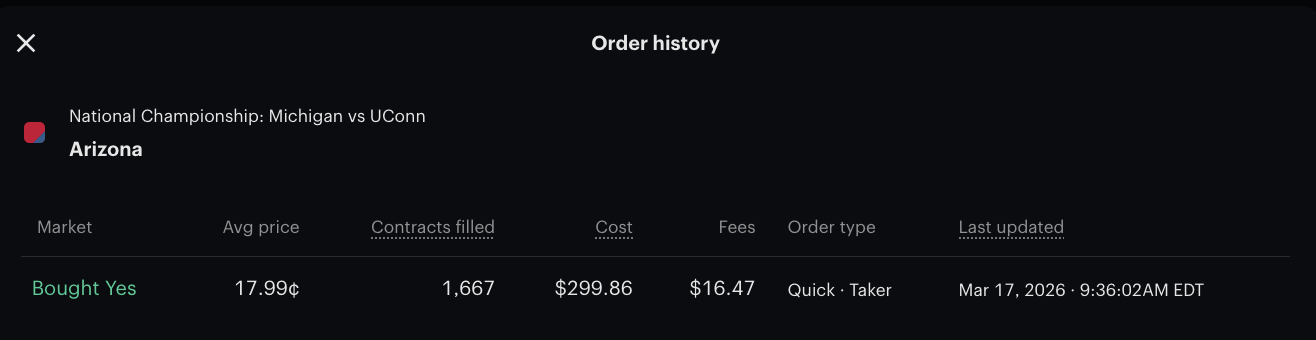
Arizona entered the 2026 NCAA Tournament as a #1 overall seed at 34-2 with the nation’s top-ranked defense. On Kalshi, “Arizona wins the national championship” was trading around $0.15 before the bracket reveal and climbed to roughly $0.19 once they drew their region. I bought 1667 contracts at ~$0.18, a cost of about $300 for upside of $1667 (minus fees) if they were to win.
The Wildcats cruised through the first four rounds. By the Final Four, the Wildcats were trading at around $0.32 to $0.35. My position was worth about $600 on paper, almost double what I paid. On a sportsbook future, I’d probably have no choice but to ride it out or take whatever cash-out number the book offered (usually significantly worse than market value). On Kalshi, I could have sold half of the contracts, reclaimed my ~$300 investment, and let it ride with the remaining shares.
I held everything. Michigan won 91-73 in a game that wasn’t even competitive after the first five minutes. Contract settled at $0.00. Obviously, that was the risk I took, which I did in part because I was partially hedged in a bracket pool in which I had Michigan beating Illinois in the championship, and had guaranteed a payout in that pool. And I thought the winner of Michigan-Arizona would go on to win the title, which was true.
In retrospect, I’d have placed a limit order with my initial position, and let it get filled on a pretty liquid market, rather than just opting for a quick settlement that resulted in some higher fees. That was just impatience at work. As far as management after Arizona reached the Final Four… I guess it may have been wise to partially trade out of the position, because Michigan at that point looked like the better team, top to bottom, even if Arizona had rocked the lesser opponents and Michigan entered the game as a 1.5-point favorite. As always, hindsight is undefeated. It was a fun ride with the Wildcats.
A golf trade: Potgieter at the Rocket Classic
Golf futures on prediction markets are where the math gets interesting because the fields are so large and the implied probabilities are so low. Fortunately, this one worked out much more favorably for me.
Aldrich Potgieter entered the 2025 Rocket Classic (formerly the Rocket Mortgage Classic) at Detroit Golf Club as a 20-year-old rookie who had only made five cuts in 14 starts that season. His outright win contract would have been priced in the lows single digits, likely around $0.02 to $0.03 before the tournament. At $0.03, buying 100 contracts costs you $3.00 and pays $100 if he wins.
After Round 1, Potgieter shot a 62 and was near the top of the leaderboard. That contract probably jumped to $0.12 or $0.15 (I don’t recall exactly). After Round 3, he held a two-stroke lead at 19-under after a 65, and the contract would’ve been trading in the $0.30 to $0.40 range. Your $3.00 in contracts is now worth $30 to $40.
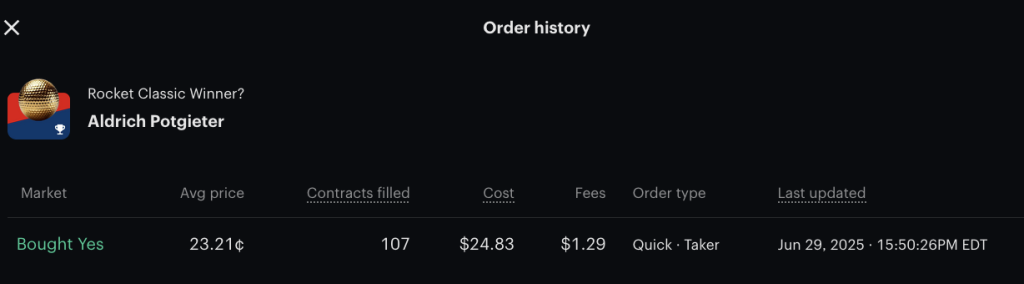
Here is where golf prediction trading gets spicy. When Potgieter was at around the 10th hole, I put in my trade at $0.23 when he was tied for the lead. He was looking dialed in and confident on a Sunday, despite his youth; there was no Scottie Scheffler in the field and some of the other big dogs like Matt Fitzpatrick and Colin Morikawa were a little too far back, I thought.
Potgieter’s final round was a 69 with a bogey on the 15th hole that nearly knocked him out. But he birdied 17 to force a three-way playoff with Chris Kirk and Max Greyserman at 22-under. During that stretch, his win contract would have swung wildly, maybe dropping to $0.20 after the bogey and spiking back to $0.35 when he made the playoff.
Potgieter eventually won on the fifth playoff hole with an 18-foot birdie putt. Contract settles at $1.00! A pre-tourney $3.00 contract would have become $100. Meanwhile, my $25 order midway through the final round became $107, for a $82.17 profit. That was fun.
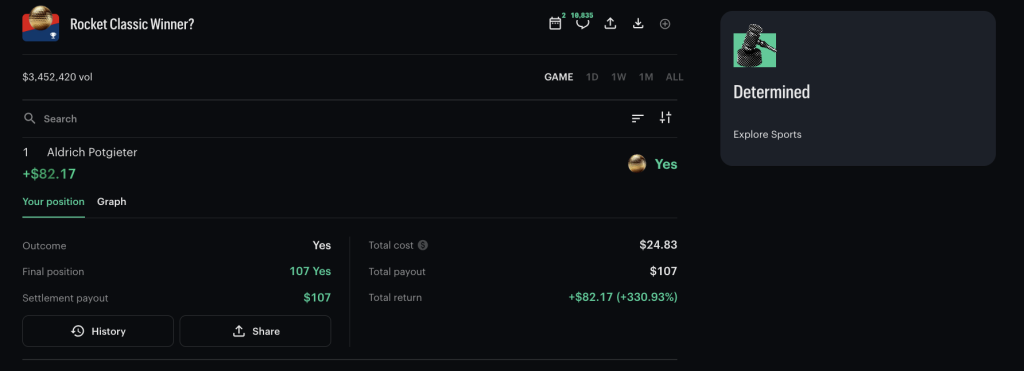
Yet, if you’d have sold after Round 3 at $0.35, you’d have locked in $32 profit on a $3 investment. If you held through a shaky Sunday and a five-hole playoff, you’d be rewarded with $97 profit, but you also watched your position nearly evaporate in real time. There’s no right answer. That’s the game.
💡 Pro Tip: Golf tournament contracts are among the most volatile on any prediction market because one bad hole can eliminate a leader. If you’re trading golf, consider selling a portion of your position when the price spikes rather than going all-or-nothing into Sunday.
🔧 Order books and execution: how trades actually fill
For single-leg trades, the order book is where everything happens. It’s a list of everyone who wants to buy and everyone who wants to sell, organized by price. If you’ve ever looked at a stock’s Level II quotes, it’s the same concept. If you haven’t, think of it like a farmer’s market where buyers and sellers are shouting prices, and the exchange matches them when someone agrees. (Combos and parlays work differently, through an RFQ process covered below.)
Limit orders vs. market orders
You have two basic choices when placing a trade.
A limit order sets your price. You say “I’ll buy 20 contracts at $0.45” and your order sits in the book until someone is willing to sell at that price. You control exactly what you pay, but you might wait. Sometimes your order never fills at all.
A market order says “fill me now at whatever price is available.” You get instant execution, but you eat the spread and, in a thin book, you might get filled at a worse price than you expected. That gap between what you expected and what you got is called slippage.
Your mileage may vary, but probably best to stick to limit orders. You may be better served by a market order when a game is live, something just happened (an injury, a score), and you think the book hasn’t adjusted yet.
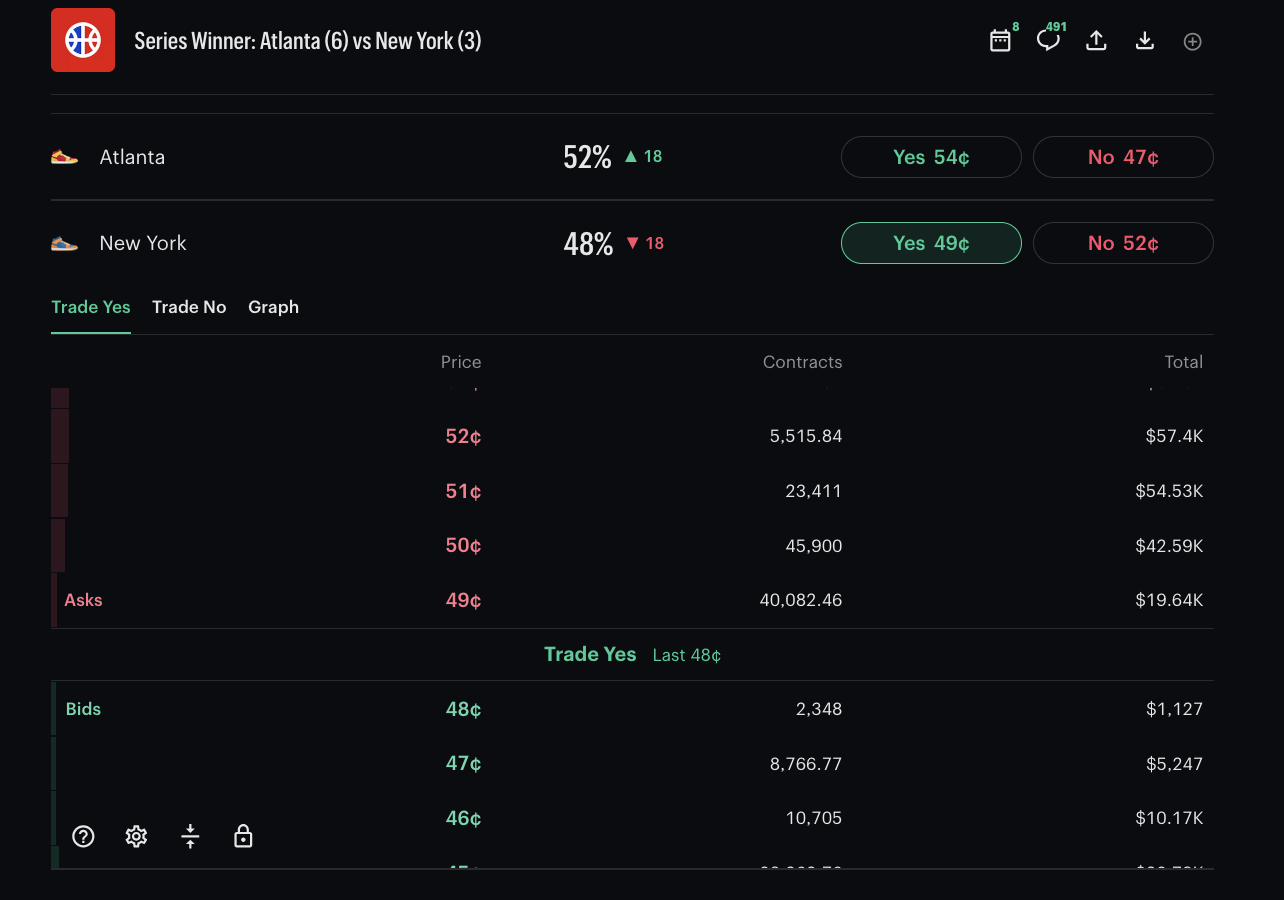
Reading a book before you trade
Before entering any position, I’d check three things:
The spread. Not the point spread. The spread here is the gap between the best bid (highest buy price) and the best ask (lowest sell price). On a liquid Kalshi NBA game, the spread might be $0.01 to $0.03. On a niche prop market, it could be $0.08 or wider. The wider the spread, the more you’re paying just to enter the trade.
The depth. How many contracts are available at each price level? If the best ask is $0.55 but there are only 10 contracts there, and you want 200, your market order is going to sweep through multiple price levels and fill at an average well above $0.55.
Recent volume. Has anyone actually traded this market recently, or is it a ghost town with stale quotes? A market showing a $0.50 price with zero trades in the last 24 hours isn’t really a $0.50 market. It’s a suggestion.
| What to Check | Good Sign | Warning Sign |
|---|---|---|
| Spread | $0.01 to $0.03 | $0.06 or wider |
| Depth at best price | 100+ contracts | Under 20 contracts |
| 24-hour volume | 500+ contracts traded | Under 50 or zero |
| Price movement | Gradual, tracks game/news flow | Stale for hours, then sudden jumps |
💧 The liquidity trap
Even experienced traders lose money to thin books. You find a player prop you like, say “Player X scores 25+ points” trading at $0.40. You buy 50 contracts with a market order. But the book is thin: only 15 contracts available at $0.40, another 10 at $0.42, and the rest fill at $0.45. Your average fill price is $0.43, not $0.40. That’s 7.5% more than you intended, and you haven’t even factored in fees yet.
Now the contract needs to reach $0.43 just for you to break even, before fees. That $0.03 of slippage doesn’t sound like much, but it compounds over dozens of trades and turns otherwise decent predictions into net losses.
The fix is straightforward: use limit orders, check depth before placing anything over 20 contracts, and stay in markets where the spread is tight enough that entering and exiting won’t eat your edge. NFL and NBA game-winners markets on Kalshi usually have enough depth. A niche golf prop on a Thursday morning may not.
⚖️ Settlement: when and how you get paid
Settlement is the moment the platform resolves a contract and distributes payouts. Winning contracts pay $1.00. Losing contracts pay $0.00. Your profit is $1.00 minus what you paid, minus fees.
For most sports markets, settlement happens within minutes to hours after the game ends. The platform checks the result against its resolution source (usually an official league data provider), confirms the outcome, and credits your account.
Where it gets trickier:
Futures and tournaments. A “Who wins the Super Bowl” contract doesn’t settle until after the Super Bowl, even if your team gets eliminated in the wild card round. Your capital is locked until then, unless you sell the (now worthless) contracts. This matters for bankroll management: $50 locked in a futures contract for four months is $50 you can’t use for anything else. This is the same in the traditional sportsbook realm, of course.
Settlement disputes. These are rare but real. Kalshi has had public disputes over how specific markets resolved, including some involving Oscars outcomes and NFL-related contracts. Polymarket has had its own controversies on the international platform around ambiguous market wording. Before you trade any market, read the resolution criteria. If the criteria are vague or depend on a source you don’t trust, skip it.
💡 Pro Tip: Screenshot the market rules and resolution source before you trade. Platforms can update their rules, and if a dispute arises, you’ll want proof of what the rules said when you entered your position.
🏈 Live trading and in-game markets
Live in-game trading is where prediction markets feel most like a trading floor and least like a sportsbook. Prices move in real time based on what’s happening in the game, and you can buy or sell at any point.
I’ve traded NBA games live on Kalshi and the price swings are dramatic. A team leading by 12 at halftime might be trading at $0.82. They give up a 9-0 run to start the third quarter and it drops to $0.71. A quick three-pointer and it’s back to $0.76. All of that can happen in three minutes, especialy in the NBA where they plays faster and they’re better shooters from distance.
The broadcast delay problem
There’s a gap between what happens on the court and when you see it on your screen. Broadcast feeds run anywhere from 5 to 30 seconds behind real time, depending on your streaming service. Professional traders, with faster data feeds, or people working with “courtsiders” (literally people sitting at a game communicating with traders in real-time) see events before you do. By the time you react to a big play, the price may have already moved.
This is why market orders during live games can be a bit risky. By the time your order reaches the book, the price you saw might be gone. You can use limit orders, but accept that you’ll miss some opportunities in exchange for not getting picked off.
Pauses and stoppages
Most platforms pause trading during official reviews, injury timeouts, and between periods. When trading resumes, there’s often a burst of activity and the spread can blow out temporarily. I’ve seen NBA spreads go from $0.02 to $0.08 right after a timeout ends, then tighten back within 30 seconds. If you’re placing orders during these transitions, be careful about what price you’re actually getting.
🎯 Combos and parlays
Same-game parlays are the biggest revenue driver in traditional sportsbooks, accounting for perhaps around 30% of all sports betting revenue in most months. Prediction markets are now trying to replicate them, but the mechanics are fundamentally different.
Kalshi launched its “Combos” feature in late September 2025, and by March Madness 2026, parlays were hitting roughly 20% of weekly platform volume. But unlike a sportsbook SGPs, where the house prices your parlay instantly using correlated odds models, Kalshi routes combos through a request-for-quote (RFQ) system. You build your combo (say, Lakers win + over 218.5 + LeBron 25+ points), submit it, and market makers on the other side of the platform price the package and send back a quote. You can accept it or walk away.
RFQ is borrowed from bond and options trading, where instruments are too bespoke for a standard order book. It works the same way here: your specific combination of legs probably doesn’t have a standing market, so the platform solicits a price on demand. The tradeoff is that fills aren’t instant, pricing can vary depending on who’s making markets at that moment, and early data suggests market makers are profiting while retail takers are net losers on combos. That’s a familiar dynamic. Sportsbook SGPs have a hold rate above 15% in most states. The exchange version isn’t necessarily cheaper just because there’s no “house.”
Polymarket’s U.S. sports product continues to evolve, so check the current app for available multi-leg or combination-trading features. Polymarket has been soliciting parlay ideas on Discord but hasn’t launched a formal combo product for its U.S. platform yet.
⚠️ Watch Out: Correlated legs (like a team winning and the total going over) are harder to price fairly in a peer-to-peer model than in a sportsbook. If you’re used to building SGPs on DraftKings or FanDuel, don’t assume the prediction market version gives you a better deal by default. Compare the implied probability of the combo price against what the sportsbook would offer on the same legs.
Prediction markets vs. sportsbooks: the practical tradeoffs
The conceptual difference is simple: sportsbooks set odds, prediction markets let traders set them. But the practical differences are what actually affect your wallet.
| Prediction Market | Sportsbook | |
|---|---|---|
| Who sets the price | Other traders (supply and demand) | The bookmaker |
| Can you exit early | Yes, sell anytime there’s a buyer | Only if cashout is offered (varies) |
| Pricing transparency | Full order book visible | Only the posted line |
| Execution speed | Depends on liquidity | Near-instant |
| Cost structure | Spread + maker/taker fees | Built into the vig |
| Live in-game trading | Continuous, price-based | New bets only (can’t sell existing) |
| Learning curve | Steeper (order types, book reading) | Lower (pick team, place bet) |
The sportsbook model is simpler. You pick a side, the book gives you a price, and you’re done. The prediction market model gives you more control but demands more attention. Neither is objectively better. It depends on whether you want convenience or flexibility.
If you’re the type of bettor who places a pregame wager and then watches the game without checking your phone, traditional sportsbooks will suffice. Prediction markets reward active management. The exit option is the advantage.
💰 Fee structures that actually matter
Fees on prediction markets work differently from the vig on a sportsbook. Instead of the cost being baked into the odds, you pay explicit trading fees on top of the spread. The two main types are maker fees (for limit orders that add liquidity to the book) and taker fees (for orders that remove liquidity by filling existing orders).
Makers almost always pay less. On Polymarket, makers actually earn a rebate. This is why limit orders are cheaper than market orders in two ways: you avoid the spread and you pay lower fees.
| Platform | Taker Fee Model | Maker Fee Model | Fee on a $0.50 Contract (Taker) |
|---|---|---|---|
| Kalshi | 7% coefficient | 1.75% coefficient | ~$0.0175 |
| Polymarket | 5% coefficient | 1.25% rebate | ~$0.0125 |
| Robinhood | $0.01 flat per contract | $0.01 flat per contract | $0.01 |
The coefficient model means fees are highest on contracts near $0.50 (maximum uncertainty) and lowest on contracts near $0.01 or $0.99 (near-certainties). On Kalshi, buying a $0.50 contract as a taker costs about $0.0175 in fees. Buying a $0.90 contract costs about $0.0063. This makes intuitive sense: the platform takes more when there’s more at stake.
What matters for you: the all-in cost of a trade is the spread plus the fee. A 2-cent spread plus a 1.75-cent taker fee on Kalshi means you’re paying roughly $0.04 just to enter a position at $0.50. That’s 8% of a potential $0.50 profit. Over hundreds of trades, the difference between Kalshi’s 7% coefficient and Polymarket’s 5% is real money. For a deeper comparison, see our Kalshi vs. Polymarket breakdown.
⚡ Risks beginners hit first
I’ll rank these by how likely they are to actually cost you money in your first month.
1. Slippage from market orders in thin books. Already covered above, but it bears repeating. This is the #1 way new traders lose money unnecessarily. Use limit orders.
2. Overtrading. Prediction markets make it easy to trade constantly because the books are always open and games are always on. The fees and bad fills from rushing into marginal positions added up faster than the winners.
3. Ignoring settlement rules. A contract on “Player X scores 30+ points” might settle based on the official box score from a specific stats provider, not the number you see on ESPN’s broadcast graphic. If there’s a scoring correction after the game, the platform uses the official source. I know traders who’ve been burned by this on Kalshi player prop markets.
4. Capital lockup on futures. Buying a Super Bowl winner contract in September locks that money until February. You might be right about the team but tying up capital for five months has a real opportunity cost, especially if you could be making shorter-term trades with that money.
5. Emotional live trading. Your team just gave up a 14-0 run. The contract price is cratering. You panic-sell at $0.30 when you bought at $0.55. Five minutes later the run stops, momentum shifts, and the contract recovers to $0.50.
6. Regulatory uncertainty. Prediction markets exist in a complicated legal space where CFTC regulation, state gaming laws, and ongoing litigation all intersect. Platforms that are available today could face restrictions in your state tomorrow. It hasn’t happened yet in a way that froze user funds, but the risk isn’t zero.
⚠️ Watch Out: Prediction markets are not risk-free and you can lose money quickly. Start with amounts you’re genuinely comfortable losing, track every trade including fees, and don’t scale up until you understand how execution works in the markets you’re trading.
📖 Glossary of core terms
Most of these borrow from both financial trading and sports betting. If you’ve traded stocks or used a sportsbook, some will be familiar.
| Term | What It Means |
|---|---|
| Contract | A tradable position tied to an event outcome. Pays $1 if correct, $0 if not. |
| Order Book | The list of active buy and sell orders at each price level. |
| Spread | Gap between the best bid and best ask. Tighter is better for traders. |
| Limit Order | An order to buy or sell at a specific price or better. You control the price; execution isn’t guaranteed. |
| Market Order | An order that fills immediately at the best available price. Fast but you eat the spread. |
| Slippage | The difference between the price you expected and the price you actually got. |
| Liquidity | How easily you can enter or exit a position without moving the price. More liquidity = smoother trading. |
| Depth | The number of contracts available at each price level in the book. |
| Maker | A trader who adds liquidity by placing limit orders. Usually pays lower fees. |
| Taker | A trader who removes liquidity by filling existing orders. Usually pays higher fees. |
| Settlement | When a contract is resolved and winners are paid. Based on the platform’s designated resolution source. |
| Resolution Source | The data provider or reference used to verify the outcome. Check this before you trade. |
| Implied Probability | The probability suggested by a contract’s trading price. A $0.65 contract implies ~65%. |
| Coefficient (fees) | The multiplier used to calculate fees. Higher coefficient = higher fee, especially on mid-priced contracts. |
🏁 Getting set up
Kalshi is the most accessible starting point: all 49 states, $1 minimum deposit, and the deepest sports liquidity of any U.S. prediction market.
Polymarket offers relatively low sports taker fees and maker rebates, and its U.S. iOS app is now live for eligible users. Android is coming soon. Eligible new users can currently deposit $10 and get a $20 trading bonus.
18+ Only. Restrictions and eligibility requirements apply. Not available in all jurisdictions. Trading involves high risk and may result in loss of your entire investment. See polymarket.us/tos for more information. The Polymarket US App serves as an independent software provider and affiliate of Polymarket US and Polymarket Clearing, the CFTC-regulated derivatives exchange and clearing organization.
Having accounts on both lets you compare prices before placing a trade, which is worth the five minutes of extra setup. For the full rundown, see our best prediction market sites ranking.
My suggestion if you’re new to the mechanics: find a game you’re already planning to watch, put a small limit order on one side, and spend the night watching how the book reacts to the game flow. One deliberate trade teaches you more about execution than ten impulse plays.
🛡️ Responsible trading
Prediction markets are financial instruments that carry real risk of loss. Treat them that way.
Set a budget before you deposit and stick to it. Don’t chase losses by doubling down on the next game. If you find yourself trading more aggressively after a bad result, step away.
Track your results, including fees. A spreadsheet with your entry price, exit price, fees paid, and net P&L for every trade will tell you more about your trading than any gut feeling. Most people who think they’re profitable aren’t, once they account for fees and slippage.
If trading stops being fun and starts feeling like a compulsion, that’s a sign to step back. The National Council on Problem Gambling offers resources at 1-800-522-4700.
🛡️ Responsible Gambling Resources: If you or someone you know has a gambling problem, call 1-800-GAMBLER or visit the National Council on Problem Gambling. Help is free, confidential, and available 24/7.
Frequently Asked Questions
Related coverage
- What are prediction markets? How do they work?
- Kalshi review 2026
- Polymarket review 2026
- Kalshi vs. Polymarket: which is better?
- Best prediction market sites for sports betting
- Prediction market vs. sportsbook: what’s the difference?
- Kalshi promo code and bonus
- Polymarket promo code and bonus
- States vs. CFTC: the prediction market legal fight
- US prediction markets: a modern timeline
Trade $25 on Kalshi and Get Up to $500 (Code INGAMEPRO) →
Certain limitations apply. The offer is available to new users only, subject to the terms and conditions at kalshi.com/tc/500. 18+ only. Restrictions and eligibility requirements apply. Event contract trading involves significant risk and is not appropriate for everyone. Please carefully consider if it is appropriate for you in light of your personal financial circumstances. Kalshi products are not available in all jurisdictions. See kalshi.com/regulatory for more information.