Last updated: August 28, 2026 | Last verified: August 28, 2026
“Prediction market” is an umbrella term that covers several distinct structures, subject categories, and regulatory models. Those distinctions matter: they determine what protections apply, what markets are available, how the market gets settled, and so on. This page breaks down prediction markets in three ways: by contract type, by subject matter, and by platform and regulatory model.
Our Top Prediction Market Apps



📄 Types by contract structure
There are three primary contract structures at U.S. prediction markets, each with its own pricing mechanism and payout logic.
Binary contracts
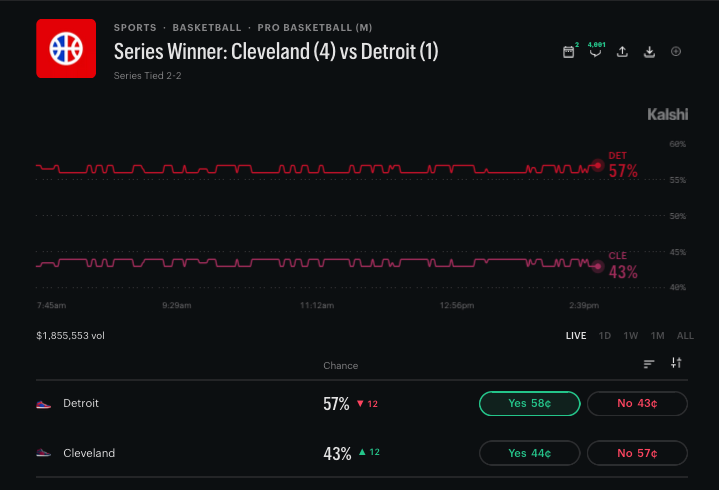
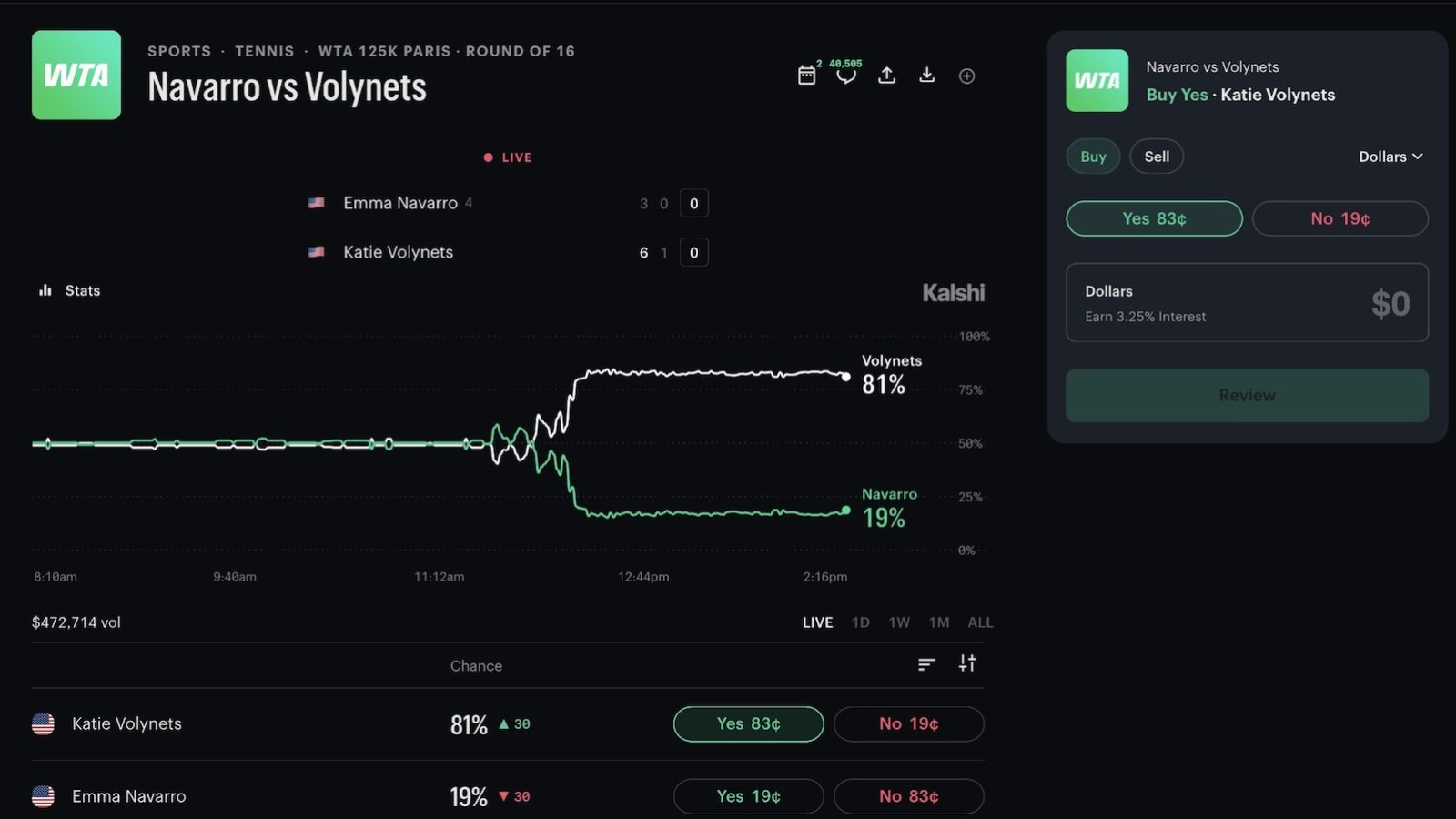
The most common and most straightforward type. A binary contract has exactly two possible outcomes: yes or no. A contract might ask, “Will the Kansas City Chiefs win Super Bowl LXI?” or “Will the Democratic party control the Senate after the November elections?” The contract pays $1 if the selected outcome occurs and $0 if it does not, with the price at any given time reflecting the implied probability of a “yes” outcome. A contract priced at $0.15 means the market assigns roughly a 15% chance of yes.
Binary contracts are a staple of sports event menus at prediction markets (see above). They are popular in part because resolution criteria are clear: either an outcome occurred or it did not. Resolution disputes can still arise if contract terms are not clearly stated and leave room for interpretation.
Categorical (multi-outcome) contracts
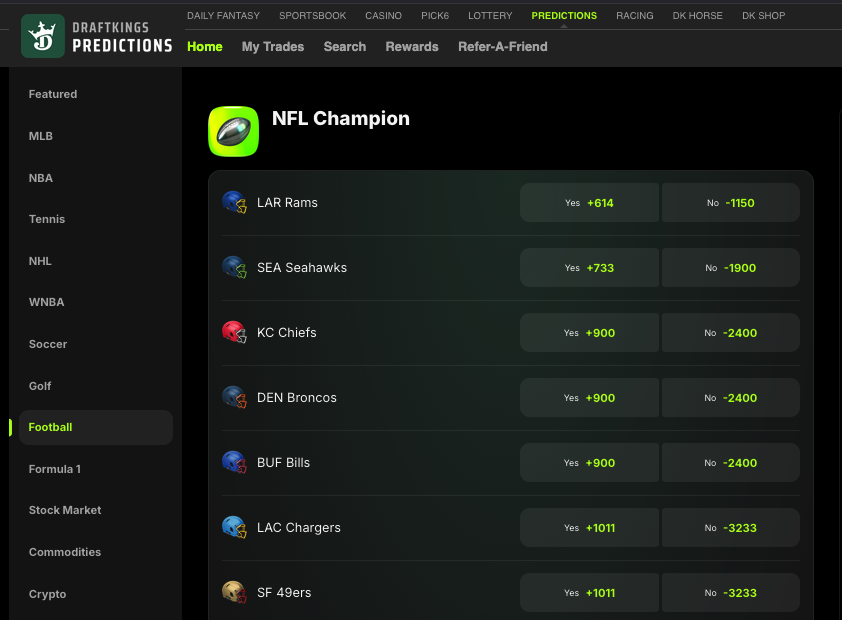
Similar to binary contracts in that each option resolves yes or no, but here there are three or more options and only one can resolve as correct. Expanding the Super Bowl example: a categorical contract would ask “Who will win Super Bowl LXI?” and list up to 32 options. These contracts are common for elections with multiple candidates, awards ceremonies, and any event with more than two possible winners.
Pricing works the same way as binary contracts: each option trades independently between 0¢ and $1, with $1 paid out to holders of the winning option. The key constraint is that implied probabilities across all options should sum to approximately 100% (plus any spread from bid-ask gaps). If they drift significantly above or below that, arbitrage opportunities arise and traders quickly correct the imbalance.
Scalar (continuous) contracts
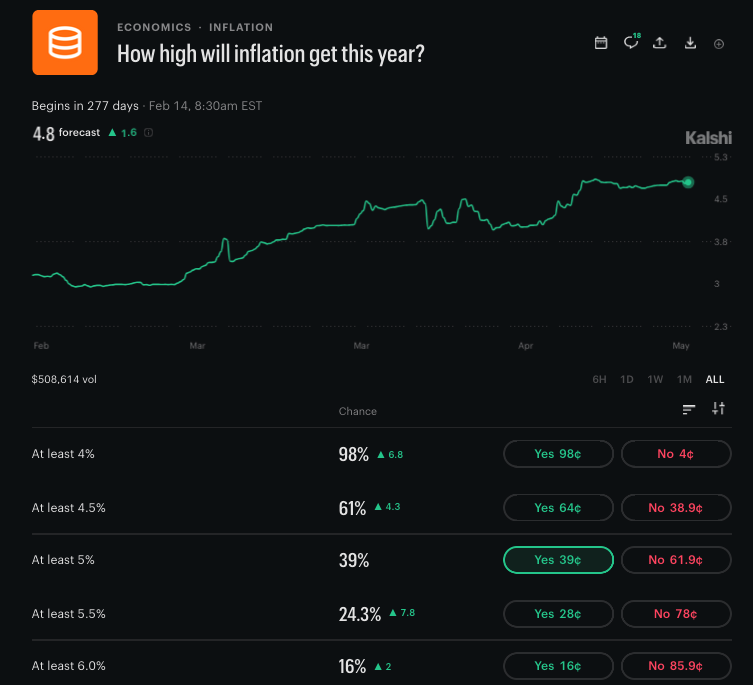
The least common structure on consumer-facing platforms, but important in financial and economic markets. Scalar contracts resolve at a point along a range of values, with payouts scaled according to the final value relative to the purchase price. If a market asks, “What will the U.S. inflation rate be on Dec. 1, 2026?” and a contract is purchased at 5%, but the rate elevates to 5.5%, the payout adjusts accordingly. These contracts are more commonly found in institutional or research-focused settings.
| Feature | Binary | Categorical | Scalar |
|---|---|---|---|
| Outcomes | 2 (yes/no) | 3+ (one correct) | Continuous range |
| Payout | $1 if correct, $0 if not | Pool-based (parimutuel) | Scaled to final value |
| Pricing | $0.01 to $0.99 per contract | Probabilities sum to ~100% | Price reflects expected value on range |
| Example | Will Team X win the title? | Who will win the title? | What will GDP growth be? |
| Where found | All major platforms | Most platforms (sports, elections, awards) | Institutional/research platforms and some major platforms |
💡 Pro Tip: Binary contracts are by far the most widely available on consumer platforms like Kalshi and Polymarket. If you’re new to prediction markets, start there. Categorical markets are common for futures-style bets (award winners, championship picks). Scalar contracts are rare outside institutional settings.
🏈 Types by subject matter
Prediction markets cover a wide range of event categories, though the mix varies by platform and regulatory status. The following are the major active categories available at U.S. prediction markets as of 2026.
⚽ Sports markets
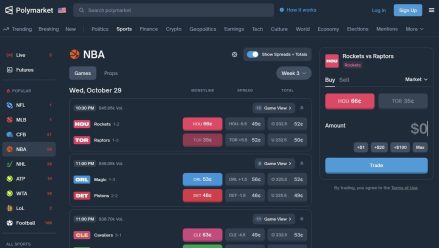
Sports event contracts drive the bulk of action on U.S. prediction market platforms. At Kalshi in 2025, 89% of fee revenue came from sports (although some recent reports indicate the number is moving closer toward the 70% range). The popularity is unsurprising: users are already comfortable with sports wagering, outcomes are clear-cut, and markets arise on a busy, predictable schedule.
Common sports contract types include individual game outcomes (win/loss, point spreads, totals), futures (championship winners, division winners, individual awards), player props tied to individual or multi-game statistics, and “combo” contracts (equivalent to parlays at sportsbooks).
Sports contracts have also been the most legally contested category, with numerous states arguing that these contracts are sports wagers subject to state regulation rather than federal oversight under the CFTC.
🗳️ Political markets
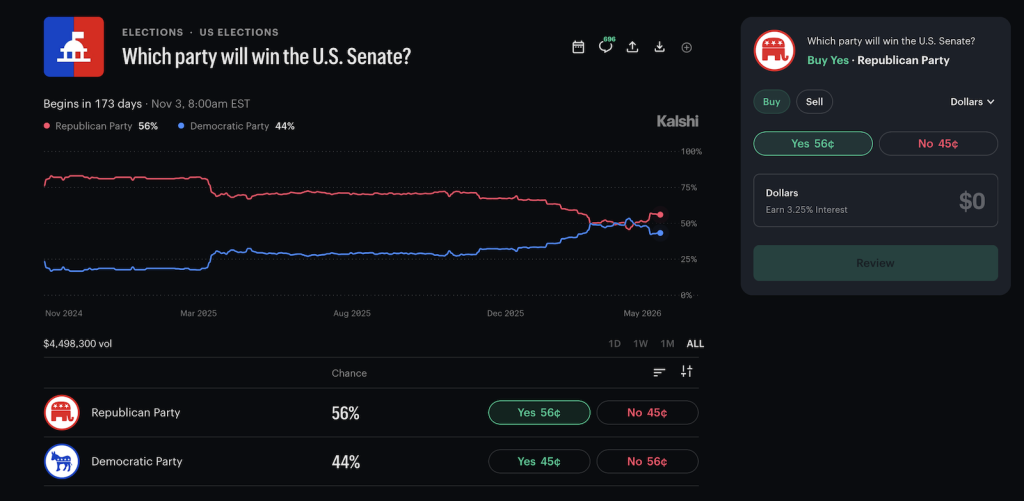
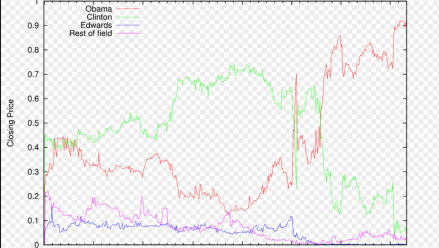
Political contracts significantly predate the recent wave of prediction market expansion. Iowa Electronic Markets offered election betting beginning in the late 1980s, and PredictIt launched in 2014. Today, platforms like Kalshi and Polymarket offer markets on election outcomes (national, local, primaries), policy outcomes (whether a bill will pass or a nomination will be confirmed), and approval or polling metrics tied to public opinion data.
Election markets garner significant media attention because they can be viewed as complementary to, or even more accurate than, traditional polling for indicating likely outcomes. They also face scrutiny over market manipulation, insider trading concerns, and the ethical questions that arise when politicians trade in markets in which they are candidates.
📈 Economic and financial markets
A fast-growing category that positions prediction markets as a complement to, or alternative to, traditional financial forecasting tools. Economic contracts appeal to traders looking to hedge against other investments and to finance-focused users who may have no interest in sports.
Tradeable events include macroeconomic indicators (Federal Reserve rate decisions, unemployment figures, GDP growth), asset price milestones (will the S&P 500 hit a specific level by a given date, or will Bitcoin exceed a particular value?), and corporate events (earnings targets, mergers, IPO prices).
🌍 Geopolitical and news markets
Any global event can be the subject of a news market: foreign election results, major appointments, international conflicts. However, these markets are becoming increasingly controversial and arguably more subject to manipulation than other categories.
In April 2026, the U.S. Department of Justice, for what appears to be the first time, charged someone with making insider trades on a prediction market. The accused is/was an active duty military member who allegedly made more than $400,000 through bets on the raid that captured Venezuelan President Nicolas Maduro.
🎬 Entertainment, awards, and pop culture
Less serious than geopolitical contracts, but popular in their own right, particularly in the lead-up to major awards ceremonies. Markets for the Oscars, Emmys, Grammys, and Golden Globes stand out, alongside markets for reality TV outcomes, pop culture moments (details of the annual Super Bowl halftime show, for instance), and professional wrestling results.
A degree of controversy surrounds these markets, as a small number of people know results before they are revealed to the public.
🌤️ Weather, science, and miscellaneous
A smaller category, often with limited liquidity, but growing. Subjects include seasonal forecasts, scientific milestones, and public health metrics. These contracts present a legitimate financial hedging opportunity for people who work in industries sensitive to weather or scientific outcomes.
⚠️ Head’s Up: Not all subject categories are available on all platforms. CFTC-regulated exchanges must receive approval for each new event contract category, and some categories (particularly sports) remain under active legal challenge. Always check a platform’s current menu before assuming a specific market type is available.
⚖️ Types by platform and regulatory model
Different prediction markets operate under different rules depending on how they are built and licensed. Understanding the platform type is essential for knowing what consumer protections exist, what markets are available, and what legal risk a U.S. user may face.
CFTC-regulated designated contract markets (DCMs)
Platforms holding DCM licenses under the Commodity Futures Trading Commission are considered fully legal and must meet certain compliance standards and consumer protections. This is the model under which Kalshi, Polymarket US, FanDuel Predictions, DraftKings Predictions, and Underdog operate, among others. While court cases surrounding sports event contracts and state-level jurisdiction continue to play out, DCMs are the most established and most regulated category of prediction market in the U.S.
No-action letter platforms
A no-action letter from the CFTC does not explicitly make a platform legal, but it indicates the agency will not pursue enforcement action for specific, limited activities. PredictIt has operated under a CFTC no-action letter since 2014, though its status came under scrutiny in 2022 when the CFTC moved to revoke it. Platforms operating under no-action letters face narrower constraints than full DCMs: limits on how much any user can risk on a given market, restricted market categories, and academic or research mandates.
Offshore and crypto-native platforms
As with mobile sportsbooks and online poker sites, there are prediction markets that U.S. users can access outside any regulated framework. Polymarket‘s international platform, which is unavaiable to U.S-based users, barring any technological workarounds, is the most prominent example; it operated outside federal regulation for years before launching its CFTC-regulated U.S. product in late 2025.
Crypto-native platforms are also unregulated in the U.S. and use blockchain-based settlement and stablecoins for deposits and withdrawals rather than traditional payment methods.
💡 Note: Polymarket’s U.S. platform operates under CFTC regulation as of 2026. Its international platform remains a separate, unregulated product. The distinction matters for which consumer protections apply.
Order book vs. automated market maker (AMM) platforms
Independent of regulatory status, platforms use one of two methods to match trades. Order book platforms (most U.S. regulated exchanges, including Kalshi) match buyers and sellers directly. AMM (automated market-maker) platforms use algorithmic pricing to ensure liquidity, adjusting prices automatically based on the balance of positions. AMMs are more common on crypto-native and decentralized platforms.
| Model | Regulation | Consumer Protections | Market Breadth | Examples |
|---|---|---|---|---|
| DCM (CFTC-regulated) | Full federal regulation | Segregated funds, compliance standards, position limits | Broad (sports, politics, economics, more) | Kalshi, FanDuel Predictions, DraftKings Predictions |
| No-action letter | Limited CFTC approval | Narrower; per-market risk limits, academic mandates | Restricted categories | PredictIt |
| Offshore / crypto-native | None (U.S.) | Minimal or none | Wide (fewer restrictions on market types) | Polymarket (international) |
💵 Real money vs. play money markets
Not all prediction markets involve real money. At play-money platforms like Metaculus or Manifold Markets, users trade with tokens that have no cash value and cannot be withdrawn. These platforms serve research, education, and forecasting purposes without financial risk.
Real-money markets require identity verification and allow users to deposit, trade, and withdraw actual funds. Every platform covered elsewhere on this page and across InGame’s prediction market coverage is a real-money platform unless noted otherwise.
🔑 Bottom Line: Play-money platforms are useful for learning how prediction markets work without risking capital. But they lack the liquidity, incentive alignment, and market accuracy that come with real financial stakes. If the goal is to trade seriously or to interpret market pricing as a forecasting signal, real-money markets are the relevant category.
🎯 Choosing the right type of prediction market
The right platform depends on what you want to trade and how much risk you’re willing to accept outside a regulated framework.
For sports trading: DCM-regulated platforms with high liquidity on major events are the primary option. Access may vary by state, so verify platform availability before depositing. Fee structures vary significantly across platforms, even within the DCM category.
For politics or economics: DCMs like Kalshi offer extensive markets in both categories. PredictIt remains an option at lower risk and exposure, subject to its per-market limits.
For research or learning: Play-money platforms like Metaculus and Manifold Markets offer a risk-free entry point to experiment with how prediction markets function.
Frequently asked questions
Binary contracts (yes/no outcomes) are the most common by a wide margin. They are available on every major platform and cover sports, politics, economics, and other categories. Categorical contracts are also widespread for multi-option events.
No. Sports contracts are available on CFTC-regulated DCMs and on some offshore platforms, but no-action letter platforms like PredictIt do not offer sports markets. Play-money platforms may offer sports-related questions, but without real financial stakes. Even among DCMs, the specific sports markets available can differ.
Offshore platforms are not regulated under U.S. law, and using them may carry legal risk depending on your state. CFTC-regulated platforms are the clearest legal option for U.S. residents.
An order book matches buyers and sellers directly at prices they set. An AMM uses an algorithm to price contracts and ensure liquidity automatically. Order books are standard on U.S. regulated platforms; AMMs are more common on crypto-native and decentralized platforms.
Related InGame coverage
- Prediction markets explained
- Prediction market fees compared
- Prediction markets vs. sportsbooks
- Kalshi vs. Polymarket
- Best prediction market sites for 2026
- Peer-to-peer sports betting explained
- U.S. prediction markets: a modern timeline
- States vs. CFTC: the prediction market legal battle
🛡️ Responsible gambling
Prediction markets carry real financial risk. Contracts can lose their entire value, and no strategy guarantees profit. Set personal limits on how much you are willing to risk, track your activity, and treat any money deposited as money you can afford to lose.
🛡️ Responsible Gambling Resources: If you or someone you know needs help, contact the National Council on Problem Gambling or call 1-800-GAMBLER for free, confidential support available 24/7.